
MID-PANDEMIC REFLECTIONS ON ONLINE TEACHING
My friend Sudip, a fellow architect and teacher, recently asked me to share my thoughts and experiences about teaching online over the last few pandemically bizarre months of our collective lives. I told him that I’ve been planning to write a blog post about it which is true enough, but the fact is that I’ve been hesitating for two main reasons.
First, I’ve felt that it’s a little premature to reflect on the ‘new normal’ when nobody really knows what that means. Even as I write this, both of my ‘home’ countries are facing spiking infections and deaths from Covid-19 with no sign of relenting. Today, on 10 August, 2020, India and the United States together account for 37% of global cases and 29% of global deaths from the coronavirus. Both of these countries account for 22% of the world population. (source: worldometers.info) Educational institutions everywhere are weighing the risks of opening up their schools and campuses against continuing some form of online learning. Unfortunately, many such decisions are being taken for reasons beyond the medical or financial; there are lines being drawn on political and ideological fronts as well. So, I thought, does it make sense to reflect on the current situation when no one truly knows how long it’s going to last, and how it’s going to evolve?
Second, I wondered whether my voice was even needed right now. The Covid-19 pandemic is probably the most talked about and written about event in human history. The challenges being faced by teachers across the globe are common and universal, more so than they have ever been. What’s the point of adding to the cacophony of opinions?
But I like Sudip and I respect his opinions. He asked me for my thoughts and it spurred me to finally put down some words. Ok, a lot of words. (The fact that I have a lot of papers to grade which I’ve been procrastinating about has nothing to do with it, no sir, not at all.)
“What do you think about online teaching?”
The quick answer to this frequently asked question is almost universally “It depends”. There are a few who absolutely hate it, and a few (only somewhat surprisingly) who love it. The rest of us are somewhere in the vast, grey middle. We’re doing it because we have to. There are advantages and disadvantages. Sometimes it’s good, sometimes it’s bad. All of these are common answers, and mine are no exception.
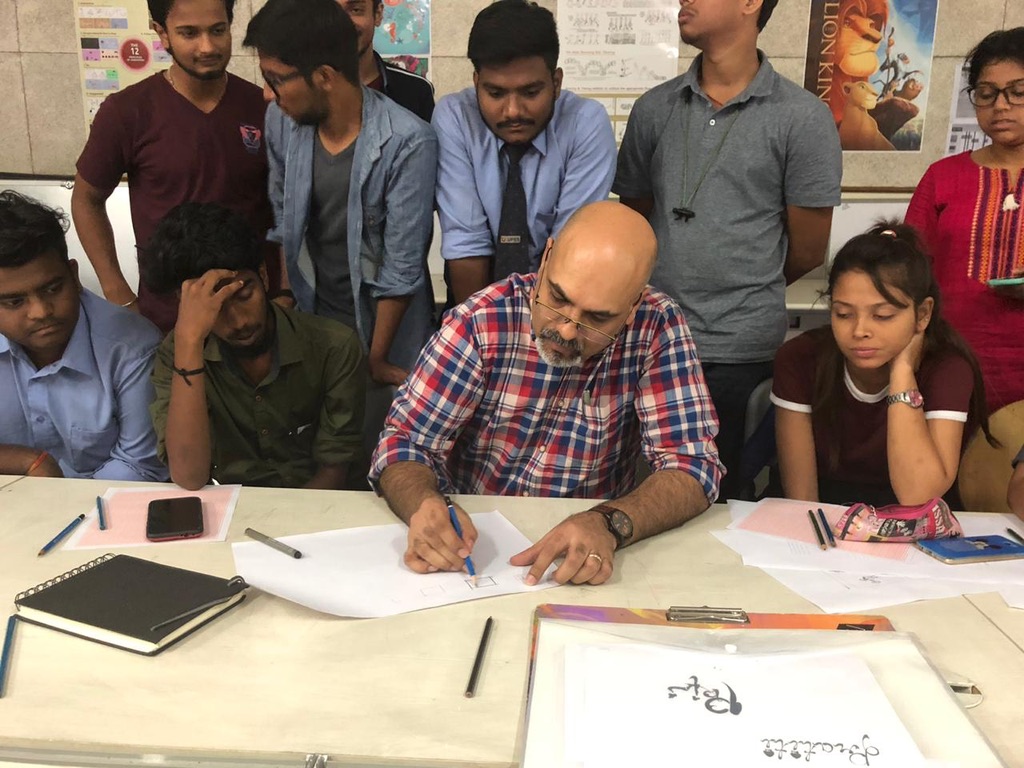
As a teacher of architecture, there are certainly things that I miss about physical in-person teaching. Design and architecture are such an intimate form of education; there is a long-treasured romantic attachment to the physical design studio – the place where magic happens in the casual interactions between teacher and student. This is no exaggeration or flowery sarcasm; it’s genuinely the single biggest thing that distinguishes our teaching from that of other disciplines, and as of now, there’s no readily available technology that perfectly replaces it. Sitting next to a student on a large table, marking up their sheets with a 2B pencil, gesticulating your critique in a frenetic fervour – I haven’t seen anything that replaces the natural ease of those actions so far, although it’s fair to say we’re getting close. The tablet, the stylus, and near instantaneous internet connectivity are starting to clumsily approximate the studio tools, but not the studio environment. The chance interactions, the random student or teacher stopping by the table to observe and offer their own comment. The unforeseen long digressions about movies or artists. If these things are happening online, it’s in spite of the medium, not supported by it.
And since my career has involved not just teaching, but administration, I’m not only thinking about the conducting of online classes, but the strategy and tactics of it. How are teachers delivering the intended curricular content? How are students receiving it? What logistical factors come into play? Is it promoting or suppressing flexibility in learning? What can we learn from it? Is it exposing flaws and weaknesses in how we teach, that we may have been ignoring all this time? These questions have been nagging me over the last few months, as I try to cope with my own classes and students.
My online teaching scenario
Before I share my reflections on online teaching, let me explain my current teaching situation. I teach architecture at a local nonprofit university in Agra, Uttar Pradesh, India. I started teaching here somewhat formally in February 2020 and I was asked to teach both Design and Research classes to 4th year undergraduate students. I teach at a traditional campus with the usual pros and cons – we have our own architecture building which we love, but we’re always short on space and facilities. Students are a mix of local commuters and out-of-town hostellers. Their socio-economic backgrounds are also diverse, ranging from children of affluent families to first-generation college-goers from families of humble means. Because the architecture course requires it, all students have their own high-end laptops with specialised software, and because it’s 2020 India, they all have smartphones. Very few have tablets or other special devices.
Less than a month after I started teaching, and a week or so before the official nationwide lockdown came into effect in late March, our university saw what was coming and sent all students home for their own safety. Classes were quickly and chaotically shifted to fully-online, leaving many of us scrambling to figure out what platforms to use. The university had a native online EMS (education management system) for things like grades and admissions, but otherwise we weren’t doing any teaching through Blackboard, Moodle, or other online teaching platform. So we quickly set up free Google Classroom pages and Zoom accounts and shifted our schedules and materials online. Classes were held whenever it was convenient or necessary, sometimes in the evenings. We tried different video conferencing apps and coordinated between those and email, WhatsApp, and even the lowly telephone, We managed to get through to the end of the semester, holding our juries and exams online, and when we were given the indication that classes would remain fully online through all of 2020, we started to do things in a more planned and formal way. In this new semester, our classes are following the proper timetable, all subjects have a Google Classroom page, and faculty have settled into either Zoom or Google Meet for their live sessions, as per their personal preferences. Things are more organised than last semester and both students and faculty have settled into a routine and pattern of online education, although we still have our challenges.
But let’s rewind a bit.
Not my first time around the online block
My previous institution – where I started as a regular permanent faculty and eventually became a Dean before leaving in 2019 – is a private and non-regulated design college. It doesn’t come under the ambit of government regulators, but is nevertheless one of the premier design schools in the country.
It’s owned by a foreign education conglomerate that, as early as 2014, had started to push the idea of online learning. The truth is that this was done mostly because they foresaw what the future of education would be, but also partly because it held a lot of opportunity to teach a much broader range of students without the usual investments in capital infrastructure. For the next few years, the leadership and academic teams had long, and sometimes fierce, debates about how (and if) we could teach design online. I won’t narrate that complex story here, but it’s enough to say that we began a program to phase in hybrid online learning over time. We introduced Blackboard and started training both faculty and students not just in the technical details but also the ideological aspects of teaching and learning in the digital environment. There was some resistance, as expected, but eventually every teacher became a sort of expert at online teaching so that when the coronavirus lockdown hit in March 2020 (a few months after I left), the institute was able to pivot to online more quickly than most.
Having been one of those that were trained and (I admit, reluctantly) pushed into shifting some of my teaching online (and getting my staff to do so as well), I was probably prepared better than some of my new colleagues in Agra, who had not really done it before. (In a further rewind) it probably helped that I’ve had experience in distance education as far back as 1994, when I worked a part-time job in the Distance Learning department of my undergraduate university to help pay my tuition fees. Among other tasks, I used to help professors convert their lecture notes into Powerpoint slides. I also did my own distance learning course in 2006. While living in New Jersey, USA, I got a Diploma in Theology from the same institute in Agra where I’m teaching now. They’d just started delivering distance education a short while earlier, but in a somewhat more text- and lecture-based format than what we do in design education. They offer vocational and other courses to over 80 study centres all over India using centralised physical course materials that are delivered by courier, and with local coordinators that facilitate students to participate in recorded and live video lectures. You could consider them more like small satellite campuses rather than the home-based flexible online learning that the whole world is experiencing now.
All of this is to say that I’ve had experience with distance and online education before, but not so comprehensively as I’m doing now. I guess I could’ve just said that to begin with and saved you a lot of reading, but I do feel some specific background is required to contextualise what I’m going to say next.
Back to the future (?)
“It depends.”
Yes, that’s still my answer to Sudip’s request. I wish I could be more passionate or polarised about it, but I’m not. This isn’t Marvel vs. DC here, or Star Trek vs. Star Wars! [Just kidding, I love all of those things equally.] I’m trying to take as pragmatic a view as possible about this because it’s no longer postulating about what the future holds. The future is here. The uncertainty that I always rant about is here, much sooner than I expected. We have to be pragmatic about it because it’s now our hot, blazing reality and we need to get it under control as much as possible.
Despite my earlier experiences with distance learning and HBO learning (no, not The Sopranos… “Hybrid Blended Online”), I’ve still learned a lot over the last few months. I admit that in earlier debates and discussions as an administrator I held the strategic viewpoint. It’s been about five years since I actually taught a full load of classes, and now I’m once again balancing a teaching load, preparing for classes, grading, and counselling. Now all of it is one hundred percent online, with no physical interaction with my students and co-teachers at all. And that’s not likely to change anytime soon; it may very well be this way for the remainder of the academic year, until May 2021. Maybe even longer. Teaching online in some capacity is something we need to get used to, quickly and intelligently. There are definitely disadvantages, but there are some things to take forward as well.
What online can’t do

I already mentioned the lack of the studio environment that we normally have in design and architecture education. Admittedly, it’s now rare to find that 24-hour open studio that was commonplace a couple of decades ago. You only see it in more well-established and well-funded design schools. Real estate costs have gone into the stratosphere and colleges all over the world are re-thinking the idea of providing dedicated, often empty, studio classrooms for a cohort of students to use as they wish. Studios are now often assigned by rotation, and more urban colleges are creating flexible, open spaces to be used commonly, rather than assigning them to specific students or cohorts. There are also calls to reduce the dominance of the design studio in architecture education. Even so, such spaces – whether dedicated or common – still allow for the intimate chance interactions that design schools are known to provoke. When you go to campus, you know other students will be there, and faculty as well. Design is driven by dialogue, and impromptu discussion and critique takes projects further and makes them better.
Can this be done online? Well, yes… after a fashion. A student can send a teacher a text message asking for advice, or they can post their progress work in a WhatsApp group for peer critique. But this doesn’t always happen. One difficulty I’ve encountered is the students’ reticence to use the full corpus of social media to discuss their work with their peers, especially in textual modes. My students have numerous WhatsApp groups but they rarely use them except for posting announcements about the class (when the group includes teachers) or gossip (when the group doesn’t include teachers). I don’t see any productive conversation, dialogue, critique – no posting of work in progress, no posting of interesting links or helpful tutorials. Maybe this is happening outside of my view, but probably not as much as I’d like to see, and this can be attributed to a number of factors, including the student’s lack of confidence to articulate their thoughts in written words (as opposed to verbally). Although they’re supposedly digital natives, they haven’t really figured out how to engage in productive online written discourse, something that I literally grew up on during the early years of internet message boards and chat rooms.
And even in the virtual video classroom, the immediacy, spontaneity, and – most importantly – the smooth, evolving articulation of verbal conversation is lost in the choppy digital back-and-forth. Facial expressions and gestures that teachers and students rely upon are not as well conveyed on screens full of lo-res rectangles.
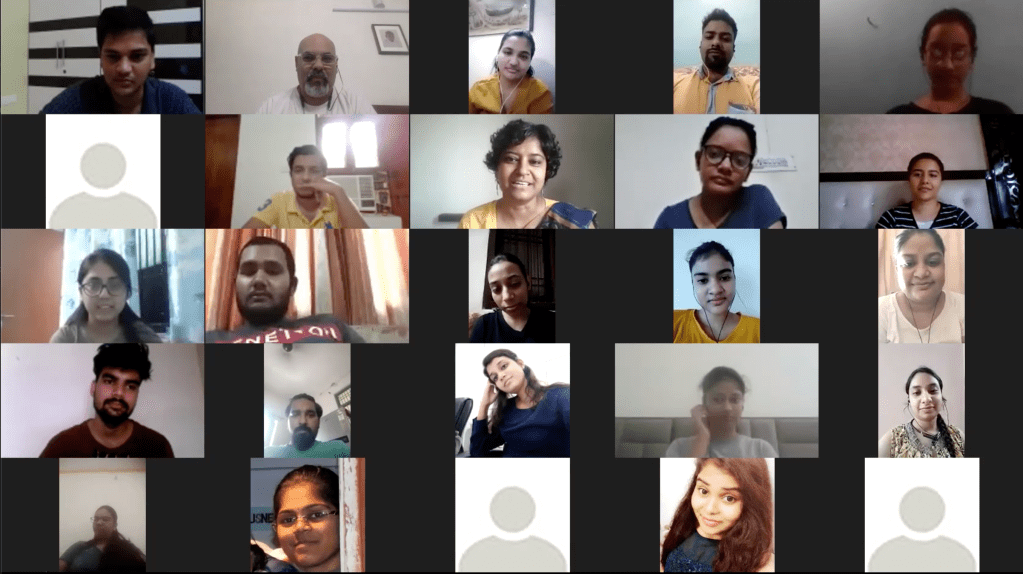
I’ve predominantly settled on Zoom as my video conferencing platform of choice, and I’ve invested in the annual Pro plan to get features which have helped me with my online teaching. I’ve tried other apps but Zoom is the most stable and has the most Host features. I frequently use the Breakout Rooms feature to split up my larger classes into smaller groups for discussion. But Zoom is still designed for business, not for education, so it lacks many things that teachers need. The digital whiteboard and annotation tools are not intuitive without a stylus and tablet. I can’t keep track of 30-40 students and see if they’re paying attention, getting bored, or even if they’re in their room if their video is off. And it’s frustrating to constantly ask them to turn their video on, so often I just forget about it and move on.
In design education (and increasingly in other disciplines) the use of physical resources are critical. A great deal of time in design studies is spent in the physical act of making, even in the digital age. Every design school in the world has labs and workshops where students can tinker, fabricate, and assemble. Using physical tools and working with the hands is still (and will foreseeably) be a crucial part of design and architecture education. Suddenly having no access to these resources has been a major handicap because they are integral to learning design. Even losing access to the library has been a problem, despite all efforts to build collections of e-books and e-journals.

There’s also a very pernicious problem with online video classes – because our college is a nonprofit with low fees, many of our students enjoy a quality education that they otherwise may not be able to afford. Asking such students to now upgrade their internet data plans so that they be on bandwidth intensive video calls all day means an expense they may not have foreseen. Some of them don’t live in areas with good network connections. Some of them have only one laptop in the family, and if it crashes, their online learning grinds to a halt.
This isn’t even touching on the psychological price that many of them pay for an online-only education that they never bargained for. What many professionals are facing with WFH are also being faced by students – lack of space, lack of privacy, lack of noise isolation. Fatigue from sitting all day, staring at screens all day, wearing earphones all day. Even I’m exhausted from a day of online teaching, more so than physical teaching. It requires a focus of concentration, volume of speaking, and energy of managing multiple screen windows at once that you don’t have in the physical environment, or at least, not in such a prolonged way.
And there are hidden costs. Students who used to find solace and respite in college because their home lives were troubled, chaotic, or even abusive – they no longer have that luxury, and were given no time to prepare for the sudden change. The number of students that face such issues is woefully underestimated and largely unknown. No attempt at focusing on the cost savings of not commuting, or not having to ‘dress up’ for college, and other such silver linings can erase the difficulty that comes from such circumstances.
There are also many factors I haven’t had to experience because I teach in higher education. I sympathise with the struggles that school teachers are going through around the world, and I won’t even enumerate the problems that online teaching has for them, and for parents of school children as well. The dilemma of keeping children occupied and interested is universal. We love to think that children of the 21st century are ‘digital natives’ but we can’t overestimate this. A child may love to play games or watch cartoons on an iPad all day, but do they want to learn in a classroom that way? Maybe years from now when this is commonplace, their attention spans will be accustomed to it, but if we’re in a transition phase right now, it’s not looking good at all. And what about social interaction? School-age children need to be in collaborative and collective environments to develop personalities and social skills, and that is now lost completely.

Some of these challenges can perhaps be overcome or managed over time, and with better planning and resources. My former colleagues who are using Blackboard invite me for online sessions, and in some ways the interface of Blackboard Collaborate is better than Zoom, because it’s designed for education. For example, my online class on Zoom is linked to my Zoom account, using my Personal ID (so that I don’t have to send my students links for every class). It’s attached to the teacher, which can sometimes be a problem if someone else has to take my class, or if the students want to meet without me. In Blackboard the session is attached to a given class, not to any specific teacher. All the resources for that class are likewise attached to that virtual classroom, which anyone with the proper credentials can log into and access. The class materials, the assignments, the grades, and the venue for video classes itself… all exist in the virtual class space. It’s a much better holistic solution that we don’t have yet. Zoom is where we hold our classes, and Google Classroom is where the resources are kept.
But different apps and platforms won’t change the other things I mentioned – the loss of the studios and workshops, the lack of intimate critique, the psychological challenges. I see no solutions for those things yet.
What online can do
It’s becoming clear to me that online classes have their place in education; we just have to be smart about where that is, and how can it best be leveraged. There are things I’m learning and practices I’m starting that will very likely continue once (and if) we go back to a physical campus. For one thing, the timetable – always a complex puzzle for every educational department – was much easier to manage this semester without having to tussle with room availability. If some portion of classes can be shifted online, even in part, then the burden on resources can be relieved.
Amongst the community of design educators that I know, there seems to be a consensus that theoretical and lecture classes are easier to manage online, although I don’t think it’s a completely resolved issue. On the one hand, attending an online class is much easier, so my online attendance has been nothing short of remarkable, averaging above 90% in the 5 weeks of the semester so far. And although it sometimes may not seem like it, my students do seem to be paying attention in class.
I like to think of myself as a good teacher, and my students seem interested in what I generally have to say. They behave well in my classes, for the most part. I think that online teaching has perhaps polarised the good teachers from the not-so-good ones. If you’re an engaging teacher, you will perhaps be more engaging online because your ability to keep students’ attention can still be effective even when their hidden laptop screens may be teeming with unknown distractions. But not-so-good teachers will suffer; if your lectures are boring, they will be even more boring with the disconnect from physical interaction.
Design education tends to have less lectures anyway, and even theory classes are more like seminars than anything, containing more discussion and dialogue. These classes may not be perfect online, but if anything can be shifted online to save resources, theoretical classes can be. The losses are not so noticeable, and the adjustments are achievable with a bit of training and planning. If a portion of subjects can be shifted to asynchronous online learning somewhat painlessly, then it’s also easier for students to engage with the class on their own terms, at their own pace of learning. This aligns with current trends that indicate today’s students are more amenable to flexible learning models. They can also do a portion of their work in their own comfortable and convenient environment (home, cafe, beach… anywhere, as long as they get the work done), as long as they come to campus for the practical learning.
The world of education was anyway moving towards what’s called a ‘flipped classroom’ model, which means that rather than lecturing and then assigning readings based on the lecture, you ask students to prepare ahead of time with readings and other resources, and then attend classes only for questions and clarifications. This avoid repetition of information and waste of resources. Online learning works well for this, with a combination of synchronous and asynchronous learning. Students use the off-hours to learn and absorb on their own time and pace (asynchronous), and time with the teacher is spent only on the critical or complex aspects (synchronous).
Online classes then become a sort of ‘virtual office hours’, which is something I’ve actually incorporated into my classes already. Most practical subjects have lots of hours in the schedule, which, in a physical studio environment, means the students work for most of the time, and occasionally come to me individually for questions or critique. If I convert the same number of hours online, I needn’t interact with all students for the entire class time. They work and I’m there to answer questions and resolve problems as needed. I often use a portion of the time for students to critique each others’ work, while I observe and interject.
Assessment and feedback is also easier online. Assignments like essays, quizzes, and other strictly written or visual material can be assigned online, submitted online, and graded online, reducing paperwork and tracking of documents. I can assign a task and know immediately when students have submitted them early or late. Questions can be posted online which can be answered at my own convenience. Feedback is made easier through the use of rubrics, which is nicely facilitated by apps like Google Classroom. I can create rubrics easily, reuse them, modify them. And students instantly get the results. We used rubrics before but because of how easy it is to use them online, I almost exclusively give feedback in rubric-form, saving me a lot of repetitive work. They don’t give all the feedback I necessarily want to give, but whatever isn’t covered in rubrics, I can type separately, or discuss with students when I meet them in class. But this quantity is much less.
Apps and platforms like Google Classroom and Blackboard – although they have their interface shortcomings – also make record-keeping much easier. Everything is stored in the cloud, no worry about data loss or laptops crashing, and I can access everything from any device.
As I mentioned, online teaching can tend to separate the good teachers from the bad, so teachers need to be trained to use online platforms to their best advantage. A sudden shift to online teaching as it happened this year doesn’t allow for this, but if this truly is to be the future, then we’d best start training ourselves now.
But one of the single best things about online teaching is the near universal availability to recruit talented professionals and academics from around the world to supplement my teaching. Before the ubiquity of live online sessions, it was often a struggle to get people to conduct guest lectures, talks, and workshops with my students because it involved the high cost of physical travel and accommodation. Since I’m doing all my classes online now, it’s really no big deal to ask a friend or acquaintance in the industry to conduct a session with my students on Zoom. We used to think it was inferior to physically conducting workshops in person, and it is. But if I can get some level of guest interaction at a fraction of the cost and hassle, then I’ll do it. And I have, with good results.
The hazy future
Sudip, if you’re reading this (and have gotten this far!) I hope you’re satisfied with my 5000-word response to your query. More likely it’s more than you bargained for, but that’s the kind of teacher I am, for better or worse.
As I said, I do hope to continue some online practices when we get back to campus. The parts of online teaching that work for me – virtual office hours, virtual guest lectures, flipped classrooms, online ‘anytime’ discussions, feedback and assessment, record keeping – these I will probably keep doing, and hopefully refine them along the way with more practice and better technology.
I also believe that the forced evolution of the pandemic will accelerate the technology to make virtual teaching less and less distinguishable from physical teaching. AR/VR, holograms, haptic and gesture-based tools, and integrated devices can all help to ease the transition.
I’m still eager to see how this all plays out. As I said, everything is too uncertain to make definitive statements just yet. Despite what they say, no one has any idea what’s going to happen next. Certainly the next year or so is going to be a difficult and challenging time for academics, in all aspects of administration and teaching. My personal view is that this is a sort of reckoning. Covid-19 has done one thing very effectively – it has exposed the flaws, gaps, and weaknesses in our social systems that were heretofore ignored or under-appreciated. In the short run, things are going to be tough, and unfortunately it’s possible that some academic careers as well as whole institutions may not be able to survive. But in the long run (how long?) things will eventually evolve and get better; of this I have no doubt. It truly has become adapt-or-die, and I for one am going to do my best to adapt. I can’t do anything else, and I still absolutely love teaching.
As it is for many, I see this another learning experience – perhaps a forced one, and very aggressive at that – but all the same it’s getting us all to take stock of who we are, what we do, and how we do it. The good thing, in a way, is that it’s happening to all of us at once, so there’s a great solidarity to be found in this crisis. All these months I’ve been doing my best just to absorb and listen to what everyone is saying about the future of education (another reason why I hesitated to write this article), and knowing that we’re all in this together is a huge boon.
I sincerely hope we know how to take advantage of it.

 PALIMPSEST