
You’re welcome. Sincerely, Your Design Faculty
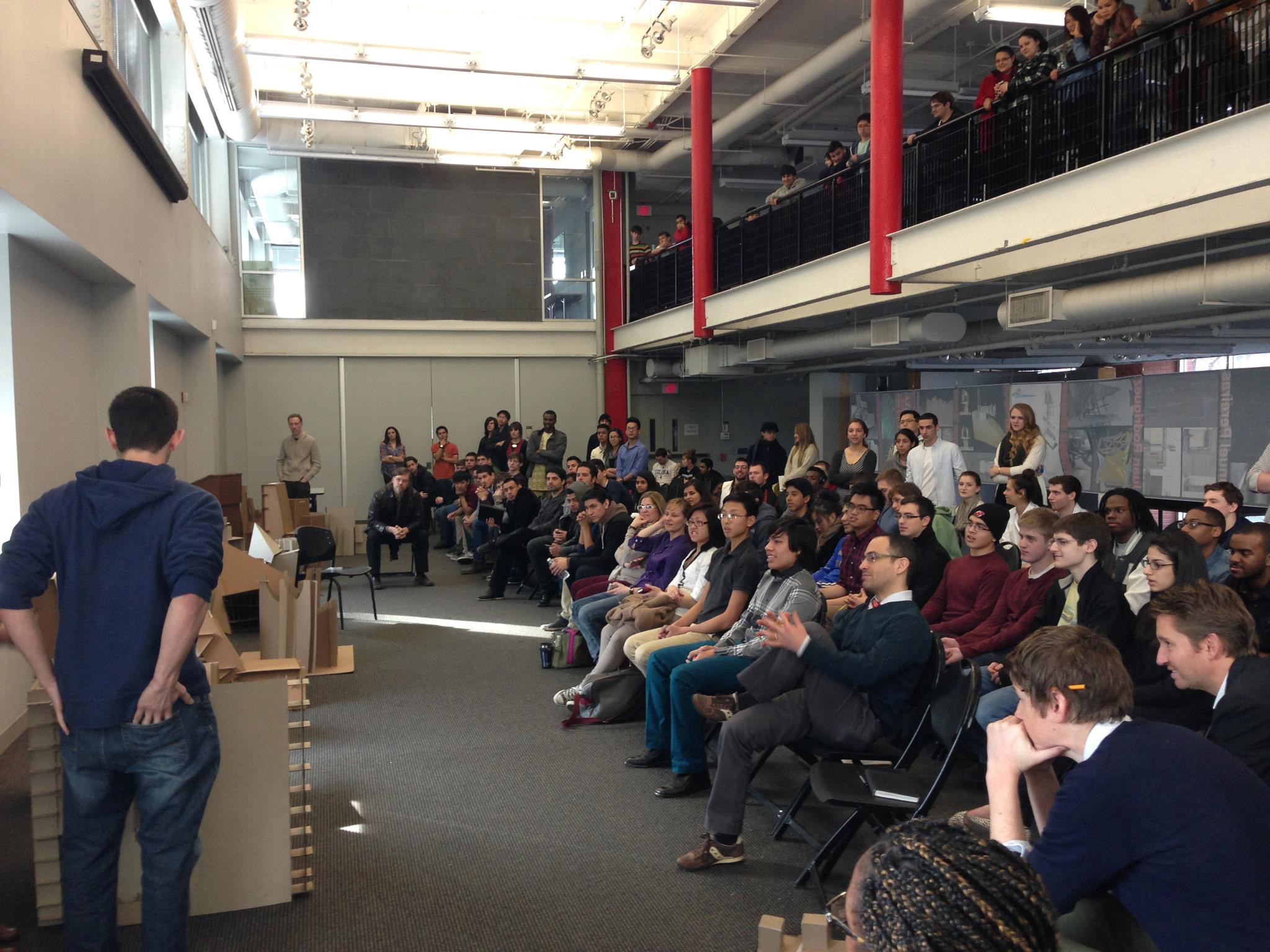
For design students, juries are often a source of anxiety and stress, but ideally they shouldn’t be. Juries are primarily about design critique and they work best when they’re open, honest, impersonal, and transparent. However, this openness can also mean that jury feedback can be subjective, contradictory, and confusing. Add this to the anxiety of presenting your work to ‘experts’ and ‘professionals’ after many months of hard work and naturally students find juries a cause for distress. And I admit that we as design teachers often give mixed messages about how seriously you should approach juries:
Message A: “Juries are important; take them seriously. Don’t embarrass us in front of industry professionals!”
Message B: “Juries are not that important; don’t worry, relax. Don’t take it personally.”
These messages aren’t necessarily contradictory, they simply need to be balanced. So take the jury seriously if you want to get feedback, but don’t take it so seriously that you get nervous and can’t represent your work in a good light. But do remember: It’s only a jury, after all…. it’s not a trial, or a judgement, or a punishment. It’s simply a critique on your work by professionals and academics who are not intimately familiar with your project, or with you. I think many students have the wrong impression about juries and put a lot of pressure on themselves which itself causes the distress that one is fearing and in turn causes the jury to go ‘bad’.
Yes, you should take juries seriously. Yes, you should speak maturely, dress appropriately, and be well groomed and bathed. You should make a good impression not just for yourself but your institution. To help with this, I’d like to share ten general tips for a healthy, productive, and stress-free jury.
1. BE PREPARED
Double check your sheets, slides, videos, renders, animations, prototypes, models. Make sure you have everything. This doesn’t mean that you’ll present everything, but be prepared to show any work that jurors may want to see. Keep in handy, and ready to find in an instant, either physically or digitally. Give yourself enough time to check. Enlist your family to help you. Be ready when it’s your turn, and don’t make the jury wait for you. Arrive on time and set up on time. If you’re presenting digitally, check all A/V connections and make sure all your tech gadgets work properly. If you’re posting physical sheets on a wall panel, bring plenty of pins! Rehearse your presentation beforehand. Keep notes if you need them, and present your work in the form of a story or narrative. Many of you go through your project like this: “First you enter from here, then you go here, then there’s a desk, then there’s a table…”. Instead, talk about your design process. Start with your design problem, your case studies, and your analysis. Describe what you learned from them, and what you chose to bring into your design brief and concept. Then explain how that concept manifested in your design development and detailing. Use the right design vocabulary which was taught to you. Avoid the words “basically” and “just” and “like” and “kind of” and “sort of” and “ummm”.
2. BE RESTED
Don’t make the mistake of staying up all night before your jury. Get a good night’s sleep. Eat a healthy breakfast. Be clean and fresh and alert. Dress appropriately; be cognisant of your appearance — whether it’s about clothes, makeup, headgear, or accessories. Be aware about appearing too formal or too casual or too revealing. You have the freedom to wear what you like, but if the focus is on your look rather than your work, then it will distract the jurors.
3. BE THICK-SKINNED
Yes, the jurors may say some things that sound humiliating or condescending. Design faculty usually try to find jurors who are not aggressive or mean-spirited, and to be honest even the ones who may say nasty things about your work (or lack thereof) or who may laugh at certain elements of your design are not doing it to be intentionally mean. They have certain standards for where you as a student should be, skill-wise or knowledge-wise, and they’re expressing their frustration at your inability to meet your potential. And jurors are human, too; they’re not perfect. Sometimes they are harsh, but more often than not they’re making a valid point. In the professional arena you will get burned much worse, believe me. So it’s good to develop a thick skin; if a juror is being harsher than you think you deserve, then keep cool and move on. Which leads to the next point…
4. BE COOL
Stay calm always and don’t lose your cool. Don’t be defensive. Don’t argue with the juror. Try not to get angry or sad or sarcastic. Not everything they say is going to be valid; that’s why we usually have more than one juror. But this is not the time to defend yourself; you’re there to receive feedback. You can ignore it or use it, that’s your decision. But it doesn’t help to be combative because then the juror will most likely get combative right back at you and you don’t want that. Students often ask me whether they should defend their work when the juror doesn’t “get it”. It depends; often I find that it doesn’t really help because there’s limited time to really change people’s minds. You stand to lose more than you gain by trying to defend yourself. Unless you think you’re really being treated unfairly, or the juror is completely off-base, then I would avoid getting entangled in an argument. But take a call.
5. BE AN OWNER
Take ownership of your work and your design decisions. Too often I have seen a response to a juror feedback as “Ma’am/Sir/Professor said to do that.” Sorry… as a design student, once you choose to accept your tutor’s critique and incorporate it into your design, it is now yours. Don’t blame your tutor for design decisions that may not have worked out. Sometimes it could be because you misinterpreted your tutor’s critique. Sometimes the critique may have been given with too little background. Sometimes the tutor may simply be wrong, but that’s part of the subjectivity of design education. You’re being trained to absorb critique, reflect on it, and decide how to incorporate it, if at all. Once it’s part of your design, it’s yours.
6. BE HONEST
Don’t try to bullshit your way through a jury. If you don’t know the answer to a question, say “I don’t know.” A juror can tell when you’re making stuff up. It’s better to be honest and say that you don’t know, or didn’t get a chance to resolve it, or ran out of time, or simply that you were unable to solve the problem. Capitalise on such a moment as an opportunity for learning, and ask the juror if they can assist you with the answer. Which leads to…
7. BE INQUISITIVE
Very few designs are fully resolved at the time of the jury. This is expected. There is always room for change, improvement, or further development. Use the jury as an opportunity to gain insight into how you could have done better, or to find out how to get past an obstacle that you just couldn’t manage by yourself. The jury is there to help you, not judge you (despite the name). And if there’s something you just couldn’t figure out, it’s ok to ask the jury to suggest a solution or direction. Learning does not end with a jury. At the end of a project, there should be a reflection on what you could do to make a better design resolution (or even a better presentation). Which leads to…
8. BE CONSCIENTIOUS
What does this mean? It means you should be an active presenter, not a passive one. Don’t just stand there and present your project. Take notes on the critique, record the comments, document the feedback, so that you can reflect on it and apply the learning. When you’re nervous anyway, you may not be n a position to remember all the feedback. So recording helps, and your friends and classmates can help you with this. Also, when you’re not presenting, be considerate of other presenters. Give them the respect and attention you would want if it was your turn. Don’t whisper, chat, giggle, laugh, or carry on while others are doing their best to concentrate on the presentation. If you need to talk, go outside. And silence your phone!
9. BE PRESENT
Don’t just be there for your own jury. Be there for the entire proceedings. You will learn far more from listening to the presentations and critiques of 10, 20, or more of your classmates than you will ever learn in the scant 15 minutes of your own feedback. Many students waste the jury day by wandering around or chatting/texting/surfing, or trying to desperately finish their projects, or simply not even being on campus. Why? You are missing out a super intense learning experience. Not to mention, why wouldn’t you want to support your friends for their presentations? It means so much to someone who is nervous to have a group of friends in the audience lending moral support, a group of reassuring and familiar faces to cheer them on. It’s about compassion and camaraderie.
10. BE BRAVE
This is the most important. Many jurors comment that student often have difficulty applying the learning from one year to the next. I think this is because of the Ostrich Syndrome. Like ostriches, when you sense danger, you bury your head in the sand and believe that if you can’t see the problem, it will go away. Which is why so many of you skip your classes and mentor sessions, and even worse, your own juries. In the design world, missing your jury is an unforgivable sin. You have robbed yourself of the chance to get what you claim you crave most — feedback. And why? Because you’re embarrassed about not having enough work to show, or the work is perhaps poor quality? So what? How do you think you’re going to get better next time? You learn from your mistakes and rebound! This means that, yes, you do have to listen to the jury tell you that you didn’t do a great job, and that’s never fun. But then you should admit your lack of progress, then turn it around and explain what the problem was and why you got stuck, and ask for advice on how to get unstuck. The most noble thing in academics and professional life is to fail and then get back on your feet and succeed. When you fail, you must acknowledge it and try to find out why, and then move on. This is life, not just design. It will define your whole existence for years to come. But if you retreat and avoid in the face of failure, you’ll almost certainly fail again. When college is long over and finished, you’ll still regret that retreat.
One last request. Please don’t ignore this advice. Design students have so much potential and so much talent; just managing to get through design school is itself a big achievement which many people can’t do. Don’t let your inner fears restrict you and get in the way of your success. Creativity requires action, boldness, honesty, and dignity. The worst punishment that design students get is from themselves, not from jurors or tutors. We’re not here to beat you down or boost our egos. We’re here to discuss new ideas and learn new things (yes… in teaching, we are learning just as much as you, if not more). We’re here to help you and we do the tough and tiring job of teaching and sitting in juries because we’re hungry to talk about design with you. If you’re not as hungry as we are, then you’ll see us become sad and frustrated, because no one wants to spend an exhausting day talking if the other person is not listening. So please continue to work hard, be imaginative and brave and confident, and we look forward to sharing ideas with you very soon.
Best of luck to all of you, in your juries and beyond!

