towards divergence in the age of automation

A CASE TO RECONSIDER THE GRADUATE PROFILE OF YOUNG DESIGNERS IN 21ST CENTURY INDIA

A large number of articles and research published globally in the last few years have spoken about the looming threat of automation having a major impact on employability in the near future. Automation — or industrialisation as it was known back in the early twentieth century — is, in fact, no new threat. Countless historians, both contemporary and latter-day, have talked about how the Industrial Revolution changed the way people work, and how the imparting of skills and knowledge in higher education took a radical shift towards better understanding of mechanised processes and of mass distribution of both products and ideas. Automation in this century has a definitively digital flavour and is akin to the previous century’s shift only in the quickly pervasive way in which entire societies and cultures were dismantled and created anew. We are in the midst of a major transition towards complexity and uncertainty in human interaction.

Research by the McKinsey Global Institute suggests that “Indian workers have a technical automation potential — the overall share of activities that can be automated by adapting currently demonstrated technologies — of 52 percent”. This is tempered by the same Report’s suggestion that, due to India’s infrastructure gap and other social issues, the change will be sectoral and evolutionary — not revolutionary. This implies that Indian industry has some time to adjust, and that job roles in the near future may not be replaced so much as changed. Working alongside automation will necessitate different learning at all levels of Indian education, particularly in professional studies at institutes of higher learning. This change is already being noticed at design institutes in India. A quick tour of any design school will reveal that workshops using traditional artisanal tools are not disappearing but are existing alongside more modern labs with cutting edge digital media and equipment. A lathe machine very likely sits in a room adjacent to a motion capture studio.

The Link to Academia

The impact this has on design education is at once significant yet unclear. The design industry in India is still widely divergent and no one is quite sure which direction the country will ultimately take with regards to specific employability factors. There are design firms partnering with local skilled artisans to promote dying regional crafts, and there are firms harnessing the power of computational design for rapid prototyping and production. Often this spectrum of work happens in the very same office, within the purview of a single design associate. Thus, design institutes must prepare graduates for this full spectrum of skills — they must appreciate the old with the new, often in less time than before, since employers have less and less time or resources to devote to the type of apprenticeship model that companies followed in the past. Employers want graduates with these attributes already baked in.

Where does that put academia? There has always been a perceived skill gap between academics and industry, no matter how many colleges partner with industry for live projects or to impart professional workplace skills. Does the gap widen with the necessity of adapting to automation? What exactly are the skills needed for this adaptation? What if the skills quickly become obsolete?

The report on Future of Jobs in India recommends embracing active learning, learner-centricity, and life-long learning. However, these attributes have been fundamental to design education from the start, so the implication is that design graduates are better prepared for the future than other disciplines. Further, the same E&Y reports suggests that Indian workers are well-primed for the ‘leapfrog’ effect in technological advancement, in which traditional evolutionary trajectories that the West followed may often be skipped entirely by the Indian marketplace. The telecommunications industry has been a good example of this, in which a large majority of Indians embraced cheap mobile phone technology well before landline networks were in place nationwide. Most of rural India skipped landline networks entirely and a majority of Indians across the socioeconomic spectrum now use mobile phones directly. This required divergent thinking.

Convergence and Divergence

Traditional learning systems in India have been largely convergent in nature, focusing on single, linear solutions for problem-solving. There is a correct answer somewhere and memory and logic will serve to find it. Design education, using divergent thinking, replaces this approach with an open-ended system of problem-solving, where the answer may lie in multiple and perhaps infinite solutions. Artificial intelligence now has the potential to do both our convergent and divergent thinking for us. Traditional computational algorithms use memory and logic to solve convergent problems far more quickly than the human brain, so fixed and formulaic solutions can be easily solved. Jobs reliant on this ability are already vanishing — counting, sorting, calculating, producing, searching, etc. are now firmly in the purview of simple computing systems (bin sorters, for example) as well as artificial intelligence (internet search algorithms).

As illustrated in an article published in The Atlantic, “[w]hen most people think of AI’s relative strengths over humans, they think of its convergent intelligence. With superior memory capacity and processing power, computers outperform people at rules-based games, complex calculations, and data storage… What computers lack, some might say, is any form of imagination, or rule-breaking curiosity — that is, divergence.” But advanced AI may even achieve this. As processing power improves and better understanding of machine learning and quantum networks leads to closer simulation of the human brain, then even divergent solutions can be managed by AI.

The Human Factor

Where humans still have a role is in experience, which is where divergent educational models come into play. With AI and automation increasingly being able to provide basic problem-solving skills, design students must grapple with the choice between specialisation and diversification, even if it’s just to remain ahead of the technology and innovation curves. Currently, there is a wide demand for design graduates to achieve broad, fundamental skills topped by specialised competencies in a particular subject area or market segment. Hence, we have architects who know how to draw, design, and render, and also have expertise in residential, commercial, or institutional buildings. A typical employer may, for example, be a specialist design firm for the hospitality industry and would demand architecture graduates to have some experience — even while in college — of understanding the needs of the user group related to hotels and restaurants. In India today, this characterises the bulk of the design industry — employers looking for graduates with fundamental skills in broad areas, with some level of competency in a specialisation (e.g., lighting, furniture, advertising, web design, etc.).

But this is starting to change. More and more design firms are starting to embrace the idea of ‘service design’, a divergent discipline in which the final design solution may not be known at all. So now, a design firm no longer gets commissions only from hospitality clients, but from clients who want a diversified solution to a broad-based problem. So, the solution is not just a beautiful hotel design, but unified designs for staff uniforms, menus, signage, amenities, fixtures, products, entertainment portals, websites, and communication systems, all preferably designed by the same firm, under the same roof.

In the past such work was distributed to a variety of consultants all working independently and not always aligned in purpose or even quality. Today, a client may request a designer to provide a brief for which the design solution is not known — it could be a space, a product, an app… What the solution actually will be could be one, some, any, or all of the above, and the designer must be ready to provide expertise in multiple disciplines.

The impact of this is profound and necessitates a complete change in how design education is currently conceived. A multidisciplinary approach cannot just be a feature of design curricula but must be its primary attribute. Students must be encouraged to be divergent thinkers by exposing them to design approaches outside of their chosen disciplines. Since the duration of design courses isn’t increasing to accommodate this wider learning, specialisation often has to take a back seat, but perhaps this isn’t such a bad thing. Specialisations that follow traditional silo divisions — lighting, furniture, web design, app design — are fading because design problems are growing more complex, and solutions are growing more divergent. Furniture is not just an object in space but can shape the space itself and can also have embedded technologies. Thus, a kitchen counter is not just a place to prepare a meal, but a place to have a conversation, with embedded screens and smart controls to provide information and data as well. The lines become blurred, so that a designer who sees a kitchen counter only as a piece of furniture to chop vegetables becomes quickly outdated and outpaced by the designer who sees many more opportunities for innovation.

Automation, for the time being, cannot fulfil such a function. Certainly, AI increasingly has the ability to observe patterns in human behaviour and suggest predictive outcomes, but the ability to use human interactive experience and associations still rests within the ambit of human designers. Prior to its launch in India, IKEA — a global company well-known for its innovative use of industrial automation — spent significant time in trying to understand the Indian consumer market by having individual employees visit 1000 Indian homes. This was not done by robots but by actual human beings who observed the way Indian families live and analysed the data.

The New Graduate Profile

There is clearly a need to consider both convergent and divergent thinking in design education. The traditionally desired graduate profile of a young designer — essentially a database of basic skills and knowledge — is no doubt important, but employers will soon rely on digital information systems for those attributes, and the young designer must embrace divergence in order to stay relevant — and employable — in the future. In turn, the design institute must develop curricula and pedagogy that fosters this approach and move away from stagnant models that require the student to develop specializations that may not even exist by the time they graduate. Forward thinking institutions need to amend their curricula now to accommodate this trend, and develop academic models that allow for not one, but multiple (and someday perhaps, infinite) graduate profiles that are flexible and adaptive enough to solve the multitude of problems that we can’t foresee. This in itself requires a divergent approach so that we can design the right design education for the twenty-first century.

[A version of this article was originally published in July 2019 in the blog for Pearl Academy, where I was until recently the Dean of the School of Design.]


the academics/industry gap in india

A while ago, I was invited to speak at a conference session in Delhi conducted by CII (Confederation of Indian Industry) whose theme was Bridging the Gap Between Academics and Industry. Along with me on the panel were some important people in education from prestigious institutions, although I was the sole panelist from a design college. Their stimulating words gave me a lot to think about and my own talk reflected on their valuable insights. It was clear from the comments during and after the panel that many people from academics and industry believe that there is a wide gap between what students in higher education are taught and what the industry expects of them when they graduate, and that there’s an urgent need to narrow that gap significantly, considering India is cascading into a turbulent period of economic and social uncertainty. Admittedly, I truly don’t believe that anyone is 100% sure how exactly to prepare our students for the future when the future itself is so ambiguous.

The panel at the CII conference on”Bridging the Gap Between Academics and Industry.

What did became clear to me were two things: First, that our traditional educational systems are designed for the present situation (and arguably even the past), and that we need to significantly overhaul the entire structure and prepare students for uncertainty by making them more adaptable to new paradigms. Second, I felt that the Academics/Industry Gap is actually more a perception than reality.

To address the first issue, we need to reevaluate existing educational models from top to bottom — in the private, non-profit, and governmental sectors, and in both schooling and higher education. Society seems to demand that traditional paradigms — degrees, fixed curricula, and numerous rules and regulations — lead to academic quality, but that is clearly not the case. Requiring all new higher-ed teachers to have PhD’s, for example, is not necessarily going to improve teaching in the classroom nor produce better graduates. Such teachers may have more domain knowledge, but does that necessarily mean they are better at teaching? I don’t believe so. Look to sports and you can find numerous examples of average players becoming excellent coaches, and vice versa. Society should start to accept that many of our recognized educational models are often outmoded and are designed for a fixed set of outcomes based on known scenarios, whereas the current need is to embrace non-traditional approaches plus different ways to produce and measure quality.

And I don’t automatically think we need to look only to the West for this, by the way. India’s own rich and ancient history has numerous examples of adaptive teaching methods, so as a start we can certainly look within in our own culture for the answers.

As for the second issue, I believe that Industry (although there is hardly such a monolithic thing anymore called ‘capital-I’ Industry) has to reassess their expectations of a graduate and abandon the idea that a fresh graduate must already have a full checklist of skills and knowledge, ready to become a professional the moment they take off their graduation cap and gown. Particularly in the design disciplines education has, for centuries, been followed by years of apprenticeship where the learning continues, and where professionals have taken on the onus of continuing the education of young aspirants. In addition, there is no longer a fixed graduate profile; every employer has different expectations and requirements, so a single fixed curriculum is not going to fulfill all workplace demands. So, if the working environment is rightly considered a natural extension of learning, the ‘gap’ between academics and industry is seen as more perception than reality.

Even so, there are ways to reduce this perceived gap, and I’d like to highlight four strategies that we have been practicing in my own institution:

Industry Accountability

As I’ve said, professional firms and companies of all shapes and sizes need to consider themselves as equal partners in education rather than just ‘recipients’ of skilled and trained professionals. Employers needs to be willing to spend the time and effort to continue the training that begins in college and provide a seamless transition to workplace learning by acting as true mentors to young graduates.

Adaptive Curricula

Academic institutions should move towards designing curricula that produces graduates of diverse profiles rather than assume that all graduates in a discipline fit a fixed outline. Allowing flexibility and student choice in the curriculum via electives and open learning, and not worrying about how much there is to ‘cover’ in a given semester is important. No teacher is able to actually ‘cover’ whatever is needed anyway, so we should give students the freedom to chart their own learning pathways. Institutions should also allow more students and teachers the flexibility to adapt to wider varieties of industry collaborations which don’t necessarily coincide with academic timelines and structures.

Embedding Industry Early and Often

Institutions should rethink the traditional internship model and think of ways to include industry from Day One of a student’s college experience. The involvement of working professionals can start small and get progressively higher so that a student’s skills also grow professionally. Moving from basic industry masterclasses to intensive workshops to live industry projects and consultancies is one way to make this natural progression happen. This mitigates the culture shock of moving directly from classroom to workplace and the ensuing distress that often gets in the way of learning performance.

Value-based Education

Finally, both teachers and employers need to strive towards creating not just better professionals, but better citizens and better human beings. Curriculum and pedagogy on one side and industry practice on the other must both be infused with sensitivity towards ethics, compassion, cooperation, integrity, and honesty. Technical skills will always be important but human skills are absolutely essential towards preparing students for uncertain futures.

Going Forward

The academics/industry gap, whether perceived or real, can be bridged with just a little bit of effort and a whole lot of mindset change. The notion that education’s purpose is solely to serve up a steady supply of workers to fill standardized positions in industry is long gone, but current practices and systems in India don’t seem to reflect this. Acknowledging that our students and graduates are diverse young talents with differing abilities and different learning preferences is an important first step towards creating a more seamless integration between two worlds which actually serve the same purpose.

(This article was previously published on Medium on 22 Aug 2019)

a remembrance of trimlines past

Image for post
Photo courtesy of Night Flight (Facebook)

A few days ago, the image of this famously well-designed Trimline phone (designed and manufactured by Bell Telephone’s Western Electric division) came up on my social media feed. Instantly, like Proust’s beloved madeleine, it triggered a cascade of sensory memories from the time when this phone used to hang on the wall of almost every household in America. That was back in the late 70s and early 80s, which was a time of great transition for my family. That was when we moved from the city to the suburbs, into our own first house, with our own yard, and our own kitchen, on whose wall this phone had hung, from the time I was in 6th grade until long after I moved out for college.

I remember the smoothness of the moulded plastic and the exact weight of the handset in my hand. I remember the feeling when you were slotting the base into the wall backplate and it slid snugly into place. And the sharp click that the cord would make when you plugged it into the RJ11 modular jack. I remember the springiness of the lighted number buttons, and how I would push it down and try to find the exact moment when the light would go off, and then try it again, and again, with each number to see if it was the same for all of them. (It was.)

I remember pushing the acrylic hang-up lever on the base, while keeping the handset to my ear. I remember the exact amount of light-fingered pressure it took to push that lever down and disconnect the call. I pushed it down while listening so that I could find the exact moment when the dial tone would go silent, and to see if there was any tiny auditory transition between the dial tone and the absence of dial tone. (There was.)

I remember the additional hang-up button on the handset itself, just below the numbers. In the beginning, this was used to disconnect the call while you were far away from the base, and then begin another call. Later on, when technology and features had improved, pushing this button allowed you to switch between callers that you kept on hold. I also used to wonder why there were more holes in the mouthpiece than in the earpiece. And why the earpiece holes were arranged in a circle and the mouthpiece holes were arranged in a square. I still wonder. I’m sure some engineer can tell me. No one told me back then. (I never asked.)

I remember peeling the plastic display cover off with my fingernail so that I could take out the slip of paper underneath and write our home phone number on it in neat letters. I don’t know why we bothered to do that… we knew our home phone number better than we knew almost any other detail about our lives, aside from our names. I still know it. That was my parents’ number for 36 years even when we moved to a new house in the same town. I guess the number was there for guests, although I don’t know why a guest would need to look at our phone to know what our number was. All I know is that it was always my job to write the number on every new phone we got, because I had the best handwriting in the family, and to make sure the tabs on the thin plastic cover didn’t break when prying it off. (They never did.)

I also used to resent when I’d go to other people’s homes and they hadn’t bothered to write their number on the phone. Or even worse, when they wrote it sloppily, like when you start out with the numbers too big and then you run out of room, so the last few digits are too small to read, curling down in a weird spiral. I never made that mistake because even though I didn’t know it yet, I was a future architect, and I paid attention to things like that. But I don’t know why it bothered me when others didn’t do it. Maybe because they didn’t take their phone seriously enough; it was just a device to them, and probably a temporary one at that. People used to go through phones a lot back then for some reason. (Not us.)

I wonder if that was the real reason why we’d write our home number on the phone in the place where you were supposed to. Because it signified ownership, long-term ownership, serious ownership… of the phone and everything it meant to us. Once we wrote that number in that strip, the phone was now ours forever and all the myriad calls that came to us — the mundane calls about directions to people’s houses, or the more serious middle-of-the-night calls when someone overseas was calling to tell us that some important family member had just passed away. (We were always momentarily anxious when the phone rang in the middle of the night.)

I remember as well the cheaper knock-offs of this phone that weren’t made by Bell, but by some other lesser brand that you’d buy at CVS or Kmart. Those phones looked the same, but they didn’t in any way feel the same… they didn’t have the same weight or solidity, or the same springiness in the buttons, or the ringing sound it would make when you’d slam the phone down after an angry phone call. The Trimline phone (like all phones that were made by the telephone company) was built to survive the angriest phone conversations you could ever imagine. (And yes, I remember those too.)

I also remember the weight and tension of the spiral cord, and the constant effort it took to keep it untangled and not over-stretched. Over-stretched cords used to bother me; they ruined the perfection of the tensioned coil, hanging lightly and cleanly from the phone on the wall, and the utility of it staying compact when the phone was at rest. And untangling the cord always meant holding it by one end and letting the handset dangle and twirl around of its own gravitational will until the cord hung clean and straight, coiling back to its tensioned potential, waiting to be stretched out across the entire kitchen again, whenever my mom needed to talk and cook at the same time. (Why didn’t they ever put the phone connection near the kitchen counter and stove, I wonder.) And sometimes, when we knew this would happen a lot more — when we acknowledged our relative middle class prosperity by moving into larger and larger kitchens — we would subsequently splurge on longer and longer cords (six feet! twelve feet! fifteen feet!), allowing a working mother the freedom to multitask and socialize on the telephone while simultaneously preparing the family meal. (Which was every single day, of course.)

If you had to get a new cord (either because it was longer, or because it got over-stretched), I remember that it was tough to match the colour of the cord to the phone, unless we got it directly from the phone company, of course. I guess this is why we always had fairly non-exotic colours of telephones in our house… Dark brown is the one I remember the best and the one we had the longest, across multiple households and kitchens. We didn’t have the fancy olives and oranges and blues and reds like phones in the houses of my other American friends, my non-immigrant friends. We had a a dark brown phone, the same colour as our kitchen cabinets. The same colour as our sofa set. The same as our stained wooden doors and cedar shingles. And it was the same colour as us. We were our Trimline phone… brown and solid and plain and simple.

designing digital humanity

How designers make digital life more livable.

Image for post

Almost every weekend I travel by train on the Indian Railways network, so I tend to book a lot of tickets online. Over the last ten years that I’ve been doing this weekly travel, this online booking process has undoubtedly gotten better. A lot of unnecessary wastage of paper has reduced thanks to technological improvements and because the government recognizes that a simple photo ID is good enough to prove that you’re a valid passenger. You never even need an e-ticket anymore, let alone a paper one. Even the IRCTC website is much better than it used to be.

But there’s still one thing that bothers me about it, even more so because I’m a designer. Let me explain. When you go to cancel a booking online, you find the ticket you want to cancel, you select it, and you click the “CANCEL” button. So far so good, right? A pop-up message then comes onscreen that says something like “Are you sure you want to cancel this booking”? Beneath this are two options to click. One says “Cancel” and the other says “Yes”.

Do you see the problem here? Most people who have the word cancel on their brain, will click on the “cancel” button first, without thinking. But that just cancels the action, not the booking. It just goes back to the previous screen. If someone thought about this properly, the two options would say “No, take me back” and “Yes, cancel my booking”.

This is what designers do.

Designers take something which is meant to be simply functional and they make it more human. Designers observe how humans behave and think, and they design the world accordingly. And when designers are not involved in the process, then you can clearly see the gaps. Maybe the booking cancellation problem is just a small thing in the larger scheme of the world, but there are many big gaps too and we see them every day.

A huge number of people who watch television these days watch their shows on streaming services like Netflix or Amazon. It’s just easier and more convenient to watch entertainment at the time you decide to, not when someone else decides. But if the menus and screens which you use to navigate the vast collection of shows on Netflix was confusing to use, then very few people would be using it. Something like Netflix absolutely must be easy to navigate. You can bet a lot of money that they employ a large team of designers to make sure their interface works well. It has to look nice; it has to be easy to navigate; it has to prioritize what they think you want to see the most; it has to make sure new shows are prominently promoted. Sure, there are lots of technical people — engineers, software programmers, coders, etc. — who make that happen, but there are also designers to make sure that it’s all human. To make sure that I don’t get frustrated by the menus and decide to log off and choose something else instead.

Companies all over the world, and now especially in India, are putting lots and lots of emphasis on making sure their products and services not only function well but feel good, too. Tech companies that used to hire mostly IT graduates and business graduates, are now also hiring more design graduates because they know that if you want to succeed in a competitive marketplace, you have to make it an easier, convenient, and pleasant experience to use their products.

The more and more that our lives become tied to the online world, the more such efforts will be necessary. In the physical world, we demand good design. Although we surely don’t always get it, we’ve still become better at recognizing when something is designed well or not. We can recognize good architecture and interior spaces when we walk into them. When we cook, we can appreciate a well-balanced knife that fits nicely in our hand. When sit in a car, we can appreciate how well the seats conform to our body shapes. And when we interface with the digital domain — something we do almost every few seconds — we appreciate when the interface makes sense and when it does what we want it to do and takes us where we want to go.

Even my parents… who are getting into their 70s… and who utilize their smartphones’ potential far less than I do… can appreciate whether something on the screen is easy to figure out or not. My parents and my brother’s family live on the other side of the planet, and the fact that I can interact with them by video and chat any time of day, instantly, is a miracle indeed. As more and more Indians start to interact with each other this way, do we appreciate what it takes to make all of this technology work? To make it human? Do we appreciate what designers do?

I think we’re starting to. More importantly, I think young people all over India are realizing how they can be part of this trend and start to harness their creative talents to become designers themselves and make this new world a better one, a more human one. Every day when I come to the college where I teach, I see young designers doing their best to fit into this new creative-led economy. They work hard for sure, but they know the payoff is there because they see the impact of what they do every day, directly and immediately. They know they’ve made the right choice to follow a creative career because they see how their work translates into good design, good products, and a good environment for people.

(This article was published in the Deccan Chronicle, April 25, 2019.)

dialogue drives design

I clearly remember the moment when my personality changed forever.

I was always in introverted kid. An only child for fourteen years, and an awkward immigrant for many more, it’s no mystery why, with my shy and nerdy inclinations, I sought refuge in science fiction and fantasy books. They were my world. Too young to leave me home alone, my parents often took me along to their social engagements, a thousand-page book my only company and a safe haven from overzealous grownups asking condescending questions. I was nowhere near a natural conversationalist, and I shied away from engaging in, let alone starting, any dialogue.

Before you get all sobby and sorry for me (“Awww!”), I should make it clear that I did have friends. I did go out and play (although less often after moving to the suburbs). It’s not like I was a recluse. I was just the kind of kid that would prefer to stay in the background of conversations and listen, and this was a trait that continued mostly through college.

Now let’s fast forward to that moment I mentioned, when things changed. It was the summer of 1996, and I was starting my final year in architecture school. My first year tutor, Prof. Craig Konyk, asked me to be his teaching assistant in our college’s Educational Opportunity Program (EOP), which was a program to offer the opportunity of a quality education to a different type of student. My college, New Jersey Institute of Technology, was (and is) a well-known technical institution with the only accredited undergraduate architecture program in the state. NJIT has a diverse student body drawn from many working class and immigrant communities of Northern New Jersey. EOP accepted students who were just below the threshold for standard admission, but it required a one-month residential summer ‘boot camp’ before they joined the rest of their cohort. The idea was to prepare them for the rigor of college life before they started college itself. Not only was EOP successful in bringing more socioeconomic and cultural diversity to NJIT, it often prepared the students better than the rest of their classmates, and many EOP students ended up being the stars of their class.

Anyway, I was asked to be a Teaching Assistant and all TAs had to take a one-day training session by the EOP management. The training was kind of like an informal team-building and problem-solving session and in one of the first exercises, they put us into groups to solve some kind of hypothetical problem. My group of five or six people — most of us doing this for the first time — started the exercise sitting in a circle and just akwardly staring at each other. No one wanted to be the first one to talk. This, in a nutshell, was exactly how all such interactions in my life had been thus far — waiting for someone else to take the initiative in group discussions.

But this time, something was different. Something in me just snapped awake. I don’t know what triggered it. Perhaps it was the four prior years of having to present my work in architecture reviews. Perhaps it was my emerging self-confidence in being a good design student. But I think the biggest factor may have been that I was now 26 — a full-blown adult — and simply fed up of the awkward immature silence in group discussions where nobody says anything.

So I began a dialogue.

I took it upon myself to be the temporary leader of this misfit group, and started asking people how we’re going to solve this problem. I didn’t realize it at the time, but it was the moment that would change my life forever because it was the moment that started me off on two pathways:

First, I think it was that moment in which I started my teaching career, although I didn’t become an actual teacher until a decade later. It was then that I realized that true learning only happens when you open your voice and communicate with others.

Second, it was the moment where I really started to appreciate the value of dialogue in design. When I say ‘design’, I mean it in the broadest sense — design as a way to solve problems — an act of creativity and innovation. I had of course already been doing this in my prior four years of architecture school, but I didn’t fully realize the importance of dialogue until that moment. I realized that creativity only really starts to happen when you take out that… thing… that is bottled up inside and release it to the world.

Design education is built on a foundation of critique. The ability to properly give and take critique is very crucial to the progressive growth and practice of design. And critique happens best through dialogue.

In later years, I came to learn of the Socratic method, and the dialectic in Buddhist scholarship traditions, as well as the pedagogy of ancient education at places like Nalanda University. All of these traditions (and many others) point to dialogue and debate as a means to develop and inculcate critical thinking. This is well-established as a means of strengthening knowledge by exposing one’s existing knowledge to an array of contradictory or polemical thinking. This typically results in a more balanced stance, and being able to adapt one’s knowledge to external critique.

Image for post
Design moves forward only when there is dialogue between participants.

Design requires critical thinking in order to work. It requires the ability to understand and adapt to external stimuli and changing conditions. A design curriculum in an educational institution should not follow a specific code of rules or formulas; neither should it merely be a checklist of skills. Design requires debate. Designers are constantly tasked with defending their proposals against contrary thoughts and opinions, and almost always have to change their proposals in order to make them work better, or make them more feasible, or innovative.

This is one reason why design education, as compared to other traditional disciplines like science or commerce, is often slow to adapt to an increasingly digital context. This is despite the fact that, in the current world of constant connectivity, communication, and exposure to vast quantities of knowledge and ideas, most design debate still happens in person. To be sure, digital technologies and social media have exponentially increased the opportunity for dialogue between people of different cultures, geographies, languages, and contexts. A typical design student in 2018 has the benefit of truly vast quantities of information that were relatively unavailable to previous generations. And indeed, this has opened up design to extraordinary new avenues of thought and innovation, both simple and complex. Western designers can be inspired by a YouTube video that highlights a simple design solution to illuminate homes of the poor in the Philippines. Meanwhile, the same platform allows a college student in India to listen to a TEDTalk at UCLA on quantum computing.

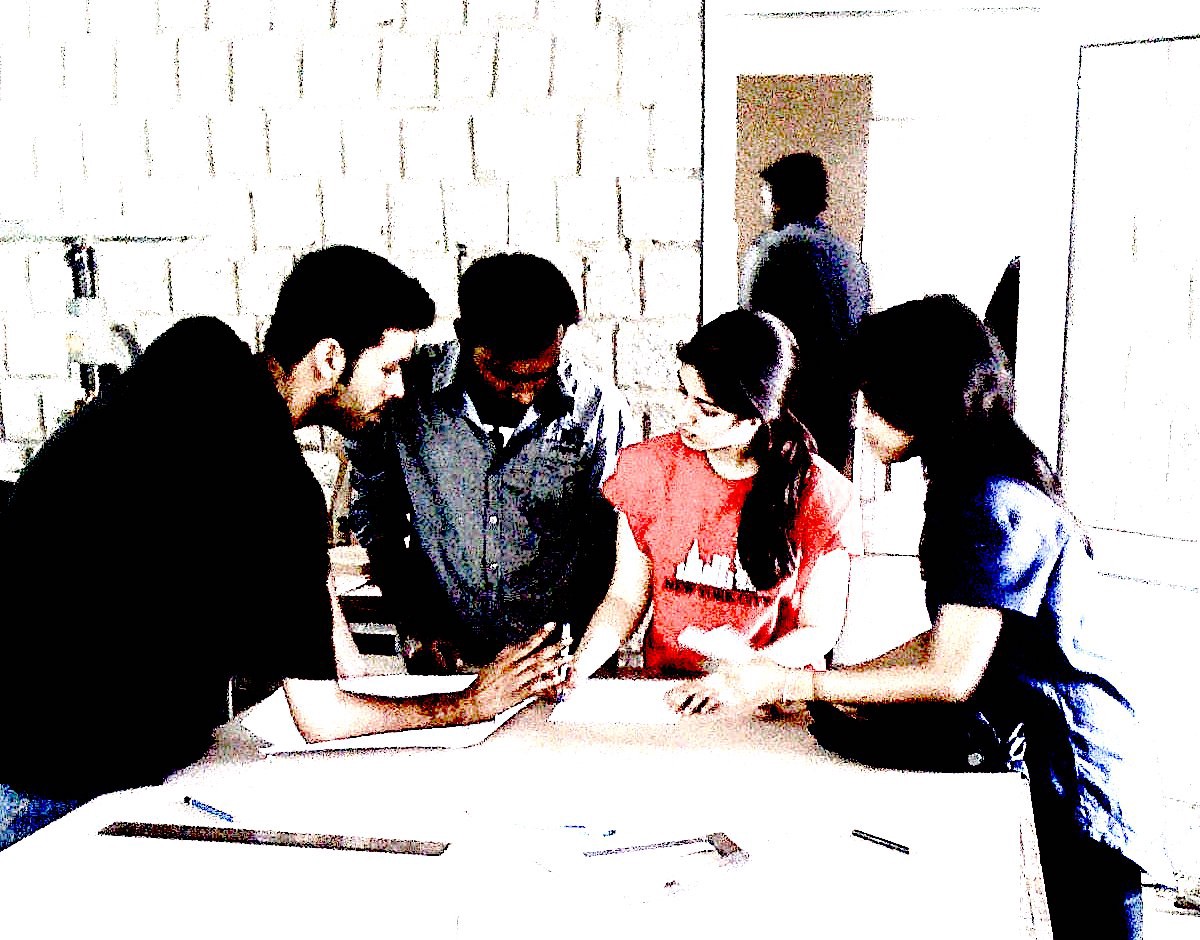
However, at its basic level, learning to become a designer still involves the simple dialogue that happens when two people sit at a table with drawings, sketches, models, prototypes and they simply discuss the problem at hand.

Image for post
The jury as a vehicle for dialogue.

The typical mode of feedback in design — the jury, or review, or pinup, and not an examination – is the primary means of assessing whether a design proposal works or not. Examinations, where a student provides a set answer to a set question and a typically faceless examiner in another room and place assesses whether that answer is correct or not, has little place in design education. In a design jury, a student presents his or her work, and a group of experts give their opinion on it, and usually provides suggestions on how to make it better. The group of experts don’t always agree with each other, and the students themselves don’t always agree with the feedback that is given. That’s all part of the dialogue of design critique, and it reflects how design works in practice as well. A designer is given a brief, works on a proposal, and shares it with the stakeholders (clients or users). They discuss, compromise, and sometimes argue and disagree, and they figure out how to go forward.

The result of this is that the student (and the professional designer) improves his or her design through dialogue, expands his or her knowledge, and goes through an iterative process that strengthens not only the quality of the design but the quality of the designer as well. The designer becomes more confident, more agile, and can better adapt to changing contexts. I might argue that indeed, this is the only way that a designer can become better. Good design requires validation for it to solve the problems it intends to solve, and dialogue can be the vehicle for that validation. Dialogue validates design. Dialogue drives design.

This not only facilitates a better designer, but a better person. A person who engages in dialogue shows that he or she does not have rigid ideas set in stone and is empathetic to the opinions and contexts of others. A person who engages in dialogue is often willing to take feedback, and to compromise and make adjustments to find real solutions. Thus, dialogue needs to be at the heart of any design endeavour, both in practice and in academia. (Fun fact: I believe this to such an extent that I named my own practice ‘DIALOG’.)

Image for post
Nothing beats sitting at the table and sharing ideas.

Many of my current colleagues and friends hesitate to believe this, but I’m still the same introverted kid that prefers to sit in the background with a book in hand and simply observe what’s happening. The difference is that I’ve learned to use the power of dialogue to try to improve myself and my situation. To try to improve my design. If I’m disconnected to a situation and have no interest in resolving it, then I revert to that inward-focused state. But when there’s a problem that needs to be solved, and I have a vested interest in its resolution (either as an academic or a professional designer), then there is no doubt that I will use what I learned that day in the EOP training session — I will voice my opinion, discuss it with others, and try to find a way to make it work. Sometimes I do it digitally [Thank you, Late-90s’ Internet Discussion Forums for that skill!] and sometimes I simply sit at a table with someone else and initiate a dialogue. Because dialogue drives design, and design solves problems. And there are still a lot of problems out there to solve.

(This article was originally published on Medium on 23 May 2018.)