
Last semester I taught several classes to final year architecture students and, as I often do, I required them to maintain a reflective journal for each class. One of the classes was Dissertation where students write a 10,000 word academic research paper on a topic in contemporary architecture. The journal for Dissertation was meant to be a research journal, in which they would compile summaries of the data they were gathering and any inferences they were making from it. I also asked them to fill in any thoughts or musings they might have on the class, what they were learning, and what it meant for them as future architects.
I did a similar thing with my Professional Practice class, except it wasn’t a research journal; it was meant to be a reflection on their learnings from the class – day by day, week by week. I asked them to keep the journal informal, and write entries as they would in a diary, but reflecting only on the learning of the class and expressing their real thoughts and opinions.
I reviewed their journals periodically, reading through all the entries, and after a few weeks I realised that the students were unable to reflect deeply on their learning. Every entry was some version of “Today in class we did this. It was very interesting.” It was reportage, not reflection – a shallow summary of the class, without any indication of how the learning affected them on a deeper level. They rarely critiqued the classes; at most, they would admit to not understanding it fully, or maybe finding it boring. But there was little or no reflection on what the learning meant in the context of their professional education, whether there were consequences of the new information, or whether it changed their existing viewpoint about an issue.
It occurred to me that the students, now in their mid twenties, had never really been taught to reflect on anything in their lives. If I asked them about a movie they watched, they responded with “It was fun”. If I asked them why they liked a certain song, they answered, “It’s really good”. It’s not that they don’t have opinions about things (I assure you, they do). They simply didn’t know how to articulate that opinion. Many of my students speak English as a second language, so I thought it might be a language issue, but even when I asked them for their opinions in their native language, they still find it challenging to express themselves with any degree of articulation.
This was when I realised that reflecting was the problem, and I immediately decided to conduct a tutorial on reflective learning, and to help them understand that meaningful reflection happens at a much deeper level than they were currently attempting. I naturally asked myself if I was qualified to teach this, but I reflected on it (meta-reflection!) and reminded myself that I do a lot of navel-gazing and pondering deeply about things. I’m no philosopher for sure, but as a natural lifelong introvert whose favourite thing to do is to sit quietly in a corner and read, I feel I can at least help the students learn how to reflect better than they were.
So before preparing my lecture, I naturally reflected on the nature of reflection (again, meta!). I wanted to express the value of reflection in a way that could be easily understood, but I wanted to avoid reducing it to just “thinking deeply”. So I came up with a framework for reflection, represented as a series of progressive layers of internalised thinking. It is, by necessity, reductionist, but I hope that doesn’t take away from how meaningful I intend it to be. In any case, for better or worse, here are my patented 6 Levels of Reflection™.

Let me explain the levels in more detail…
Level 1 – Documentation (FACTUAL)
This is the easiest and most shallow level of reflection. It barely even counts as reflection but is nonetheless an important preliminary step to deeper reflection. Level 1 is simple reportage, describing what has occurred, narration. It is highly objective and unbiased, and although it can be detailed, the information doesn’t really have much meaning. Here are some examples of 1st Level reflective learning:
- “Today we were taught _______.”
- “First we did _______, then we did _______.”
- “The teacher told us _______.”
- “We did an exercise that involved _______.”
- “We were asked to do _______. Then we discussed it.”
This is what students do easily, and usually by default. When you ask them to reflect on their learning, they simply tell you what they learned, without articulating what the learning meant to them. The only thing I would ask students to improve about this level is to document the activity or learning as a cohesive narrative rather than a flat description of events. Otherwise, there’s not much else to say about this initial level; it’s fairly straightforward. So let’s swim a bit deeper.
Level 2 – Appreciation (EMOTIONAL)
At this level, students express their immediate emotional response to the learning – whether they liked it or not. It doesn’t go much beyond this, however; rarely will a student explain why they liked it or disliked it. I imagine that part of the reason for this is their hesitation to express disappointment to a nominal authority figure, which is still how many students (in India at least) see their teachers. If they do feel open enough to share their honest feelings, they will often be cagey about it, expressing their dissatisfaction in simple, uninformative terms, often writing things like:
- “The activity was pretty fun.”
- “We never did something like this before; it was exciting.”
- “The feedback we received was demotivating.”
- “Yesterday’s class was interesting, but today was boring.”
Even at this relatively low level of reflection, much can be improved within it. Students can be more emotive, more articulate, and more descriptive of what exactly they liked or disliked about the activity, and why it provoked an emotional response. But even if they’re able to do this, Levels 1 and 2 are usually about as far as most students will go. This is the Rubicon that they seem unwilling or unable to cross.
Level 3 – Relevance (APPLICABLE)
A minority of students I’ve had are able to venture down to Level 3, which is about evaluating the importance or value of the learning relative to their existing context. It’s about questioning whether it was helpful, harmful, or neutral for their ongoing learning. Reflection on relevance is not necessarily biased, but focused on what is applicable to them. Some examples of this are:
- “This will help me organise my thoughts.”
- “The examples clarified my doubts and now I know what to do.”
- “This will add to my body of knowledge.”
- “I don’t see how this will help me get unstuck with my project.”
Finding relevance is particularly critical for younger generations; Millennials and Gen Z are often characterised (perhaps unfairly) by their inability to focus on things that they’re not directly interested in, or things that aren’t going to help them in the here and now. My ongoing theory on why this is so (which I’ll perhaps discuss in a later blog post) is based on video game culture. Younger people will rarely involve themselves in a video game until they know what the game’s objective is. Are you supposed to kill all the Nazis? Accumulate treasure? Rescue a princess? Complete a mission? Until the objective is known, the player won’t “buy in” to the game, and won’t play it. Similarly, with learning, Millennials and Gen Z – generally speaking – must have a buy-in before engaging in their learning, and a deep reflection on the relevance of their learning is absolutely necessary for them to move on and apply that learning further.
Level 4 – Provocation (INTELLECTUAL)
This level is characterised as “intellectual” because it requires the student to question whether the learning provoked some intellectual thinking. Whether it reminded the student of some prior thought, or triggered a chain of new thoughts or realisations on the subject. The student might reflect on this in the following ways:
- “The video made me realise that my project is not actually about _____ but about _____.”
- “The lecture reminded me of a poem I read last semester.”
- “Afterwards, it made me think about my previous mistakes.”
- “This _____ is actually the same as _____.
This is a more momentary and instantaneous type of reflection; it represents the moment of provocation; the spark or light bulb that goes off when the student is able to make a connection to an existing idea, or find a pattern – through synthesis – from seemingly unrelated bits of data. Although the moment of provocative reflection may be fleeting, it leads to the next deeper level of response.
Level 5 – Response (CRITICAL)
Following the provocation is usually the response to the learning. I don’t mean the emotional response of appreciation (Level 2), but the critical response ignited by the provocation in Level 4, which embodies a deeper evaluative reaction to the points raised in the learning activity. It can be either a “gut reaction” or a “measured response”, and the student can either agree or disagree with the information. This level involves finding nuances, flaws, or strengths in the learning and formulating a responsive argument. For example:
- “I disagreed with the teacher’s statement because ______.”
- “This is a valid point, but it doesn’t cover all the reasons behind the problem.”
- “This won’t work because ______.”
- “Instead I think we should do ______.”
Some of my students have asked “What’s the difference between Levels 4 and 5?” I see Level 4 as the moment of a realisation and Level 5 as the rationalisation behind it. First, acknowledging that this is something new or different or wrong or right, and then reflecting on why it might be so. You can probably reach Level 4 and not go further, but it’s hard to reach Level 5 without first reaching Level 4. And Level 6 is usually the natural result of both.
Level 6 – Consequence (ACTIONABLE)
The final (?) and deepest level of reflection in my framework is when the student ultimately asks “Now what?” The student has to figure out what needs to happen and what can/should they do with this information. To reflect on this is to ponder the next steps, and it encourages a call to action, perhaps requiring a change in thinking or behaviour. In my experience, very few students dive as deeply as Level 6 – at least consciously. They may document their learning, gauge their appreciation of it, find relevance, and then ignite a provocation and subsequent rationale or response, but they rarely take it forward into the next learning domain, which requires students to say things like:
- “How do I move forward?”
- “I need more information.”
- “I need to change my focus and find a new direction or approach.”
- “I will try to fix the problem.”
- “I need to practice this more.”
Reflection for its own sake – especially in design education – is usually not enough. It must lead to some resolution of learning, an action that results in progressive growth. It’s not enough to navel-gaze and ponder the mysteries; one has to think of the consequences and decide what to do with it. I consider Level 6 to be the most meaningful and important level because it results in forward motion, impetus, and potential innovation. As a teacher, I don’t want students to reflect on what I teach them and just mimic it; I want them to critically respond and then find their own direction and their own design identity.
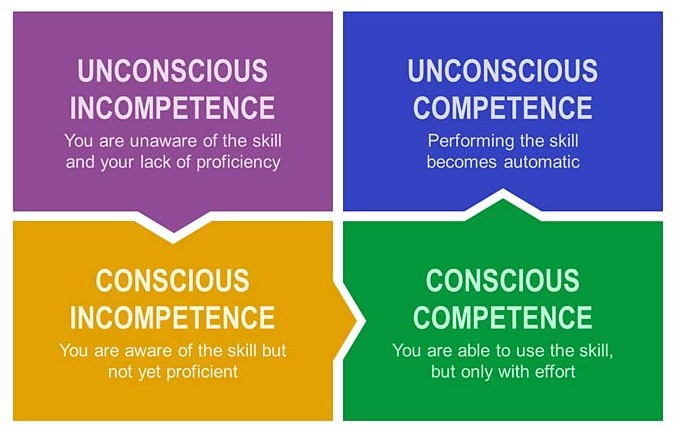
People who are experienced in reflective learning don’t necessarily go through these layers in sequence, but I do suggest that my students try to do so in the beginning. When learning how to drive a car, a new learner will go through each step sequentially and consciously, until familiarity is gained and sequential thinking is no longer required, and the driver is unconsciously competent at driving. The same applies roughly to reflective learning. It’s not automatically intuitive (especially after years of indoctrination by schooling), so in the beginning it’s better to do it step by step, layer by layer, with the conscious intention of reflecting in each of the six ways separately.
No doubt some of you reading this will be aware that mine is hardly the first model or framework of reflection that anyone has come up with. Indeed, after ideating these six levels, I googled to see if perhaps I was unconsciously coming up with something that I’d already seen before. The closest I found was Gibbs’ Reflective Cycle, which was remarkably (and embarrassingly) similar to my own six levels, with minor differences. On the one hand, I wondered whether I’d known about Gibbs before and had just suppressed it, but I didn’t think so. So I just assumed that Gibbs and I had independently come up with similar frameworks because, uh, great minds and all that. That made me feel slightly better.
All I can say is to reflect (!) on this however you like, and if it helps you be a more critical thinker, then that’s great. In any case, it’s an evolving framework (I’m already thinking of a 7th level) and I would certainly love to hear your thoughts and, ummm… reflections.
 PALIMPSEST