12 tips for new design graduates

MY PERSONAL ADVICE TO NEW GRADUATES STARTING THEIR CAREERS IN ARCHITECTURE AND DESIGN

My undergraduate architecture students have finished up their thesis and are getting ready to graduate. I’m proud of all of their successes, and eventually they will all have rosy futures, but right now they face a somewhat grim outlook… the industry is suffering from the effects of the global COVID-19 pandemic and jobs may be hard to come by. I wrote this piece partly to relieve some of their anxieties. It’s not going to get them jobs but once they do, it can help them transition into it a little easier.

In truth, I could’ve written this article several years ago. I have often given my advice to graduating students as they start their careers, and yes, mostly the advice is unsolicited. But I suddenly felt like writing it now and I hope my students (and any students who might read this in the future) will excuse my presumptuousness.

Aside from architecture, I teach and advise students from other design disciplines, so I want to disclaim that this article is mostly focused on architecture and interior design graduates, primarily because the advice I’m offering is based upon a certain kind of job profile in small to medium companies which form the bulk of architecture and interiors practices. In contrast, my students from product design or communication design generally go on to work in large corporate offices and although there may be some common carryover, these tips are more suited to smaller workplaces. So, if you’re not an architect or interior designer, take from it whatever you can. I hope it helps.

Here’s my dozen personal tips to all of you who are about to enter the professional world of architecture and design.


#1 DON’T RUSH INTO WORKING

Sometimes I wonder why students want to start work almost immediately after they graduate. I wonder why they don’t want to take some time off to recover from a rigorous and stressful design education. Once you start your career, you fall under the constraints of a traditional working life and will never get as many days off as you deserve. Take the time now to rest your brain, think about your future, work on your portfolio, travel, volunteer, or do things that a full-time job won’t allow you to do once you start working. Now I do understand that many of you need to start earning, either to support your family or to pay back your education loans. I get that, and if that’s the reason for jumping into a job right away, so be it. But if you have the time and financial standing, take some time off and travel. You may not get a chance like this again.

For the record, when I graduated, I took six months off to travel through Europe and India, with friends and later, by myself. It did cost a lot of money, most of which I put on a credit card, for which I paid dearly over the next couple of years. I don’t normally recommend students to be so financially frivolous but I’m honestly glad that I did it. I’ve never been able to have that much time and freedom since then, after 10 years of studying (!), and that small amount of credit card anxiety wasn’t that much compared to what I earned in subsequent years. And nothing compared to the experience of traveling to see places and buildings that I had only read about in textbooks. A lot of that experience has now borne fruit in my teaching career.

#2 CHOOSE A LEARNING WORKPLACE

If you can, try to work in an office that promotes a learning environment rather than a place where you’re just another CAD Monkey (as my friends and I jokingly called ourselves). Architecture has been an apprenticeship-based discipline for millennia, and employers who expect freshers to already know everything the day after graduation are not employers you want to work for. Of course, beggars can’t be choosers, so try to avoid being a beggar in the first place. Do the kind of work in college that elevates you as a candidate for better companies. Spend the time to create a portfolio that shows as much of your process work and learning as the final designed product. Do some research on how firms treat their fresh graduates. During interviews, ask questions about how the office works as a learning environment. Employers will rarely say that they’re hiring you purely to educate you, but good ones will understand that they’re making an investment in training you and will be clear about how and what they expect you to learn.

It’s often the case that small and medium firms offer better opportunities for learning than large corporate offices. There are exceptions, of course, but generally in a small office there are more diverse responsibilities and work is often shared. In larger firms, you tend to get pigeon-holed into one task that either you’re really good at or a task that is necessary but no else wants to do.

#3 MAKE A LONG-TERM COMMITMENT

One of the things that bother me as a teacher is finding out how soon my students leave jobs that they find unsatisfactory or unfulfilling. No one wants to work in a job that they don’t like, but when you just start out in your career, you also don’t really have a good idea of what you like and what you don’t. I don’t mean to sound condescending about this, but I find students nowadays to lack the patience to stick through a difficult job; many leave before a year is up, sometimes not even lasting six months. There are two problems with this. One is that architecture projects typically aren’t short projects, most last six months or more. It’s a good learning experience to work a full project cycle from start to end. Just because parts of a project aren’t fun or interesting doesn’t mean that all of it will be that way. You’re learning how to solve problems, not how to escape them. You can learn just as much from negative experiences as positive ones (if not more). 

The other reason is that an employer has invested in your training. It often takes six months just to get used to how an office works – their design process, team dynamics, hierarchy, logistics, digital systems. Typically, your first six months isn’t economically productive for your employer; they tend to spend more time and manpower in training you than they get from your actual work. As a manager, I’ve often thought it would simply be faster and easier for me to do the work myself than to check, re-check, and approve the work of a less experienced fresher. It’s harsh to say but a firm is still a business; if an employer invests in you and doesn’t get a return on that investment, it can be both emotionally and financially disappointing for everyone.

#4 PRIORITIZE LEARNING OVER COMPENSATION

This is a big one because more and more graduates have become vocal about low wages in architecture, especially for fresh graduates and interns. In another blog article, I’ve discussed in detail about why this tends to happen so I won’t get into that here. I believe that young designers deserve to be paid fairly for their time and effort, but I’ll also say that this shouldn’t become an obstacle to learning. When students come to me for advice about whether to take a low-paying offer at a good office or a higher-paying offer at a more mediocre office, I usually tell them to take what they think is fair while prioritizing a good learning experience. I wouldn’t advise anyone to work for free or for extremely low wages, but I think students should also be more realistic about their worth. The work that young graduates do in their first year of working is often not much more than drafting, and an office will usually pay accordingly. 

It’s a tough balance to strike, but I use my own experiences as an example. In almost every job I’ve taken, I’ve initially earned less than I think I deserve, but I also understand that I’m untested. An employer doesn’t know my potential yet and low margins of profitability make it difficult for an architect to gamble on paying someone more than they might be worth. So I ask for a performance review six months after I start. (Many firms already have a policy like this, which is good.) If I can prove my worth and value after six months, and if I work hard and diligently, then I’m in a better position to demand higher compensation.  This technique has worked for me for my entire career. It’s more satisfying to know I earned more because of my proven worth, not because of what’s written on my resumé. 

#5 ASK QUESTIONS BUT RESPECT THEIR TIME

Once you start working, you will undoubtedly have many, many questions. In my first job after graduating architecture school, I was very fortunate to have managers who were willing to answer my questions whenever I asked them. I only realized later how much of a disturbance and distraction that must have been for them, and I wasn’t nearly the only one – I had several friends working with me who had similar levels of experience, and who knows how many times our manager had to stop working to entertain our frequent questions. He rarely complained or told us to come back later. But once we realized that we might be distracting him, we started to do it differently… we kept a list of questions at our desks and as long as the question wasn’t urgent, we would simply add it to the list and keep working. Then at some convenient point in the day, we’d ask our manager if he could give us some time and we would ask all our questions together.

The advantage of this is that, in delaying the question sometimes it would answer itself in due course. That’s an important learning when you start your career – to balance the things you can figure out on your own with the things you genuinely need help with. It’s also a well-known advice that when you go to a colleague with a problem, try to go with at least one potential solution as well. Even if your solution is rejected, your employer will appreciate your genuine attempt to think independently. Employers tolerate questions (and often encourage them), but they also want to eventually trust you to figure it out yourself.

#6 HAVE AN ENTREPRENEURIAL MINDSET

I like to teach entrepreneurial practices to my students even though most will spend the first few years working for someone else. But many will likely start their own practices in due time, so it’s important to know how to be a good entrepreneur – not just about the business and finance side, but also the managerial aspect. However, the big myth is that these learnings are only valuable once you start your own practice. That is not true. A good employee who has an entrepreneurial mindset regardless of their hierarchical rank is usually recognized and rewarded eventually.

An ‘entrepreneurial mindset’ is an attitude of ownership over the work, the projects, and the general workings of any organization. It’s the idea that your work, however minor, has some reflection on the business as a whole, and that you have a share in that reputation. Maybe you don’t actually have a financial share and you’ll get paid a salary regardless, but that’s misleading because architecture firms don’t tend to have big profit margins and often have high turnover. Your salary may not reflect profit-sharing, but when profits go down for whatever reason, the employees who don’t have an attitude of ownership will likely be the first to go, the younger ones in particular. Keep a sense of pride in your work and maintain an attitude that what you do reflects on the entire organization. Believe me, in all but the most unbalanced and unfair working environments, this attitude is rewarded with better projects, more responsibilities, more compensation, and more advancement. Not only will this mindset earn you respect in your job, it will also be valuable for when you’re ultimately running your own firm.

#7 AVOID OFFICE DRAMA

Too often I hear about my students getting caught up in office politics, drama, gossip, and the many machinations and manipulations that even the smallest of offices can fall victim to. Interns and freshers often become unwitting pawns in these games, which almost always result in an unhealthy office environment, and it takes an disproportionate toll on less experienced employees. My simple advice – stay away from it. Lie low, focus on your work, and avoid getting caught in the middle of interpersonal conflicts that have little to do with you. Sometimes this isn’t easy – a young designer working on a team needs a clear channel of hierarchy, and office politics can cloud that channel. Who do you report to? Who makes decisions on a project? Whose instructions to follow? It’s best to keep a clear head and clarify any doubts in the beginning. Make sure you find out before you join on any project team who are the team leaders and what role everyone plays. If there’s any doubt, ask openly. Avoid corridor conversations and taking sides, and when you’re given instructions make sure you note them down in a personal project journal. And of course, don’t fall prey to gossip involving you or anyone else.

If you find that an office is too enmeshed in this toxic culture and it’s more than you can handle, then seek counseling from other professionals that you trust and perhaps start planning an exit strategy. But in the meantime, observe. Sometimes being observant of bad behaviour gives you a good idea of what not to do in your own practice. Many of my lessons as a professional have come from observing the behaviour of others and deciding that that is definitely what I don’t want to do. 

#8 MAINTAIN A HEALTHY WORK-LIFE BALANCE

Adding to the potential stress of office drama is an unhealthy working schedule. Many architects and designers still cling to the romantic vision of a creative practice with long, grueling working hours, late night charrettes, and last-minute deadline encroachments. There’s abundant research that shows that none of this is actually productive, and in fact becomes unnecessarily taxing on workers. In a discipline where most of your work requires your brain to be creative and innovative, it isn’t good to always be tired. Of course, I’m not saying that everyone should ideally be 9-to-5 workers, and if the pandemic has predicted anything, it’s likely that all the norms of the standard workday and workweek may be up for reconsideration soon (if not already). But don’t become a victim of ‘architecture overtime’ simply because that’s ‘how it’s done’. 

I think that sometimes many of my students leave their jobs so quickly because they get burnt out. It’s often expected for a junior designer to put in lots of work-time to impress the boss, but this has consequences in the enjoyment of the work and your motivation to do it. I don’t believe that the first year of a designer’s professional life should be spent in 16-hour working days with no social life. There are many other avenues in which you can grow in these early years. Don’t waste it all on poor time management.

#9 SUPPLEMENT YOUR OFFICE WORK WITH OTHER LEARNING

Your faculty in college always told you that a great deal of your learning will happen outside the classroom. The same is true in your professional life. You will no doubt learn a lot on the job – in fact, more intensely than in college. But you won’t learn everything there. Most offices have a very narrow way of working – they use a specific software package, they have an established process of design, they perhaps even use similar materials, details, and techniques in their architecture. It can be easy to fall into a rut of learning, but the answer isn’t necessarily to leave the job for another one. You’ll just be moving from one routine to another. So it’s important to supplement your office experience with additional learning while you still have free time and energy in your life. Take a class in something entirely different than your office work. Learn software platforms that your office doesn’t use. Go to events, conferences, and exhibitions, and travel on the weekends to visit architecture in different cities and towns. And read, read, read… stay up to date on what’s going on in the profession – both in theory and practice.

You might even decide to study something different from architecture. I strongly believe that future economies will be disruptive and volatile, so it may not be a good idea to focus all your abilities into one discipline. There’s a lot of scope for diversification within architecture, but there’s also a lot of scope outside of it. In case the industry growth declines, it’s good to learn other design disciplines, or even other business practices. The best thing about a 5-year architecture education is that it prepares you for many other related careers. Many more architects branch into other disciplines than vice versa. My personal feeling is that architects should branch into interaction design, digital experiences, environment visualization (gaming, CGI), and data visualization and analysis. A lot of the skills you need for these fields are already baked into an architecture degree, so it’s good to diversify while you can and be prepared for uncertainty.

#10 DON’T SHRINK YOUR SOCIAL CIRCLE – WIDEN IT

The great thing that university life does – especially architecture school – is that it opens up your life to new ideas, new experiences, and new people. College tends to be a time of social expansion; your social circle gets wider and encompasses more and more people, cultures, and ideas every year. 

But I’ve noticed that when students graduate, their circles tend to contract. You stay in touch with only those college friends you were really close to, and the majority of new people you meet are through work. This is understandable because after years of expansion, one tends to want to settle down and contract… especially if you’re an introvert like me. But the problem is that this is the time in which you need to actually expand your horizons. You are in an even more intense period of growth, and you need to meet more people, you need to make more connections. As we’ve said before, you may quickly find that your job doesn’t suit you and you need to find something else. At that time, it’s good to know people so that you can find better opportunities. 

You may soon become ready to start your own practice, so having a network of collaborators is seriously important; it can make or break your new career. You’ll need to know vendors, suppliers, contractors, designers, and of course, clients. So while networking is often seen as a bad word (I used to think so, and sometimes still do), I’ve found that having a solid professional network of people you like and trust can make your next role much easier to transition into. You will need the help and support of others, so build up that network and stay in an expansive social mode while you still can.

#11 SPEND YOUR FREE TIME IN WORTHWHILE CAUSES

I mentioned earlier that you should supplement your working life with learning new skills. Another thing to consider is to devote some time to charitable causes. When working to build up your career, it can be easy to get caught up in your own self, especially once you start earning your own money. There’s a ladder of consumption that’s all too easy to climb – get a new place, buy new clothes, get a new car, then get a bigger place, more clothes, a better car, and so on. I don’t want to preach and tell you how to spend your hard-earned money, but I think it’s also important to reflect on what your architecture education has given you – the power to help people and change their lives for the better. If that’s not necessarily happening in your job, then it’s good to exert that power in some other way – by volunteering your time and energy.

As an architect you have a lot of creative potential. Use that to help people. Improve homeless shelters, assist with pro bono building projects, create newsletters or flyers for non-profit NGOs. My rule of thumb is to spend at least half a day each week in some kind of voluntary, charitable project. Of course, no one is forcing you to do this, but look around you… the world is not in great shape right now. It needs creative people like you to help fix its problems, even in very small ways.

#12 BE ETHICAL IN YOUR SIDE WORK

Almost every principal architect knows that the majority of his or her employees do some work on the side. It could be charitable work as I mentioned above, or it could be the humble beginnings of your own practice. Most employers know this and look the other way. Some will explicitly tell you that it’s ok to do it as long as it’s not on ‘company time’, using company resources. It’s important to respect this, no matter how easy it is to get away with. It’s simply not fair to your employer to use their time and resources for your own projects without their explicit approval. You don’t want to start off your professional career with unethical behaviour.

You know what I’m talking about. Working on your own projects during your workday, on the office workstations and software. Printing drawings on the office plotter after hours. Just don’t do it. An employer has built up his or her practice over years, and it’s unfair to repay their investment in you in this way. Use your own resources – your own laptop and software license, and get your plots printed somewhere else. It’s not that hard to do.

Of course, the best thing is to simply be open about it and ask your boss if you can do it. Most employers will not be ok with you doing work that directly competes with them, but many employers are ok with you doing small projects that they wouldn’t take on, as long as you don’t use their resources. Some may ask for a share of the fee, or some may simply just let you do it as long as you’re open about it, and you don’t do it during office hours. I once was working on a long-term pro bono charitable project and I simply asked my boss if I could print my 4-5 sheets on the office plotter, after hours. I did it openly, and he was fine with it because it was a charitable project, and it was only a few sheets. He even sat down and hand-rendered my elevations for me (he liked to remind me how much better at drawing he was than me). 

Situations vary, and you have to carefully reflect on your specific relationship with your employer and think about how he or she would respond and whether it’s worth the risk to burn bridges like that. In the end, I feel that it’s always better to either be open about it, or simply do it all on your own time.


That’s my 12 tips (for now). You’re welcome to add more, comment, agree, disagree… anything. But regardless, I wish all my graduating students the very best for the future.

summertime for design students

TIPS FOR DESIGN STUDENTS TO STAY MENTALLY ENGAGED, ACTIVE, AND CREATIVE DURING SUMMER VACATION

[Note: This is an essay I wrote and have been sending to my students every year. Obviously this year, things are a bit different. The pandemic and subsequent lockdowns are going to limit some of the activities I’ve listed here. But on the other hand, they will give you ample time to do some of the other activities. So adjust accordingly.]

A lot of my students complain about being bored during the summer holidays. On the one hand, it’s surprising how quickly you start being bored. On the other hand, I can understand how a full year of design school gets your neurons firing with intense frequency, and sitting at home or hanging out at the coffee shop is just not doing it for you anymore. You’ve gotten used to thinking at a high level and being creative. So I’ve put together a few suggestions to relax during the holidays and still exercise that brain muscle of yours. Like all muscles, if you don’t exercise it, it will be that much harder to get back in shape.

I don’t expect all of you to follow all of these suggestions, but give them a try. Without a doubt, have fun… have loads of fun. Anyway, here are some ideas that help fight off boredom and will also make you a better designer.

  • Read! You can read books about design or architecture, but just read something! Fiction, non-fiction, comic books, newspapers, magazines, online articles, whatever. Try audio books if you have a hard time reading. At the end of this essay, I’ve listed some books that might be interesting for architecture and design student
  • Practice drawing. Go outside and observe the macro world — go to malls, train stations, airports, and other public spaces and draw what you see. If you’re at home, draw what you see at home or outside your window. Practice rendering techniques and drawing with unfamiliar media. Learn to get better at free-hand skills. Develop your ability to draw what you imagine — visualise things in your mind and draw them.
  • Go to public places and simply observe human behaviour. Watch how people interact with spaces and the objects within them. Ask them questions and inquire why they’re doing what they’re doing and whether they’re even conscious of it. Take pictures! One of my favourite idle activities is to sit at an airport or station and invent background stories for people that I observe.
  • Learn a new software (or simply get better at what you already know) like Autocad, Sketchup, Revit, Rhino, Grasshopper, Maya, Vray, 3DS Max, Photoshop, Illustrator, InDesign, Final Cut Pro, AfterEffects, etc. YouTube has become a great resource for this. Learn to code, design a website, or Flash, HTML, CSS, and Javascript. Learn how to do better presentations beyond simple Powerpoint.
  • Learn a new form of creative expression, like filmmaking or cartooning. Explore different media, e.g. watercolour, clay sculpture, mosaic, photography, etc. Learn a musical instrument or explore a musical genre that you’ve never listened to before. Act in a play, or write one.
  • Design a new game. It could be a board game, card game, mobile app, or even a new sport.
  • Practice writing and composition. Start a blog or write reflective essays. Write poems.
  • Design (or refine) your portfolio. Document your work and think of a way to present it, both as a hard-copy and digital. Figure out how to let it expand as your body of work grows. Make sure it’s a good representation of “you”. But try to keep it simple and resist the temptation to include everything. Sometimes it’s worth asking someone to help you edit.
  • Browse random Wikipedia articles or use websites like StumbleUpon or HowThingsWork to discover new things. There are many YouTube channels which explain how things work and how things are made.
  • Explore design workshops or seminars (or webinars) that are happening in your town (or nearby). Go to museums and galleries and be aware of new exhibitions.
  • Learn a language, or learn about a new culture, craft or art form. Travel to somewhere you’ve never been, even it’s a neighbourhood in your own city. Meet an artist, craftsman, artisan, performer, or designer and observe how they work.
  • Engage in some social work or volunteer activity. Join an NGO and find out ways that you can perhaps help them with their design objectives (e.g. designing posters, brochures, or newsletters for them).
  • Try to get a job at a design firm as an intern. Offer to help them in any way you can (but insist on getting paid in some way, even if only to cover your expenses).
  • Watch movies, preferably about art, design or architecture, but watch stuff that’s intellectually stimulating. Sure, there’s nothing wrong with the occasional mindless summer action blockbuster, but balance it out with some ‘other’ stuff. Again, I’m including a list of movies that have some relevance to design and architecture.
  • Watch TV and OTT shows. Life is not all about bad American sitcoms. Watch quality TV shows and limited series. Subscribe to a streaming service if you don’t have it already and dig deep into their library for shows that you may have never heard of. Look for good documentaries.
  • Listent to Podcasts. There are hundreds if not thousands of podcasts on incredibly interesting topics — some specific, some general. If you have difficulty reading, then podcasts is another way you can learn.
  • Above all, don’t let boredom be an excuse for wasting time. Fill your time with interesting stuff. Catch up on sleep (because you know you won’t be getting much when school starts again) and break up your day into fragments of activities so you don’t get bored of doing the same thing.

SUGGESTED READINGS

Books and articles that feature architecture and design

  • Architecture: Form, Space and Order by Francis DK Ching
  • A Tractate on Japanese Aesthetics by Donald Richie
  • The Death and Life of Great American Cities by Jane Jacobs
  • The Wright Space: Pattern and Meaning in Frank Lloyd Wright’s Houses by Grant Hildebrand
  • Invisible Cities by Italo Calvino
  • Ways of Seeing by John Berger
  • The Soul of a Tree by George Nakashima
  • Drawing on the Right Side of the Brain by Betty Edwards
  • Great Streets by Allan Jacobs
  • The Poetics of Space by Gaston Bachelard
  • Principles of Art History by Heinrich Wölfflin
  • Flatland: A Romance of Many Dimensions by Edwin A Abbott
  • Why Buildings Stand Up by Mario Salvadori
  • Why Buildings Fall Down by Mario Salvadori
  • Zen and the Art of Motorcycle Maintenance by Robert Pirsig
  • The Tibetan Book of the Dead by Sambhav Sambhav
  • Learning from Las Vegas by Robert Venturi and Denise Scott Brown
  • Brave New World by Aldous Huxley
  • 1984 by George Orwell
  • Red Mars by Kim Stanley Robinson
  • Freakonomics: The Hidden Side of Everything by Steven Levitt & Stephen Dubner
  • Mother Pious Lady: Making Sense of Everyday India by Santosh Desai
  • The Enlightened Cyclist by The Bike Snob
  • Rendezvous with Rama by Arthur C. Clarke
  • How to Read Towns and Cities: A Crash Course in Urban Architecture by Jonathan Glancey
  • The World Without Us by Alan Weisman
  • How to Live in a Flat by W. Heath Robinson and KR Browne

SUGGESTED MOVIES

Films that feature architecture and design

  • Metropolis (1927, dir. Fritz Lang)
  • Gattaca (1997, dir. Andrew Niccol)
  • North by Northwest (1959, dir. Alfred Hitchcock)
  • Rear Window (1954, dir. Alfred Hitchcock)
  • 12 Monkeys (1995, dir. Terry Gilliam)
  • Ran (1985, dir. Akira Kurosawa)
  • Rashomon (1950, dir. Akira Kurosawa)
  • Seven Samurai (1954, dir. Akira Kurosawa)
  • Moon (2009, dir. Duncan Jones)
  • The Fifth Element (1997, dir. Luc Besson)
  • Dark City (1998, dir. Alex Proyas)
  • My Architect (2003, dir. Nathaniel Kahn)
  • Parasite (2019)
  • Blade Runner (1982, dir. Ridley Scott)
  • Blade Runner 2049 (2017, dir. Denis Villeneuve)
  • The Grand Budapest Hotel (2014, dir. Wes Anderson)
  • 2001: A Space Odyssey (1968, dir. Stanley Kubrick)
  • Brazil (1985, dir. Terry Gilliam)
  • The Hudsucker Proxy (1994, dir. Joel/Ethan Coen)
  • Koyaanisqaatsi (1982, dir. Godfrey Reggio)
  • Powaqqatsi (1988, dir. Godfrey Reggio)
  • Life as a House (2001, dir. Irwin Winkler)
  • Helvetica (2007, dir. Gary Hustwit)
  • The Five Obstructions (2003, Jorgen Leth & Lars von Trier)
  • Art and Copy (2009, dir. Doug Pray)
  • Handmade Nation (2009, dir. Faythe Levine)
  • Rivers and Tides: Andy Goldsworthy Working with Time (2001, dir. Thomas Riedelsheimer)
  • Wal-Mart: The High Cost of Low Price (2005, dir. Robert Greenwald)
  • Wall-E (2008, dir. Andrew Stanton)
  • 9 (2009, dir. Shane Acker)
  • Logan’s Run (1976, dir. Michael Anderson)
  • City of Ember (2008, dir. Gil Kenan)
  • The Matrix (1999, dir. The Wachowskis)
  • Total Recall (1990, dir. Paul Verhoeven)

dear design students: here are ten tips for your upcoming jury

You’re welcome. Sincerely, Your Design Faculty

Image for post

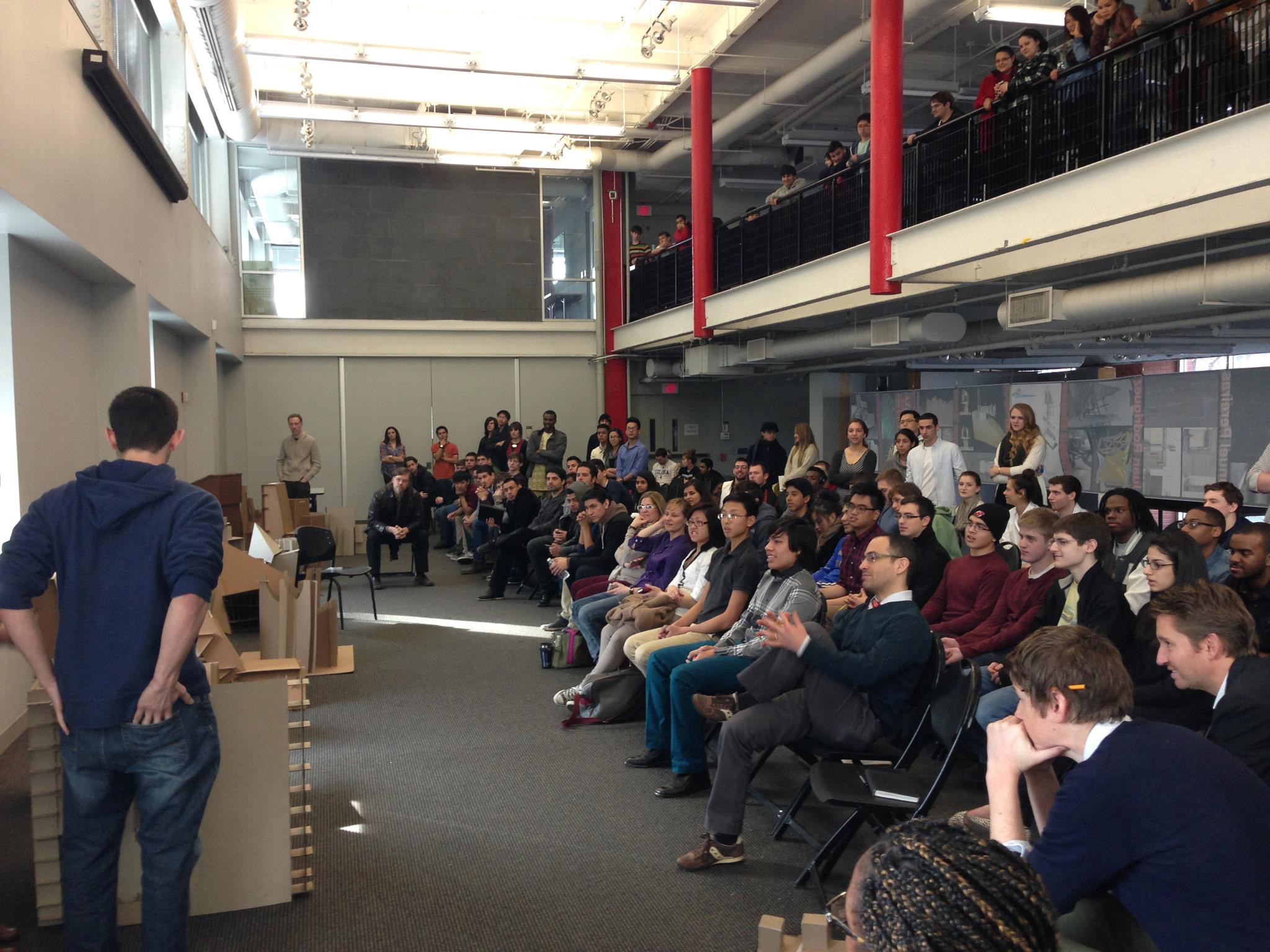
For design students, juries are often a source of anxiety and stress, but ideally they shouldn’t be. Juries are primarily about design critique and they work best when they’re open, honest, impersonal, and transparent. However, this openness can also mean that jury feedback can be subjective, contradictory, and confusing. Add this to the anxiety of presenting your work to ‘experts’ and ‘professionals’ after many months of hard work and naturally students find juries a cause for distress. And I admit that we as design teachers often give mixed messages about how seriously you should approach juries:

Message A: “Juries are important; take them seriously. Don’t embarrass us in front of industry professionals!”

Message B: “Juries are not that important; don’t worry, relax. Don’t take it personally.”

These messages aren’t necessarily contradictory, they simply need to be balanced. So take the jury seriously if you want to get feedback, but don’t take it so seriously that you get nervous and can’t represent your work in a good light. But do remember: It’s only a jury, after all…. it’s not a trial, or a judgement, or a punishment. It’s simply a critique on your work by professionals and academics who are not intimately familiar with your project, or with you. I think many students have the wrong impression about juries and put a lot of pressure on themselves which itself causes the distress that one is fearing and in turn causes the jury to go ‘bad’.

Yes, you should take juries seriously. Yes, you should speak maturely, dress appropriately, and be well groomed and bathed. You should make a good impression not just for yourself but your institution. To help with this, I’d like to share ten general tips for a healthy, productive, and stress-free jury.

1. BE PREPARED

Double check your sheets, slides, videos, renders, animations, prototypes, models. Make sure you have everything. This doesn’t mean that you’ll present everything, but be prepared to show any work that jurors may want to see. Keep in handy, and ready to find in an instant, either physically or digitally. Give yourself enough time to check. Enlist your family to help you. Be ready when it’s your turn, and don’t make the jury wait for you. Arrive on time and set up on time. If you’re presenting digitally, check all A/V connections and make sure all your tech gadgets work properly. If you’re posting physical sheets on a wall panel, bring plenty of pins! Rehearse your presentation beforehand. Keep notes if you need them, and present your work in the form of a story or narrative. Many of you go through your project like this: “First you enter from here, then you go here, then there’s a desk, then there’s a table…”. Instead, talk about your design process. Start with your design problem, your case studies, and your analysis. Describe what you learned from them, and what you chose to bring into your design brief and concept. Then explain how that concept manifested in your design development and detailing. Use the right design vocabulary which was taught to you. Avoid the words “basically” and “just” and “like” and “kind of” and “sort of” and “ummm”.

2. BE RESTED

Don’t make the mistake of staying up all night before your jury. Get a good night’s sleep. Eat a healthy breakfast. Be clean and fresh and alert. Dress appropriately; be cognisant of your appearance — whether it’s about clothes, makeup, headgear, or accessories. Be aware about appearing too formal or too casual or too revealing. You have the freedom to wear what you like, but if the focus is on your look rather than your work, then it will distract the jurors.

3. BE THICK-SKINNED

Yes, the jurors may say some things that sound humiliating or condescending. Design faculty usually try to find jurors who are not aggressive or mean-spirited, and to be honest even the ones who may say nasty things about your work (or lack thereof) or who may laugh at certain elements of your design are not doing it to be intentionally mean. They have certain standards for where you as a student should be, skill-wise or knowledge-wise, and they’re expressing their frustration at your inability to meet your potential. And jurors are human, too; they’re not perfect. Sometimes they are harsh, but more often than not they’re making a valid point. In the professional arena you will get burned much worse, believe me. So it’s good to develop a thick skin; if a juror is being harsher than you think you deserve, then keep cool and move on. Which leads to the next point…

4. BE COOL

Stay calm always and don’t lose your cool. Don’t be defensive. Don’t argue with the juror. Try not to get angry or sad or sarcastic. Not everything they say is going to be valid; that’s why we usually have more than one juror. But this is not the time to defend yourself; you’re there to receive feedback. You can ignore it or use it, that’s your decision. But it doesn’t help to be combative because then the juror will most likely get combative right back at you and you don’t want that. Students often ask me whether they should defend their work when the juror doesn’t “get it”. It depends; often I find that it doesn’t really help because there’s limited time to really change people’s minds. You stand to lose more than you gain by trying to defend yourself. Unless you think you’re really being treated unfairly, or the juror is completely off-base, then I would avoid getting entangled in an argument. But take a call.

5. BE AN OWNER

Take ownership of your work and your design decisions. Too often I have seen a response to a juror feedback as “Ma’am/Sir/Professor said to do that.” Sorry… as a design student, once you choose to accept your tutor’s critique and incorporate it into your design, it is now yours. Don’t blame your tutor for design decisions that may not have worked out. Sometimes it could be because you misinterpreted your tutor’s critique. Sometimes the critique may have been given with too little background. Sometimes the tutor may simply be wrong, but that’s part of the subjectivity of design education. You’re being trained to absorb critique, reflect on it, and decide how to incorporate it, if at all. Once it’s part of your design, it’s yours.

6. BE HONEST

Don’t try to bullshit your way through a jury. If you don’t know the answer to a question, say “I don’t know.” A juror can tell when you’re making stuff up. It’s better to be honest and say that you don’t know, or didn’t get a chance to resolve it, or ran out of time, or simply that you were unable to solve the problem. Capitalise on such a moment as an opportunity for learning, and ask the juror if they can assist you with the answer. Which leads to…

7. BE INQUISITIVE

Very few designs are fully resolved at the time of the jury. This is expected. There is always room for change, improvement, or further development. Use the jury as an opportunity to gain insight into how you could have done better, or to find out how to get past an obstacle that you just couldn’t manage by yourself. The jury is there to help you, not judge you (despite the name). And if there’s something you just couldn’t figure out, it’s ok to ask the jury to suggest a solution or direction. Learning does not end with a jury. At the end of a project, there should be a reflection on what you could do to make a better design resolution (or even a better presentation). Which leads to…

8. BE CONSCIENTIOUS

What does this mean? It means you should be an active presenter, not a passive one. Don’t just stand there and present your project. Take notes on the critique, record the comments, document the feedback, so that you can reflect on it and apply the learning. When you’re nervous anyway, you may not be n a position to remember all the feedback. So recording helps, and your friends and classmates can help you with this. Also, when you’re not presenting, be considerate of other presenters. Give them the respect and attention you would want if it was your turn. Don’t whisper, chat, giggle, laugh, or carry on while others are doing their best to concentrate on the presentation. If you need to talk, go outside. And silence your phone!

9. BE PRESENT

Don’t just be there for your own jury. Be there for the entire proceedings. You will learn far more from listening to the presentations and critiques of 10, 20, or more of your classmates than you will ever learn in the scant 15 minutes of your own feedback. Many students waste the jury day by wandering around or chatting/texting/surfing, or trying to desperately finish their projects, or simply not even being on campus. Why? You are missing out a super intense learning experience. Not to mention, why wouldn’t you want to support your friends for their presentations? It means so much to someone who is nervous to have a group of friends in the audience lending moral support, a group of reassuring and familiar faces to cheer them on. It’s about compassion and camaraderie.

10. BE BRAVE

This is the most important. Many jurors comment that student often have difficulty applying the learning from one year to the next. I think this is because of the Ostrich Syndrome. Like ostriches, when you sense danger, you bury your head in the sand and believe that if you can’t see the problem, it will go away. Which is why so many of you skip your classes and mentor sessions, and even worse, your own juries. In the design world, missing your jury is an unforgivable sin. You have robbed yourself of the chance to get what you claim you crave most — feedback. And why? Because you’re embarrassed about not having enough work to show, or the work is perhaps poor quality? So what? How do you think you’re going to get better next time? You learn from your mistakes and rebound! This means that, yes, you do have to listen to the jury tell you that you didn’t do a great job, and that’s never fun. But then you should admit your lack of progress, then turn it around and explain what the problem was and why you got stuck, and ask for advice on how to get unstuck. The most noble thing in academics and professional life is to fail and then get back on your feet and succeed. When you fail, you must acknowledge it and try to find out why, and then move on. This is life, not just design. It will define your whole existence for years to come. But if you retreat and avoid in the face of failure, you’ll almost certainly fail again. When college is long over and finished, you’ll still regret that retreat.


One last request. Please don’t ignore this advice. Design students have so much potential and so much talent; just managing to get through design school is itself a big achievement which many people can’t do. Don’t let your inner fears restrict you and get in the way of your success. Creativity requires action, boldness, honesty, and dignity. The worst punishment that design students get is from themselves, not from jurors or tutors. We’re not here to beat you down or boost our egos. We’re here to discuss new ideas and learn new things (yes… in teaching, we are learning just as much as you, if not more). We’re here to help you and we do the tough and tiring job of teaching and sitting in juries because we’re hungry to talk about design with you. If you’re not as hungry as we are, then you’ll see us become sad and frustrated, because no one wants to spend an exhausting day talking if the other person is not listening. So please continue to work hard, be imaginative and brave and confident, and we look forward to sharing ideas with you very soon.

Best of luck to all of you, in your juries and beyond!

the importance of ethos in design

DESIGN AS A VEHICLE FOR SOCIAL JUSTICE

[A version of this article was recently published in “What’s Next: The Creative Spark”, a book of essays chronicling an event of the same name held in Mumbai in February 2019 organised by Pearl Academy. Click here for more info on Pearl’s well-received “What’s Next” series of confluences .]

The Lack of Ethos

In the 1996 Hollywood film Jerry Maguire, directed by Cameron Crowe, the titular character played by Tom Cruise infamously writes a mission statement for his sports agency firm, the result of a late-night epiphany about the direction in which he felt that his company should be heading. The statement (the full text of which was released by Crowe some two decades later) entreated the company’s workforce to take a more compassionate and less profit-oriented approach to the high-profile business of sports management. What did Jerry Maguire get for his efforts? He got sacked.

Granted, the rest of the film is a sort of redemption story for him but the fact that his company not only outright ignored his vision but they instantly fired him, and that only one colleague felt strongly enough to join him as he left, is a grim acknowledgement of how the corporate world views compassion and justice. The cynical takeaway is that a well-meaning ethos is all well and good, but it’s not welcome in larger society where we have more important things to worry about like business targets, jobs, and salaries.

Fast forward to 2020. We look at the current political and socio-economic situation around the world and we can see where giving lip service to ethos has brought us. Corporate greed during the Great Recession of 2008, massive dependence on fossil fuel economies despite dire warnings of climate change, rising xenophobia and ‘otherism’ around the world as nations tighten their borders… We’re now living in a time where social groups — nations, cities, communities, organisations — are unable to clearly agree amongst themselves on what defines them and what values should drive their actions and policies towards the uncertain future. They either lack a clearly defined ethos, or they had it and rejected it altogether.

Developing a Workable Ethos

Social justice — in any form — requires a community or organisation to define, codify, and then strictly live by an ethos that represents its inherent values clearly and unambiguously. When it began as a lowly startup, Google defined its ethos with the words “Don’t be evil” which was not only spelled out in the company’s Code of Conduct, but was emblazoned on the walls of its brand new offices. Google has since removed those words and minimised their importance in their Code of Conduct after experiencing how difficult it actually is to be one of the world’s biggest companies and still live by a vague imperative to avoid something as complicated and commonly misinterpreted as ‘evil’. Google’s problem is not the lack of vision to impact people’s lives; rather, the mistake was being too glib about it. They believed that a superficially simple motto of “Don’t be evil” is enough to guide the actions of the massive diversity of its employee base, and to consistently do so through decades of business practice. When Google itself became a quasi-political power, they realised they could no longer live by the very ethos that guided their humble beginning.

What organisations can do, however, is to be more definitive about their stated values and then take steps to ensure that all members of the organisation from top to bottom understand and adhere to those values, no matter what. This applies not just to corporates, but any organisation or group of people with shared goals. You can call it what you like — a mission statement, or vision statement, or motto, or code of conduct — but it should be clear and unambiguous, and should not conflict with the organisation’s objectives. If a company’s ethos is to be mindful of the environment, they can’t be a polluter of air and water. If a non-profit’s ethos is to provide underprivileged people with economic upliftment, then 75% of its endowments shouldn’t go to upper management salaries. If an educational institution’s ethos is to ensure a delightful and meaningful learning experience to its students, then it shouldn’t force its students to go through endless bureaucratic hurdles just to get a simple permission note for a justified late assignment.

Social justice, in these respects, is not just about activism and communal responsibility. It’s certainly not only about just saying what you believe in. It’s about putting your money where your mouth is, and adhering to the high ideals and values that make up one’s ethos. This is hard enough to do at the individual level; having to worry about one’s own integrity and the lines they will not cross is ultimately a personal decision, and a weighty one. Where an ethos is most impactful is when groups of people work concertedly towards shared goals and abide by the values they’ve chosen to inculcate in themselves. Unfortunately, this doesn’t happen as often as it should, because organisations and groups are diverse in nature, and agreeing on a common ethos to define the group’s behaviour isn’t as easy as it sounds. But this doesn’t mean that they shouldn’t try.

Ethos in Design

The importance of ethos should figure prominently in the design community. The outcome of designers’ work is very often subjective in quality, intent, and functionality. There is a lot of ambiguity in design, and practicing design with a clear ethos is often a matter of interpretation. In addition, maintaining a strong ethos while producing design is an added layer of complexity, particularly because the nature of the design industry is mostly the small scale of personal entrepreneurial ventures. Being a ‘struggling young designer’ is almost as much a cliché as ‘struggling young artist’, and rightfully so. Design is rarely appreciated at face value, and getting the public to understand the value of a designer’s ability takes a great deal of time and effort, where jobs are won or lost almost entirely on the basis of reputation and word of mouth. For a designer to stick to an ethos and live by it often requires giving up paid work that the designer sorely needs.

In addition, for a young designer to get into socially responsible work is extremely difficult. First of all, it doesn’t pay. Second, because the work is often voluntary, it requires more time than a young designer has. So there are few incentives for a young designer to spend the time working on projects that have a strong social benefit. Therefore, it becomes even more important for an ethos to be embedded in ALL of a designer’s work, where it is infused with social sensitivity and ethical responsibility.

For example, there is currently a strong emphasis on Sustainable Design, which is a term that I have some problems with. It implies that sustainability is something that is added to design, like an overlay; it’s not necessary but it makes design better. In my opinion all design must be sustainable. If it’s not sustainable then it’s not design. The term sustainability should be part of the definition of design, in the same way as the terms usabilityprocessempathy. Is there a separate discipline of architecture called Comfortable Architecture? Of course not, because all architecture is assumed to provide comfort by definition. So why Sustainable Architecture?

This is because the design community has yet to embed social justice and social responsibility as an ethos in the definition of what design is all about. The medical field has “First, do no harm” in its Hippocratic Oath. Can design have a similar ethical manifesto? Can designers be made to swear by a Designer’s Oath to be socially responsible towards all populations, to do no harm to the planetary ecosystem? To use design as a vehicle to aid and assist humanity, decrease oppression, and promote good will? Perhaps these are as vague and difficult to follow as Google’s “Don’t be evil” but it can be a start. Designers can certainly band together and make it a priority to have an ethos for all design work. Traditionally, professional guilds would ensure this would happen; if a practitioner was a member of a guild, it was a way to ensure that certain ethical standards would be practiced. Indeed, this is still the case with many professions; in particular, architecture guilds around the world have a code of conduct or ethics that is required for all members. But too often, only the most egregious or criminal acts are the ones that make a case for debarment. Professional associations for design can go farther, and be more persistent about establishing opportunities and requirements for social justice for all designers.

Whatever the nature of the ethos, it is important to have one. Whether it’s an oath taken by all designers, or a code of conduct for each design practitioner, it is high time for designers to reflect on their respective practices and work towards building an ethos for practicing design. And more importantly, staying true to it.

designing digital humanity

How designers make digital life more livable.

Image for post

Almost every weekend I travel by train on the Indian Railways network, so I tend to book a lot of tickets online. Over the last ten years that I’ve been doing this weekly travel, this online booking process has undoubtedly gotten better. A lot of unnecessary wastage of paper has reduced thanks to technological improvements and because the government recognizes that a simple photo ID is good enough to prove that you’re a valid passenger. You never even need an e-ticket anymore, let alone a paper one. Even the IRCTC website is much better than it used to be.

But there’s still one thing that bothers me about it, even more so because I’m a designer. Let me explain. When you go to cancel a booking online, you find the ticket you want to cancel, you select it, and you click the “CANCEL” button. So far so good, right? A pop-up message then comes onscreen that says something like “Are you sure you want to cancel this booking”? Beneath this are two options to click. One says “Cancel” and the other says “Yes”.

Do you see the problem here? Most people who have the word cancel on their brain, will click on the “cancel” button first, without thinking. But that just cancels the action, not the booking. It just goes back to the previous screen. If someone thought about this properly, the two options would say “No, take me back” and “Yes, cancel my booking”.

This is what designers do.

Designers take something which is meant to be simply functional and they make it more human. Designers observe how humans behave and think, and they design the world accordingly. And when designers are not involved in the process, then you can clearly see the gaps. Maybe the booking cancellation problem is just a small thing in the larger scheme of the world, but there are many big gaps too and we see them every day.

A huge number of people who watch television these days watch their shows on streaming services like Netflix or Amazon. It’s just easier and more convenient to watch entertainment at the time you decide to, not when someone else decides. But if the menus and screens which you use to navigate the vast collection of shows on Netflix was confusing to use, then very few people would be using it. Something like Netflix absolutely must be easy to navigate. You can bet a lot of money that they employ a large team of designers to make sure their interface works well. It has to look nice; it has to be easy to navigate; it has to prioritize what they think you want to see the most; it has to make sure new shows are prominently promoted. Sure, there are lots of technical people — engineers, software programmers, coders, etc. — who make that happen, but there are also designers to make sure that it’s all human. To make sure that I don’t get frustrated by the menus and decide to log off and choose something else instead.

Companies all over the world, and now especially in India, are putting lots and lots of emphasis on making sure their products and services not only function well but feel good, too. Tech companies that used to hire mostly IT graduates and business graduates, are now also hiring more design graduates because they know that if you want to succeed in a competitive marketplace, you have to make it an easier, convenient, and pleasant experience to use their products.

The more and more that our lives become tied to the online world, the more such efforts will be necessary. In the physical world, we demand good design. Although we surely don’t always get it, we’ve still become better at recognizing when something is designed well or not. We can recognize good architecture and interior spaces when we walk into them. When we cook, we can appreciate a well-balanced knife that fits nicely in our hand. When sit in a car, we can appreciate how well the seats conform to our body shapes. And when we interface with the digital domain — something we do almost every few seconds — we appreciate when the interface makes sense and when it does what we want it to do and takes us where we want to go.

Even my parents… who are getting into their 70s… and who utilize their smartphones’ potential far less than I do… can appreciate whether something on the screen is easy to figure out or not. My parents and my brother’s family live on the other side of the planet, and the fact that I can interact with them by video and chat any time of day, instantly, is a miracle indeed. As more and more Indians start to interact with each other this way, do we appreciate what it takes to make all of this technology work? To make it human? Do we appreciate what designers do?

I think we’re starting to. More importantly, I think young people all over India are realizing how they can be part of this trend and start to harness their creative talents to become designers themselves and make this new world a better one, a more human one. Every day when I come to the college where I teach, I see young designers doing their best to fit into this new creative-led economy. They work hard for sure, but they know the payoff is there because they see the impact of what they do every day, directly and immediately. They know they’ve made the right choice to follow a creative career because they see how their work translates into good design, good products, and a good environment for people.

(This article was published in the Deccan Chronicle, April 25, 2019.)