Exactly two years ago today, I felt compelled to write the following piece as a Facebook post, written for my students. It was during a time when I felt that academia was being assailed by ‘greater’ powers and that intellectualism was under attack by populist demagoguery. I feel the same today, even while the gap of the last two years has been filled by one of the most challenging disruptions to education in recent history. I still feel that students need to reassess the value of their education, take ownership of it, and fight for it without taking it for granted. So I’m reposting the message here on my blog, with a few minor revisions. Hopefully some of you may find something of value in it.

The Urgency and Power of a Good Education
This is a message to my students – past, present, and future – wherever I may have taught you, in whatever capacity. Some of you may remember my saying to you (quite often) that as teachers, we’re not really training you for a career – we’re training you for a life – teaching you how to be a responsible, compassionate, contributive, and free-thinking member of your community.
Now, more than ever, it’s important to realize the importance of that last quality… the ability to think freely. And it’s important to realize how much that quality is now in jeopardy. And not just now… this has always been so. The indisputable truth is that through the vast timeline of human history and within almost all cultures of the world, the structures of power have feared the individual, independent, educated person. To put it bluntly, it’s not in the interest of those in power to equip you with the education that will question them or their policies. So while they give lip service to the importance of education, look behind the curtain and realize that most of them are working to limit the influence and scope of your educational ambitions if it doesn’t align with their own agenda.
That’s not to say that all governments or government agencies are out to suppress you. There are indeed some power structures and individuals in the world that are truly seeking to empower more people by giving them the freedom to be educated and to educate others.
The Agenda of Power Structures
One need only look at the budgets of most governments of any scale to see what they prioritize over education – usually it’s War or Political Aggression, disguised as ‘Defense’. Next in priority is usually commerce, but that too is largely designed to profit only the bigger financial players. Despite all the speeches you hear claiming otherwise, the common man is rarely the prime beneficiary of governmental economic policy, and even so it’s most often in the form of welfare, which is only helpful after the fact. It’s what you’re offered when all other systems have failed you.
This brings me to corporations, who are often the second tier of power structures that academics seek out for help and opportunity (and in some cases, the hidden first tier). Indeed, a huge amount of money and influence is poured into academia by corporations, as well as by individually affluent corporate tycoons. Indeed, a lot of this comes in the form of individual scholarships, which is nothing to scoff at. But it’s never enough to fulfill the actual demand. And by the way, don’t be fooled by the apparent generosity of such grant-awarding corporations. Very few of them are willing to give full autonomy to the academy or student to pursue educational aims that will further the recipient’s own personal agenda. Corporations are more likely to cultivate the seeds of their own agendas. They seek either to sow the small crop of a new elite governing class to propagate their own narrow financial goals, or to make potential worker drones just educated enough to be trained to work within the company’s own proprietary limits – automatons who are programmed to primarily fuel the company’s own unchecked growth and influence. They’re investing in you so that you become good, loyal, unquestioning employees.
The fact is (and this has been proven time and again) that if you go through the motions of your education as narrowly defined only by the curriculum structure or whatever technical skills you’re taught, then you will forever be an unwary tool of some power structure or another that defined those skills in the first place. Which is why we as teachers implore you to take your education seriously and openly. To learn how to think independently and critically. To avoid becoming clones of us. To find ways to supplement what we teach you with your own learning, so that you foster your own individual growth as well as that of your family, community, society, nation, or world. This is why it hurts us when you miss our classes, harmless as it may seem. This is why it hurts us when you don’t live up to your own academic potential and become a victim of distraction, laziness, mediocrity, or ambivalence.
Education for a Life
I admit that I’m not the best example of a person who followed this advice. I struggled deeply as a student in my early years, and it was only when I saw education not as something to get me the career that I wanted, but to get me the life that I wanted, in which my work could actively and physically contribute towards the well-being of the world around me. That was when I started to take my education seriously and to enjoy it and succeed in it.
I’m lucky to have taught students who are now literally spread out all over the world, and wherever you all are, I’m sure you’re not so sheltered that you can’t bear witness to what is happening around you. Academics and scholars are being ridiculed as being elitist and out-of-touch. Intellectualism and critical thinking are being devalued in favor of operational and technical skills. Students are being demonized as brainless cattle when they speak their own minds. The academy, meant to be the institution in which we invest our highest trust, is in turn becoming mistrusted and its freedoms are being curtailed.
I don’t particularly care where in the political spectrum your beliefs lie. I simply implore you to treat your education as a very precious gift – and not one to be passively served to you on silver platter, but an empowering tool with which you work actively and tirelessly. And you must realize that what we teach you as part of a formal education is only the beginning of the process that crystallizes your identity and personality; the process continues informally long after you leave our classrooms and studios.
Therefore, I say again that you must treat your education as a precious gift, because there will always be someone who wants to devalue it, to demonize it, to take it away, or even to use it against you. Don’t take your education for granted either, because I guarantee that for every one of you happily being taught, there are a hundred others in the world who would literally give up everything to be in your place. This isn’t just about making you a productive professional, but a responsible and independent academic activist for your own personal agenda. And in such academic activism, you will always encounter resistance. Hopefully, we teachers have some part in teaching you how to RESIST BACK.
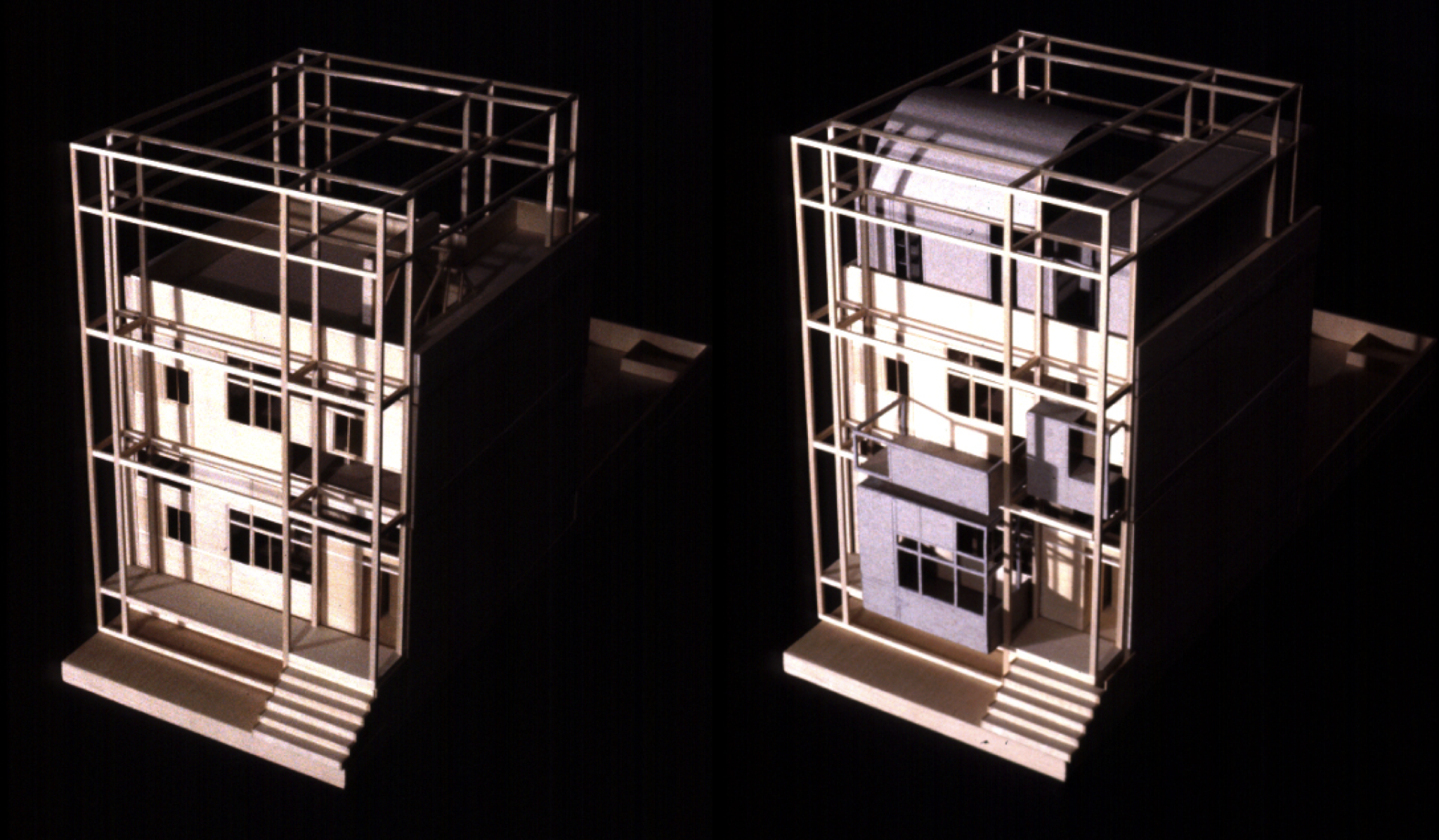
A competition entry I worked on as a student working with konykarchitecture for a new prototype for Atlantic City Housing (New York City, 1995). Working with “industry” in my second year of architecture school.
A few years ago, at a design event in Delhi, I met a talented and well-known architect who had hired a few of my interior design graduates in the past. In fact, a former student was working with him at the time, so I naturally asked him how she was getting on. He acknowledged that she didnโt come in with a huge bank of knowledge (especially being an interior designer working for an architect), but he was fine with that; he liked that she was thoughtful, hardworking, eager to learn, and never turned down an opportunity to work on tasks that were beyond her initial skillset. It was her attitude that impressed him, more so than her skills or knowledge.
I was really happy to hear this. It was a validation of everything I try to do as an educator. I know full well that thereโs a lot of pressure on academics to prepare students to meet industry expectations even though no one can really agree on what that actually means. Instead, I try to focus on making my students adaptable, confident, courageous, and willing to learn. That will help them far more than grooming them for any particular industry. I left that meeting thinking that itโs better to groom my students for such employers rather than what some vague and nameless industry is actually looking for.
Above everything, itโs not even really fair to use the word industry when weโre talking about design and architecture. My friend and long-time colleague Tapan Chakravarty prefers to use the word profession instead and I agree with him. Designers are professionals after all, and while thereโs nothing wrong with industrial labour, weโre not grooming designers to be factory workers. On the other hand, most of what I want to write today is not just about the design profession, but all the related disciplines associated with it โ builders, contractors, labourers, vendors, artisans, engineers, brokers, and so on โ all of whom collaborate with designers in some way. The only easy way to classify them all is the word industry so with apologies to Tapan, Iโll keep using that word for now.
Academia and Industry – An Unbalanced Relationship
As a full-time academic, when I have conversations about the relationship between industry and higher education, I admit I tend to get somewhat defensive. Thatโs because it always seems to boil down to a one-way relationship, focusing on what industry expects of us and how weโre meant to churn out employable graduates to be gobbled up by the work force. It always seems to be about what we can do to serve industry, and not enough conversation about what industry can likewise do for academia, except to act as jury members and examiners, and occasionally as advisory board members. Even these functions tend to place academics in a bit of subordinate role to industry, as if weโre desperate for their acceptance and approval. This shouldnโt be the case. The relationship between academia and industry should be more balanced and equitable, and it should be mutually beneficial with neither as subordinate to the other.
I sometimes get the impression that industryโs expectation of graduate readiness assumes that colleges are simply vendors who provide a necessary product or service for the industry to use or consume. I jokingly worry that if my graduates donโt meet a certain standard, employers will ask me for a refund. Of course, no one ever does, but I have read many articles and listened to many employers complain about colleges not providing them with graduates who have the necessary skills and competencies to do the work expected of them. I find this dynamic interesting because in academia, thereโs an ongoing debate about having to treat students as โcustomersโ to whom weโre beholden to provide a certain standard of service. Are we similarly beholden to industry? Is industry just another customer who is always right?
And why is there such a strong focus on industry readiness? Colleges themselves fall into this mindset, literally promoting their educational brand as making students industry ready. But what is industry readiness? Is that even possible? Thereโs no monolithic and singular industry which has a standard set of requirements. The design industry itself is famously varied in terms of employment scenarios. A design graduate is as likely to work for a two-person boutique firm as a giant multinational corporation. How can higher education make students ready for industry that has such a wide and diverse playing field? Not to mention that many design and architecture graduates end up working in different disciplines altogether, and thereโs nothing wrong with that. So preparing students to meet a wide variety of industry expectations with just one standard curriculum is exceedingly difficult.
Another problem we face is funding related. Universities used to be hotbeds for innovation (and still are, in some few cases). Most of the ground-breaking research and innovation in a given field used to happen on a university campus because it was the place where one was free to experiment without ordinary constraints of time and profitability. Industry (and other stakeholders like government) used to fund innovation on university campuses extensively. Nowadays, with a strong focus on start-ups and in-house innovation cells, most of the real innovation is happening in the corporate or VC sector. And in any case, such financial support rarely ever reached design schools in any real way. Universities and design schools have become employment factories instead, because this is what both students and industry seem to want. A four-year design programme has become a venue for learning a set of basic technical and software skills, along with grooming for corporate recruitment and training.
On the one hand, academics are urged to be funding-agnostic, because education shouldnโt be transactional, even though it often appears that way. We have pressures to be egalitarian and provide equal opportunities to underprivileged students via scholarships and fee waivers. But with no other sources of revenue in the traditional private education model, how can we simultaneously reduce fees and also spend money to cultivate cutting-edge innovation? I remember my time as a Dean, having to balance a budget between paying high salaries to attract good teachers and providing adequate workshop infrastructure (adequate, mind you, not even cutting edge) while simultaneously ensuring that all students were treated fairly and given equal opportunities to learn by keeping fees reasonably low. Industry doesnโt have such a burden to be egalitarian; they hire whomever they want and pay whatever the market can bear. Of course, industry does have to face the ups and downs of economic cycles, but then again so do private colleges. There are lean years in educational enrolments as well, yet weโre still required to provide the same quality education regardless. So whereโs the room for innovation in this tight financial model, without other sources of funding? Whereโs the angel investor for academia, especially in a country like India that has no culture of alumni fundraising?
Finally, thereโs a proprietary problem. Even if colleges manage to secure investment or participation from a certain industry player, weโre bound to align with only that company because of competition clauses. If we collaborate with Pepsi, there will surely be a no-competition clause that prevents us from taking up a similar project with Coca-Cola, should the opportunity arise. If we get HP to set up a computer lab and promote it, we wouldnโt be allowed to do a similar promotion with Dell or Apple. This kind of exclusivity could potentially become more constraining than having no support at all.
What Industry Should Do
In general, I think industry could do more. I think industry needs to look at academic collaboration as an investment. If they can integrate more into academics across the board, they can reap a richer benefit than simple industry readiness which is actually a meaningless term. In particular, design has historically been an apprenticeship discipline. But now, employers expect graduates to be readymade designers or architects from the get-go. Design education will always be incomplete in that regard, and employers need to stop holding graduates up to an impossible standard. I once had an architect recruiter complain that my student didnโt know how to select proper door hardware, and I couldnโt help but wonder what kind of employee was this person actually looking to hire? When I graduated, I barely knew anything about doors, let alone door hardware. Thatโs what job experience is for. If, as a teacher, I have to spend my precious class time focusing on information thatโs anyway likely to be obsolete by the time my students graduate, then when will I teach them what I actually think they should learn โ conceptual thinking, observation, research skills, ability to reflect, eagerness to learn?
I think lately too many employers in design and architecture have absolved themselves of the responsibility to supplement a graduateโs academic knowledge with professional knowledge. They are expecting readymade, industry-ready graduates when such a thing is actually impossible to create, because thereโs no single industry profile for which they can be made ready. Employers instead should fill in those gaps, and they should accept that graduates should be taught more for eagerness to learn than for knowing all the skills necessary to sit at a desk in a design studio and start working on projects from day one.
The industry should also be more open to collaborations with academia, more than what they currently do. They should initiate projects (like competitions) that have more flexible timelines and criteria so that students can plug into them within the constraints of their academic calendar. Certain company staff can be given dedicated roles as academic liaisons (not just as recruiters and trainers), so that such collaborations can be more meaningful and integrated. Companies should also be more willing to go beyond collaborating with only the โtopโ design schools, which actually make up only about a very tiny percentage of the aggregate pool of design graduates.
What Academia Should Do
But the burden isnโt only on industry. Academia can also do more. The first step is to relinquish the subservient mindset and put themselves on equal footing with industry. Professional guests and collaborators should be treated as equal partners, not VIPs or royalty. The second step is to break the โblame chainโ and avoid turning about and complaining that schools are the problem. Too often, Iโve heard my academic colleagues complain that schooling has done a poor job of preparing students for college. This may in fact be true, but it doesnโt help to sit on the sidelines and complain. If we expect industry to collaborate better with higher education, then higher education needs to likewise offer to collaborate with K-12 schools, and not just as feeders for admissions. I remember getting excited a few years ago when one of my colleagues initiated a program to train school teachers to teach design thinking. Unfortunately, that project didnโt fully take off.
Another step is to allocate dedicated faculty to act as liaisons with industry, mirroring the same staff members on the industry side. These academic liaisons should be faculty themselves, not corporate staff, so that there can be smoother integration with the curriculum, which only the faculty know well. Of course, these faculty should be given the bandwidth (and authority) to do this work, not on top of their existing teaching loads. Every teacher doesnโt have the ability or even the ambition to become a Department Head or Dean. So such alternative roles can provide additional pathways to professional growth. I have yet to see a design school in India (to my knowledge) with someone in the position of โAssociate Dean for Industry Outreachโ; this should be a role in every design school from inception.
Academies also need to restructure their curricula to allow industry to fill in the gaps where they potentially have more expertise and opportunity, in subject areas like technology, leadership, management, or entrepreneurship. Colleges too often try to offer everything in one package but this isnโt possible, especially for smaller design schools that donโt have diverse faculty resources. Curricula should be designed to be flexible in these subject areas and allow students to learn the competencies in ways other than the traditional classroom setting, and no, the typical internship or training period is not the only answer. Live projects, consultancies, and other opportunities should be given a higher priority than they currently have in a design curriculum.
Finally, incubation needs to be given proper resources and attention. It canโt be just a co-working space in the corner of a college campus. Colleges with good incubation cells have fully integrated them not just into their campus space, but into the curricula as well. I once visited some former students who had set up their own practice a year or so after graduation. They were set up in office space not 5 minutesโ drive from their former campus. I asked why they didnโt take advantage of the newly set-up incubation space on campus itself. Their answer was that they were anyway using space in the factory owned by one of their parents, so they were able to use the space rent-free. Plenty of other start-ups similarly begin in private homes, in basements, attics, and garages. My students didnโt see a value in the college incubation cell because they only saw it as discounted office space, which they didnโt need. But incubation has to be seen as much more than that. My students ideally shouldโve been aware that, in being part of the incubation cell, they would have access to shared infrastructure, resources, and faculty mentorship, as well as a pool of in-house student talent to help them with their projects. As alumni, they could have been industry mentors for their junior classmates while providing valuable opportunities for live projects built into the studentsโ curriculum, all of it outside the traditional internship model. In my opinion, this was a lost opportunity.
What Students Should Do
Of course, students themselves need to see the value of meaningful industry collaboration. Many students, especially in India, are so dead set on getting a lucrative job after graduation that they tend to miss the most of what college is teaching them. Students seem to want to learn the skills to land that first job, exclusive of almost anything else. Their mindset also needs to look beyond the โjobโ as the only way to fulfil career aspirations. A job is all well and good, but there are so many other career experiences one can follow to achieve professional growth. Design students should be made to see the career value in research, writing, business, entrepreneurship, and other aspects of life that are tangential but related to their chosen design discipline. Getting hung up on learning X or Y software suite can be a waste of energy and attention in college. The deeper learning is about independence, decision-making, communication, articulation, reflection, observation, time management, task management, and myriad other parameters that are what the design industry is actually looking for, beyond simply X or Y software proficiency. Design education (like the profession) is more than just an aggregate of skills, and if industry needs to accept this, then likewise so do students and faculty.
This article may come across as being overly defensive, but Iโve also tried to offer solutions to the problem of industry-academic mismatch. Both sides of this problem need to see each other less as vendors or customers and more as partners and collaborators. Indeed, this is what many academicians and professionals say they want to do, but there are things they can initiate that can make this easier. Mindset change is the beginning of it, followed by real (not superficial) integration and cooperation. Either side canโt just add collaborate to business-as-usual; the fundamental model must significantly change.
THOUGHTS ON THE MANUAL/DIGITAL DIVIDE IN ARCHITECTURE EDUCATION
Yesterday I read a post on LinkedIn from an architecture student (or perhaps a recent graduate) who called out architecture schools for being hypocritical about sustainability. The example she used was the common requirement for printing out multiple large sheets of paper for project presentations, both during the project and at the end of it. Most of these sheets are submitted and then discarded after some time, and whether they get recycled or repurposed is questionable. The same was said about the materials used for model-making and workshop assignments: wood, paper, plaster, foam, clay, and sometimes concrete, brick, paint, plastic, etc.
She has a point. One of the clearest visual images of any architectural school is the view of large quantities of materials swept up at the end of each working day and piled into overflowing garbage bins. On the one hand, thereโs a romantic association with these images โ they imply productivity, creativity, activity, and represent experiential and practical learning. For a teacher like me, itโs actually a joy to walk into a studio and see such a mess every day. But it does have its cost in wastefulness.
The deeper point she was making was that with the rapid advance of digital tools, why do architecture schools still require physical sheets and models to be produced in such vast quantities, all while chirping about waste reduction and conservation of resources in the building industry. Many commenters agreed, and sharply pointed how backward some institutes can be with respect to digital presentation tools. They pointed out how the COVID pandemic proved that we could get along fine with digital-only tools. Online learning forced us all to admit that we can indeed present and review digital design work without a loss in learning.
But is that really true? And is a shift to digital tools and presentations actually more sustainable than physical drawings and models? I question the premise of this, and Iโd like to address this supposed claim of hypocrisy on two fronts โ physical and metaphysical.
THE PHYSICAL FOOTPRINT OF ARCHITECTURAL PRESENTATIONS
Iโve done no direct environmental studies of the impact of paper sheets and physical models used in architecture schools. Let me disclaim that right away. (But then again, neither did the student who made the claim in the first place). So, I wonโt go deeply into carbon footprint calculations or estimates of greenhouse gas emissions. But many peopleย haveย done the work and the consensus is that, while paper does generate a lot of waste in landfills, it also contributes only 1% towards total global greenhouse gas emissions. Iโm not saying itโs so small that we should ignore the problem, but there are way bigger issues to deal with first โ transport and vehicle fuel is the biggest culprit, along with electricity generation, construction, and a host of other sectors.
By comparison, the contribution of the ICT sector (digital communications, etc.) to greenhouse gases is 6%. Looking at life cycle costs of paper vs. digital rather than just the landfill component, the claim that digital presentations are more sustainable than paper sheets becomes more dubious. And while we now realise that recycling isnโt the solution we all hoped it would be, we do know that one of the easiest materials to recycle is the paper and cardboard we use for drawing, printing, and model-making.ย
For a roughly calculated example of this, letโs look a typical jury presentation day in an architectural college conducted in two different waysโฆ an entirely digital presentation and an entirely physical presentation. Assuming 6-8 hours of presentations by 15-20 students, we can look at the following carbon footprint impacts (measured in carbon dioxide emissions, CO2e):
A digital presentation requires a large 42-60 inch LED screen or projector, and at least one laptop or desktop computer to run the presentations. Based on current calculations of energy usage and assuming coal-generated power, the electricity alone generates about 1kg of CO2 emissions (more for a projector because of the bulb) for the day. But if you also consider the cost of the internet, servers, cooling of rooms that contain the servers, and everything else in the background that makes the presentation possible on that day, that number can go as high as 25kg CO2e.
And what if the presentation was done entirely online via videoconferencing, like weโve been doing during COVID? Thereโs no LED screen or projector needed anymore, but we have to multiply the number of devices by 20-plus and multiply the data transfer accordingly. The carbon footprint goes even higher. (Estimates of the carbon footprint range from 0.1 to 1kg per hour depending on how long the camera is on.) So weโre potentially at 30-40kg CO2e for a full day of online presentations.
That number can obviously be reduced a lot if we consume energy generated from non-fossil fuels like solar panels or wind, and in fact this is where our emphasis should be. If weโre teaching entirely on campuses in person, then campus buildings should be converted to solar power, like they are at the college where I currently teach. If weโre teaching remotely, then individual homes should go solar, like my wife and I did in our own home. Or the entire grid should be made renewable, if we do it at the infrastructural level.
By comparison, the amount of paper and cardboard that might be generated for one dayโs jury presentation by 15-20 students can be roughly estimated at 2-5 kg (assuming students print out sheets as well as documents of their research and detail drawings). If big site models are made with lots of cardboard contours, then slightly more. Estimates for the carbon footprint of paper (including production and transport costs) give us a carbon footprint for this dayโs presentations of about 5kg CO2e, about one-fifth the footprint a purely digital presentation on campus, and up to one-eighth of a strictly online jury. Plus, most of that paper and cardboard can be recycled and/or reused. One factor that would increase this footprint, however, is accounting for the energy consumption of plotters used to print such drawings (as well as the transport cost of going to the print shop to get them printed in the first place). But the overall footprint is still much less than digital.
Since many presentations (before and hopefully after COVID) will likely be a blend of physical and digital presentations, we may actually be having the worst of both worlds. A constantly running LED screen showing digital renders with simultaneous printed sheets of orthographic drawings pinned up on a board is a likely scenario. So it may not be an either/or question. It may have to be a compromise.
One of the things Iโve personally done to reduce the consumption of paper is to eliminate the need to print every single stage of the project journey. I usually require all my students to produce a Project Portfolio, a 100+ page document which contains all of their research, progress work, sketches, diagrams, references, and technical drawings. These usually donโt need to be displayed in an exhibition or jury situation; theyโre primarily kept as a reference. These are usually heavy printouts, and if we restrict the printed material to large sheets alone (for better visibility of orthographic drawings) then the carbon footprint of that single dayโs presentation can be reduced tenfold.
We can also ask students to make physical models out of recycled or recyclable materials like wood, paper, and cardboard rather than plastic, foam, or metal. And if non-fossil fuel power supply becomes more the norm, then even the digital footprint can be reduced simultaneously.
But the main reason why I still like to see orthographic drawings printed large scale and pinned up on a board is that architectural plans, sections, and elevations can be complex and layered drawings. I have yet to see a floor plan shown on a digital screen where I didnโt have to constantly zoom in to see the details. Seeing a plan or section on a sheet that I can see in its entirety as well as in detail is critical for giving feedback on things like layout, proximities, adjacencies, etc. And seeing plans together with sections, elevations, and 3D views is also critical so that I can orient myself in the space the student has designed.
Am I being nitpicky and old fashioned? Perhaps. But seeing an architectural presentation on a sequential series of disconnected digital slides is nowhere near as clear as seeing all the drawings and images together in one place, at a large scale. Iโm constantly asking students to โgo back to that slide, now go back to the other slideโ. The overall image and impression of the project is fragmented and disconnected. It takes me far longer to understand and โgrokโ the project this way, and I donโt think it solely has to do with my age or generation. A huge 1m x 2m panel where one can see all the project images at once allows anyone to see and appreciate the project holistically, which is (presumably) the way it was designed.
THE METAPHYSICAL NATURE OF DESIGN EDUCATION
By far, the larger debate of using manual vs. digital is ideological rather than practical. Very few people bring up the sustainability issue; people seemed more concerned with the philosophical viewpoint. And itโs a fierce debate, with many accusations and stereotypes thrown around in a chaotic fury. The debate often falls along generational lines, but not necessarily so. And I think itโs no longer strictly a binary argument between manual vs. digital. The reality of technology and the internet has forced the discipline to shift strongly towards the digital side so that the debate now occupies the spectrum between hybrid vs. all-digital, with most people arguing just how hybrid it should be.
Iโm not going to rehash that debate here; there are plenty of articles for and against. What Iโm only going to advocate is that purely digital is to be avoided, not just for the sustainability reasons I outlined above, but also on metaphysical grounds.
When I refer to metaphysics of design education, Iโm speaking about the intangible ways in which we perceive the existence and quality of objects, spaces, and materials. In design education, we teach about the materiality of things, the physical presence and mass of things, the fullness or emptiness of things. For architects, this is supremely important because even though the output of our labour is a set of abstract drawn instructions for someone else to build, the final outcome is still a physical building that is affected by gravity, light, shadow, and other forces. These forces are weak or absent in all but the most advanced digital modelling tools.
I want to emphasize that despite my age and experience, I donโt consider myself a dinosaur or old-fashioned (even though some may consider me so). I welcome new technologies in architectural representation. I graduated from an architecture school that was at the forefront of these technologies, and Iโve used digital tools throughout my career. They have a much-needed value and importance in the work we do. But theyโre not the entire picture. I consider myself a hybrid practitioner (as do many architects) and I tell my students that they need to master both manual and digital tools so that they can know when to use each in their own time and place.
One of the arguments in favour of all-digital representation I often see is when people point out that the vast majority of architecture offices no longer have drafting tables or modeling workshops. And itโs true that in most firms, the output is primarily and overwhelmingly digital. There are many architects of course that sketch and draw by hand, or make study models by hand, but the output that is paid for by the client in terms of deliverables is 99.99% digital.
My counter to this point is that even if professional architects are using primarily digital tools, most of them have used manual tools at some point in their education, and thatโs precisely where itโs needed โ during training โ to develop the metaphysical understanding of architecture. Even if an architect abandons the hand drawings over time, their digital skills will still carry over that manual sensitivity. A good digital drawing will have the same life, weight, and character of a manual drawing. A good digital model will be created with the understanding of the weight and assembly of components, and the proper texture of materials. A student who has felt, weighed, handled, smelled, and heard the difference between a slab of granite and a slab of wood will know how to apply each judiciously in a digital model, rather than haphazardly. A student who knows how the components of a wall are assembled, and how the elements of the wall are represented by hand on paper through line weight, pattern, and shading will know how the wall would actually be built on site.
Iโve seen the work of students who rely too heavily on digital tools in their presentations. Materials are applied randomly or thoughtlessly. Components are assembled in no real sequence. Cantilevers are projected impossibly. Columns are too slender and unbraced. Furniture is out of scale and proportion. These are all failings that occur when the jump to digital tools is made too early. An experienced architect can draw wonderful digital drawings and make beautiful digital renders, but they will only become beautiful buildings if theyโve understood the physical โ and metaphysical โ nature of what theyโre designing.
In the end, I do agree that architecture schools need to โwalk the walkโ in terms of sustainability, so Iโm glad that the LinkedIn user provoked a conversation about this issue. But I feel it has to go far beyond whether weโre printing and throwing away too many paper sheets. There are some compromises we can make to reduce wastefulness while still retaining the tangible and sensorial aspects of what we do. We should definitely embrace the advantages that digital tools give us, and we can also sometimes wax nostalgic about the way things used to be done. But we should do so without romantic attachments. As long as weโre still in the business of making physical buildings, there will be a need to be in touch with our physical understanding of architecture in its wholeness.
Choosing to make a profession out of academia has innumerable challenges – the bureaucracy, the workload, the unfortunate behind-the-scenes politicking, and of course the disproportionate compensation relative to oneโs perceived expertise. And then there’s the frustration of being unable to connect with students in a class or to motivate them. Indeed, many of my colleagues have left academia because of these challenges and I don’t fault them in the least. It does take a toll.
One coping mechanism that helps me deal with these challenges is to detach myself from the expectation of immediate gains and to seek satisfaction in the long-term results of my teaching, results which often bear fruit long after the student has left the classroom, well outside of my purview. No doubt, itโs a wonderful thing to see a studentโs discovery unfold before your own eyes, within the duration of a class or a semester. Itโs a great satisfaction to see that glint of an awakened mind, an imaginative thought, a deep reflection, or an innovative idea. But the absence of visible awareness in a student doesnโt necessarily mean that the teaching didnโt make it through, or that the student didnโt learn. The aftereffects of learning can sometimes be quite delayed.
Iโm fortunate that, for most of my own education (especially my design education, which I undertook when I was older and mature enough to notice such things), I was able to appreciate what I was being taught right at the time of learning it. But much of my appreciation also came later, as a working professional. Some of it happened when I became a teacher myself. This delayed appreciation isnโt a bad thing; itโs natural and expected. So as a teacher, I assume the same happens with my own students and Iโve stopped looking for immediate results. Most students donโt become talented designers overnight, or even within the few years of design school. Many young designers really start to thrive when theyโve had the time and space to build on what theyโve learned in school and supplement it with the knowledge and resources that come from the profession or further studies. As long as Iโve inculcated in them the ability to continue learning far beyond graduation, thatโs fine with me.
There’s no better example of this delayed outcome than the daily reminders of the accomplishments and achievements of former students in their current lives and careers. In my case, this is no exaggeration. Literally on a daily basis, I get some notification from somewhere (one of the few reasons I still appreciate social media) that a former student has done something good for themselves, for their clients, or for humanity at large. Sometimes this manifests as an award, sometimes as a successful project, sometimes as a new role or a job promotion. Whatever form it takes, it’s a reminder to me that I had some tiny part in that achievement, either directly as a teacher or mentor, or in my role as an administrator.
Six years ago, with great hesitation, I relinquished my role as a full-time teacher and agreed to become an administrator and academic leader. I say “with hesitation” because any teacher would know the sense of loss that comes with not being in a classroom day to day. But one of the things that propelled me was knowing that my impact, while indirect, was now broader and embraced many more students in many more disciplines. Teachers donโt often get a lot of appreciation (at least, not as much as they deserve), but the appreciation for administrators is even rarer. When students succeed, they may credit their teacher first and foremost, and rightly so. But rarely are academic administrators thanked for, say, framing a new curriculum, or requisitioning a new lab, or facilitating the hiring of good teachers. Occasionally, an administrator might be able to connect with some students directly, and that does make things better, but itโs more often that the efforts go unrecognised students. And that’s ok. Iโve made my peace with that.
The satisfaction instead comes from the quiet knowledge that you had some small part to play in a studentโs success, either before or after graduation, that small part is multiplied by all the student successes that happen year to year. By my own rough estimates, Iโve directly taught about 600 students in my overall career. As an administrator, Iโve overseen the education and graduation of perhaps another 600. All told, thatโs a lot of successes to have played a small part in, even if some of those graduates barely knew me, I did impact their education in some way, whether they were aware of it or not. And Iโm nowhere near finished teaching; I still have many years left in my tank, and many more students to come.
What keeps me going through the sometimes frustrating parts is the awareness that although most of the students leave my teaching not fully knowing the value of what they learned, some of them will likely figure it out over time. The delayed gratification that comes from deeply embedded learning makes it fruitful for me, and in many ways the fact that the outcome is delayed somehow actually makes it even better because you realise that the learning wasnโt momentary; it stuck with them and guided them when they really needed it, even if they werenโt fully cognizant of it. I advise my colleagues sometimes when theyโre really upset about a difficult batch of students, or angry at the โsystemโ, that this is really what teaching is supposed to do, and it works better when the learning materialises over time. One just has to be open to seeing it.