farewell, alok baraya

Sometimes in my cynicism I wonder if perhaps some human beings are just too good for this often unruly world. As if they don’t really belong here with the rest of us troublemakers, and they were only put here to give our otherwise sullen lives a bit of brightness and joy.

My friend and colleague Alok Baraya passed away yesterday from Covid complications, and he was one of those genuinely good humans who brightened our lives and brought us joy. This alarming Covid surge in India has suddenly hit too close to the heart and has taken away one of the most genuinely decent humans I’ve had the good fortune to know. I had recently spoken to him a few weeks ago about a potential teaching opportunity at Ashoka. We had a nice long conversation after more than a year of not working together and of no longer seeing each other every day. We made plans to meet in Delhi after this current incarnation of Covid went back into its cave to hibernate. Now this same ugly scourge has taken away that chance. We won’t meet in Delhi. We won’t meet in Jaipur. We won’t go on our long-planned retreat in Rajasthan that we had been talking about for years.

When Alok joined Pearl Academy some four years ago, he became part of our leadership team as the head of Institutional Affairs. It took me some time to figure out exactly what his role was in this newly minted position, but it took me no time to take an instant liking to him. Here was this tall, handsome, gregarious fellow who got along with everyone and quickly became one of the ever-present smiling faces in a multitude of group selfies taken after meetings, lunches, events, workshops, and other such lively affairs. When he eventually transitioned into the role of the Delhi Campus Director, I pitied him because I knew it was a thankless and stressful job. No doubt he would be a great public face to the campus and a good co-manager of our faculty, but I couldn’t bear the prospect of his gentle heart and glowing smile being dimmed by having to extinguish a constant stream of small fires that a Campus Director must always deal with. But he thrived (of course) and his smile never dimmed (of course).

Alok, myself, and other dear friends in Independence Day colours, pre-meeting (photo courtesy of Priya Mary Mathew)

I will remember countless discussions with him about life and work. His office was just a few doors down from mine and it was a solace sometimes to just sit with him and unload our mutual frustrations about working and teaching and ensuring that students would always get the best education that we could give them. I was an academic and a designer, and he was an administrator and management guy. These things don’t often mix well. But he lived in a family of creative people and he knew what people like me were all about and shared those sensibilities. He wasn’t a corporate guy. He wasn’t a money guy. He genuinely believed in academics as a noble calling and was genuinely involved in education for all the right reasons. He and I had many ideas about raising the level of discourse amongst our students and staff, to introduce debates to promote critical thinking, and to show how the idealism of design could co-exist with the pragmatism of business.

He wasn’t afraid to speak the truth either. Once, in a particularly frank team-building workshop, he asked me why I always tended to find fault with everything and why I had to always take the stance of the contrarian in administrative discussions. It was a harsh truth spoken with civility by someone whose opinion I valued, and it really made me reflect about myself and made me want to change. I’ve never been apologetic about being a contrarian because the world needs that, but his honest and well-meaning critique made me think about how my message was maybe getting lost in my idiosyncrasies.
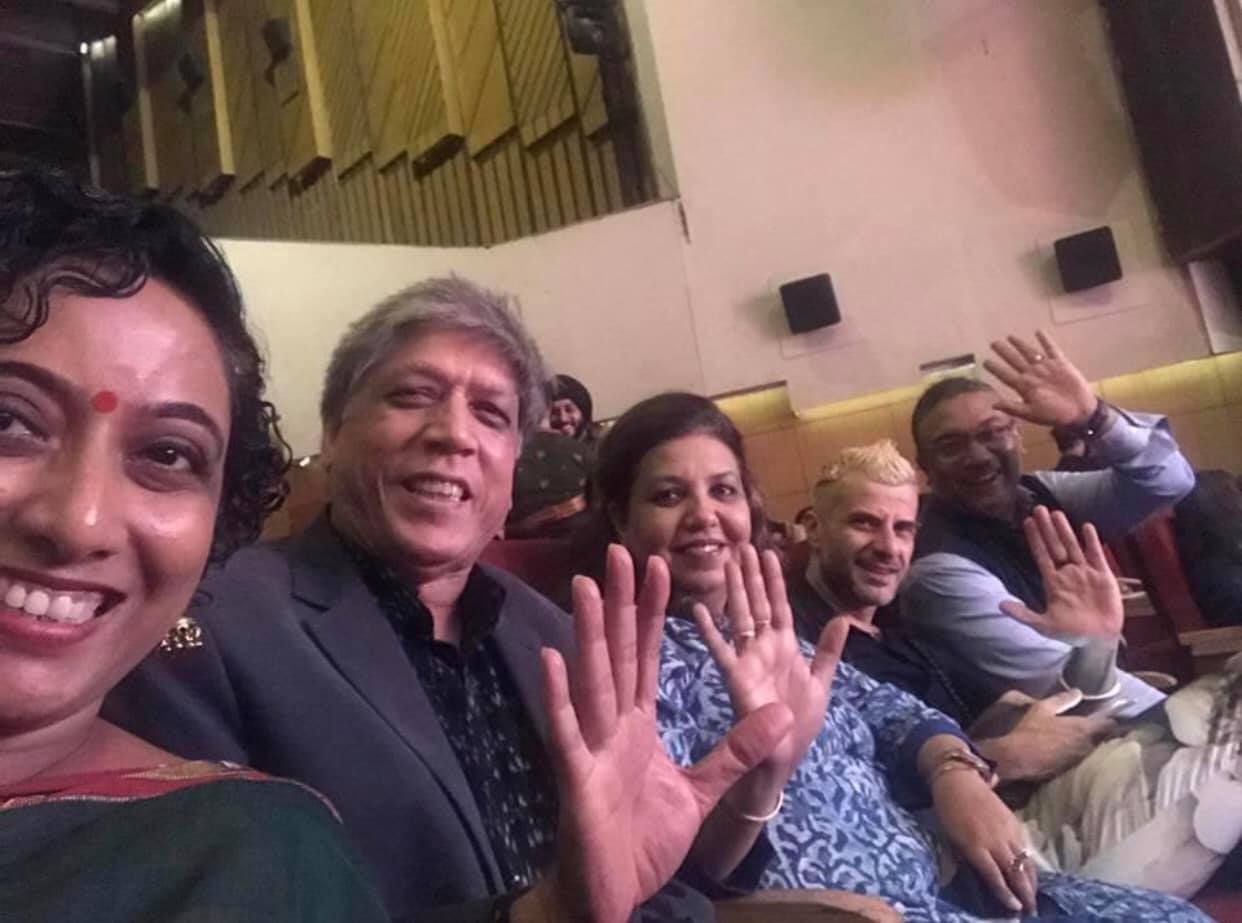
Photo courtesy of Priya Mary Mathew

More often though, we were in sync and if there was something we felt needed to change in our organization, we tended to agree with each other and worked together to fix it. He was much better at it than me, because he was smarter, more pragmatic, more eloquent, more diplomatic, more concise, and far more charming to boot. I was glad to have him on my side on more than a few occasions. He made my job easier and was a pleasure to work with. It was only natural that we would also become friends as well as colleagues, and I will treasure that.

My heart reaches out to his family – his wife and children whom I’ve had the pleasure to meet. I may have lost a friend – a true gentleman, and a kindred spirit – but they have lost a son, a brother, a husband, and a father. I also considered him a big brother in many ways, but I offer my prayers and condolences to his bereaved family and I hope that Time is compassionate to them and allows them to heal soon. To Alok I say only that I will miss you, and that you were a good friend to me and many others. Godspeed.

a remembrance of trimlines past

Image for post
Photo courtesy of Night Flight (Facebook)

A few days ago, the image of this famously well-designed Trimline phone (designed and manufactured by Bell Telephone’s Western Electric division) came up on my social media feed. Instantly, like Proust’s beloved madeleine, it triggered a cascade of sensory memories from the time when this phone used to hang on the wall of almost every household in America. That was back in the late 70s and early 80s, which was a time of great transition for my family. That was when we moved from the city to the suburbs, into our own first house, with our own yard, and our own kitchen, on whose wall this phone had hung, from the time I was in 6th grade until long after I moved out for college.

I remember the smoothness of the moulded plastic and the exact weight of the handset in my hand. I remember the feeling when you were slotting the base into the wall backplate and it slid snugly into place. And the sharp click that the cord would make when you plugged it into the RJ11 modular jack. I remember the springiness of the lighted number buttons, and how I would push it down and try to find the exact moment when the light would go off, and then try it again, and again, with each number to see if it was the same for all of them. (It was.)

I remember pushing the acrylic hang-up lever on the base, while keeping the handset to my ear. I remember the exact amount of light-fingered pressure it took to push that lever down and disconnect the call. I pushed it down while listening so that I could find the exact moment when the dial tone would go silent, and to see if there was any tiny auditory transition between the dial tone and the absence of dial tone. (There was.)

I remember the additional hang-up button on the handset itself, just below the numbers. In the beginning, this was used to disconnect the call while you were far away from the base, and then begin another call. Later on, when technology and features had improved, pushing this button allowed you to switch between callers that you kept on hold. I also used to wonder why there were more holes in the mouthpiece than in the earpiece. And why the earpiece holes were arranged in a circle and the mouthpiece holes were arranged in a square. I still wonder. I’m sure some engineer can tell me. No one told me back then. (I never asked.)

I remember peeling the plastic display cover off with my fingernail so that I could take out the slip of paper underneath and write our home phone number on it in neat letters. I don’t know why we bothered to do that… we knew our home phone number better than we knew almost any other detail about our lives, aside from our names. I still know it. That was my parents’ number for 36 years even when we moved to a new house in the same town. I guess the number was there for guests, although I don’t know why a guest would need to look at our phone to know what our number was. All I know is that it was always my job to write the number on every new phone we got, because I had the best handwriting in the family, and to make sure the tabs on the thin plastic cover didn’t break when prying it off. (They never did.)

I also used to resent when I’d go to other people’s homes and they hadn’t bothered to write their number on the phone. Or even worse, when they wrote it sloppily, like when you start out with the numbers too big and then you run out of room, so the last few digits are too small to read, curling down in a weird spiral. I never made that mistake because even though I didn’t know it yet, I was a future architect, and I paid attention to things like that. But I don’t know why it bothered me when others didn’t do it. Maybe because they didn’t take their phone seriously enough; it was just a device to them, and probably a temporary one at that. People used to go through phones a lot back then for some reason. (Not us.)

I wonder if that was the real reason why we’d write our home number on the phone in the place where you were supposed to. Because it signified ownership, long-term ownership, serious ownership… of the phone and everything it meant to us. Once we wrote that number in that strip, the phone was now ours forever and all the myriad calls that came to us — the mundane calls about directions to people’s houses, or the more serious middle-of-the-night calls when someone overseas was calling to tell us that some important family member had just passed away. (We were always momentarily anxious when the phone rang in the middle of the night.)

I remember as well the cheaper knock-offs of this phone that weren’t made by Bell, but by some other lesser brand that you’d buy at CVS or Kmart. Those phones looked the same, but they didn’t in any way feel the same… they didn’t have the same weight or solidity, or the same springiness in the buttons, or the ringing sound it would make when you’d slam the phone down after an angry phone call. The Trimline phone (like all phones that were made by the telephone company) was built to survive the angriest phone conversations you could ever imagine. (And yes, I remember those too.)

I also remember the weight and tension of the spiral cord, and the constant effort it took to keep it untangled and not over-stretched. Over-stretched cords used to bother me; they ruined the perfection of the tensioned coil, hanging lightly and cleanly from the phone on the wall, and the utility of it staying compact when the phone was at rest. And untangling the cord always meant holding it by one end and letting the handset dangle and twirl around of its own gravitational will until the cord hung clean and straight, coiling back to its tensioned potential, waiting to be stretched out across the entire kitchen again, whenever my mom needed to talk and cook at the same time. (Why didn’t they ever put the phone connection near the kitchen counter and stove, I wonder.) And sometimes, when we knew this would happen a lot more — when we acknowledged our relative middle class prosperity by moving into larger and larger kitchens — we would subsequently splurge on longer and longer cords (six feet! twelve feet! fifteen feet!), allowing a working mother the freedom to multitask and socialize on the telephone while simultaneously preparing the family meal. (Which was every single day, of course.)

If you had to get a new cord (either because it was longer, or because it got over-stretched), I remember that it was tough to match the colour of the cord to the phone, unless we got it directly from the phone company, of course. I guess this is why we always had fairly non-exotic colours of telephones in our house… Dark brown is the one I remember the best and the one we had the longest, across multiple households and kitchens. We didn’t have the fancy olives and oranges and blues and reds like phones in the houses of my other American friends, my non-immigrant friends. We had a a dark brown phone, the same colour as our kitchen cabinets. The same colour as our sofa set. The same as our stained wooden doors and cedar shingles. And it was the same colour as us. We were our Trimline phone… brown and solid and plain and simple.