inclusive habitation in indian cities

THE NEED FOR RETHINKING URBANISATION IN THE POST-BOOM ECONOMY

[A version of this article was recently published in “What’s Next: The Creative Spark”, a book of essays chronicling an event of the same name held in Mumbai in February 2019 organised by Pearl Academy. Click here for more info on Pearl’s well-received “What’s Next” series of confluences .]

Raising the Alarm: India’s Housing Crisis

“Cities that adopt a strategy of inclusive prosperity now still have the power to transform their communities and neighbourhoods into more open, equitable, and profitable places to live.” – Amitabh Kant, CEO Neeti Aayog

An internet search of “indian housing crisis” will uncover a disturbing array of cautionary tales and doomsday scenarios, and amongst all the data, one can find two grim statistics revealing a paradox in understanding the nature of the exploding urban population of India.

The first statistic is that, as of February 2016, there are almost 700,000 unsold homes in India (Mukherjee, 2019). This is apparent to anyone who drives past the unfinished hulks of luxury high-rises along the fringe highways of Indian metros. The second statistic is that, as of November 2017, there is an urban housing shortage of about 10 million units (Economic Times, 2017). The paradox: India has been unable to house millions of (mostly poor) people while simultaneously overbuilding housing for the wealthy.

This reveals an uncomfortable truth about how we’ve dealt with India’s rabid (and rapid) urbanisation and the imbalanced benefit for the entire population. This is a well-reported problem, and indeed there are already several public and private schemes that are attempting to correct this unnerving disparity. But where does the design community fit into this? Can creative professionals provide any solutions?

Grass Roots Action: Academics and Designers

Indeed, this problem is largely the responsibility of policymakers. Most designers, architects, and urbanists are only able to contribute to projects for which they’re hired, and usually don’t have extensive control over policy decisions at a metropolitan scale. But there can certainly be an effort to foster a sensitivity towards such socioeconomic imbalances, perhaps starting with professional academic institutions. The graduates that enter the workforce as young professionals may not have a strong voice in the way their projects are run, but they can surely plan their careers to find opportunities to deal with urban disparities. Many colleges are themselves located in urban areas where these disparities are highly visible to everyone. So, there’s a potential to sensitise new generations to first become aware of such problems, and then to encourage them to try and solve them.

A striking reflection of my academic experience in India thus far has been that even though my students have often come from privileged backgrounds with a lack of active exposure to ‘real’ urban issues, by the time they complete their academic programme, their sensitivity towards the needs of the underprivileged becomes more pronounced. Many of the graduate thesis projects I’ve encountered have been focused on improving the lives of children, the elderly, the poor, the disabled, and other underprivileged and marginalised populations. This implies that higher education, working together with industry, can be a strong support in developing the necessary sensitivities.

But with so many issues at hand, it’s difficult to prioritise the most urgent needs of urban India. In my experience as a teacher, I’ve been happy to see many socially sensitive projects including packaging for the blind, apps to increase sexuality awareness, devices to assist with manure collection… the list goes wonderfully on and on. However, as an architect and urbanist, my most urgent concern goes back to the persistent inequity in urban housing policy, planning, financing, and design. If we don’t create more affordable, equitable, and sustainable housing for all populations, then almost all other efforts are meaningless.

Organisations like URBZ are another good example of grass roots efforts to bring creative solutions to urban housing problems. They focus on community-oriented solutions for slum improvement and have a strong user-centric approach to problem solving, engaging all stakeholders with an emphasis on the contexts of how people really inhabit cities, whether they are native-born locals or migrants seeking new opportunities. Such organisations are able to fill some of the gaps left by policymakers. Matias Echanove, co-founder of URBZ, says, “India has an endless opportunity to look within. Accommodation and mass housing are the first point of requirement for the rural exodus to the cities, aided by a well-connected transport system which facilitates this movement. Resource support and planning is required to maintain the health of urbanisation” (Echanove, 2019).

The Broader Challenge: Inclusive Habitation

However, large scale solutions still require the attention that only major policymakers can give. Besides academics and grass-roots organisations, where else can such matters be taken up by designers? The answer is uncertain, as there will always tend to be a divide between policymakers and design consultants. But there are two areas in which I believe we should focus our attention with respect to better urban housing.

The first is to radically alter the process of private property development in India’s metros. There is almost no synchronicity between commercial interests and socio-communal needs. Private development, which is the largest producer of housing units in urban metros, is almost purely driven by speculation and market trends. Thus, one tends to see rapid construction of massive housing schemes long before any real infrastructure or public amenities are in place. Scores of residential towers are built and sold first, while shopping centres, hospitals, bus-stands, metro stations, and other public amenities come later, only when there is a proven ‘demand’. This traditional demand-driven approach to urban planning has already proven to be ineffective.

Urban designers and planners know this and are trained to design cities that, from inception, provide a variety of public amenities needed for sustainable residential growth. They are also trained to make design decisions based on principles of design thinking, contextual research, user-centricity, and collaborative ideation. If policymakers (and private developers) choose to listen to what urban designers have to say, it will result in well-designed communities that consider the full spectrum of urban life, not just the living quarters and the garages.

The second area involves integrating a more diverse set of people to live in new developments. The great disparity between unsold luxury homes and housing shortage mentioned earlier happens because affluent home buyers were seen as the only viable market for large-scale residential development. Entire tower blocks of only 3-bedroom apartments serve only a narrow user profile and income group. When the whims of politics and economy cause a change in the fortunes of this narrow group, the entire real estate industry is impacted, taking years to recover. We’re undergoing that downturn now, and there’s no magic solution on the horizon to make things better. Developers and financiers are simply crossing their fingers and hoping that economic growth resumes to earlier levels and that upwardly mobile professionals start buying homes again.

Certainly, some municipalities have enacted legislation that requires developers of luxury apartments to provide a quantity of ‘affordable’ homes, usually to house the displaced slum-dwellers previously living on the property. But it’s questionable whether the needs of the displaced residents are being adequately served, let alone whether their living situations have actually improved.

But it’s not just the economically lower strata that need to be housed. There is a rapidly growing sector of young, single, college-educated urbanites from lower-tier Indian cities who have trouble finding suitable housing in large metros because: a) they usually need to find flatmates to share; and b) landlords are less keen to rent to transient populations. Many of these young professionals come to cities like Mumbai and Bengaluru for their first jobs and will only stay as long as the company keeps them. Many will find other jobs within a year or two, and often in a different city altogether. Many have to leave simply because they can’t afford the cost of living. Are any developers building housing for such people? Rarely. Some overseas cities have designed and built co-housing options for young professionals, but this isn’t the focus of Indian private developers, which is a short-sighted attitude. It’s financially unsustainable to view the entire housing market as only buyers of luxury 3-bedroom apartments. Designers and architects can help with this and provide innovative co-housing solutions for diverse groups of residents, allowing them a better opportunity to stay in their preferred city and not be priced out. This permanence leads to greater community ownership and engagement as well as the sustained usage of public amenities.

There is no greater truism proven by history than the fact that diverse and inclusive cities make better cities, for all stakeholders. The Indian urban development industry — property developers, investors, bureaucrats, community activists, designers, and planners — need to integrate better and follow a more collaborative and systems approach to decision-making, and ultimately understand that no community will succeed very long as a segregated island of residents with near-identical backgrounds. If rapid urbanisation is our new reality, then quality housing for all should be our highest priority.

References

Bellman, E. 2020. “India’s ‘Ghost Towns’ Saddle Middle Class With Debt — and Broken Dreams”. Wall Street Journal. [online] 16 January 2020.

Echanove, M., 2019. Keynote speech at “What’s Next: The Creative Spark”, February, 2019. Mumbai, India.

Economic Times, 2017. Housing shortage in urban areas down at 10 million units: Government. Economic Times [online].

Kant, A., 2019. Keynote speech at “What’s Next: The Creative Spark”, February, 2019. Mumbai, India.

Mukherjee, A., 2019. 673,000 unsold homes hold the key to India’s next shadow-banking crisis. Business Standard [online].
towards divergence in the age of automation

A CASE TO RECONSIDER THE GRADUATE PROFILE OF YOUNG DESIGNERS IN 21ST CENTURY INDIA

A large number of articles and research published globally in the last few years have spoken about the looming threat of automation having a major impact on employability in the near future. Automation — or industrialisation as it was known back in the early twentieth century — is, in fact, no new threat. Countless historians, both contemporary and latter-day, have talked about how the Industrial Revolution changed the way people work, and how the imparting of skills and knowledge in higher education took a radical shift towards better understanding of mechanised processes and of mass distribution of both products and ideas. Automation in this century has a definitively digital flavour and is akin to the previous century’s shift only in the quickly pervasive way in which entire societies and cultures were dismantled and created anew. We are in the midst of a major transition towards complexity and uncertainty in human interaction.

Research by the McKinsey Global Institute suggests that “Indian workers have a technical automation potential — the overall share of activities that can be automated by adapting currently demonstrated technologies — of 52 percent”. This is tempered by the same Report’s suggestion that, due to India’s infrastructure gap and other social issues, the change will be sectoral and evolutionary — not revolutionary. This implies that Indian industry has some time to adjust, and that job roles in the near future may not be replaced so much as changed. Working alongside automation will necessitate different learning at all levels of Indian education, particularly in professional studies at institutes of higher learning. This change is already being noticed at design institutes in India. A quick tour of any design school will reveal that workshops using traditional artisanal tools are not disappearing but are existing alongside more modern labs with cutting edge digital media and equipment. A lathe machine very likely sits in a room adjacent to a motion capture studio.

The Link to Academia

The impact this has on design education is at once significant yet unclear. The design industry in India is still widely divergent and no one is quite sure which direction the country will ultimately take with regards to specific employability factors. There are design firms partnering with local skilled artisans to promote dying regional crafts, and there are firms harnessing the power of computational design for rapid prototyping and production. Often this spectrum of work happens in the very same office, within the purview of a single design associate. Thus, design institutes must prepare graduates for this full spectrum of skills — they must appreciate the old with the new, often in less time than before, since employers have less and less time or resources to devote to the type of apprenticeship model that companies followed in the past. Employers want graduates with these attributes already baked in.

Where does that put academia? There has always been a perceived skill gap between academics and industry, no matter how many colleges partner with industry for live projects or to impart professional workplace skills. Does the gap widen with the necessity of adapting to automation? What exactly are the skills needed for this adaptation? What if the skills quickly become obsolete?

The report on Future of Jobs in India recommends embracing active learning, learner-centricity, and life-long learning. However, these attributes have been fundamental to design education from the start, so the implication is that design graduates are better prepared for the future than other disciplines. Further, the same E&Y reports suggests that Indian workers are well-primed for the ‘leapfrog’ effect in technological advancement, in which traditional evolutionary trajectories that the West followed may often be skipped entirely by the Indian marketplace. The telecommunications industry has been a good example of this, in which a large majority of Indians embraced cheap mobile phone technology well before landline networks were in place nationwide. Most of rural India skipped landline networks entirely and a majority of Indians across the socioeconomic spectrum now use mobile phones directly. This required divergent thinking.

Convergence and Divergence

Traditional learning systems in India have been largely convergent in nature, focusing on single, linear solutions for problem-solving. There is a correct answer somewhere and memory and logic will serve to find it. Design education, using divergent thinking, replaces this approach with an open-ended system of problem-solving, where the answer may lie in multiple and perhaps infinite solutions. Artificial intelligence now has the potential to do both our convergent and divergent thinking for us. Traditional computational algorithms use memory and logic to solve convergent problems far more quickly than the human brain, so fixed and formulaic solutions can be easily solved. Jobs reliant on this ability are already vanishing — counting, sorting, calculating, producing, searching, etc. are now firmly in the purview of simple computing systems (bin sorters, for example) as well as artificial intelligence (internet search algorithms).

As illustrated in an article published in The Atlantic, “[w]hen most people think of AI’s relative strengths over humans, they think of its convergent intelligence. With superior memory capacity and processing power, computers outperform people at rules-based games, complex calculations, and data storage… What computers lack, some might say, is any form of imagination, or rule-breaking curiosity — that is, divergence.” But advanced AI may even achieve this. As processing power improves and better understanding of machine learning and quantum networks leads to closer simulation of the human brain, then even divergent solutions can be managed by AI.

The Human Factor

Where humans still have a role is in experience, which is where divergent educational models come into play. With AI and automation increasingly being able to provide basic problem-solving skills, design students must grapple with the choice between specialisation and diversification, even if it’s just to remain ahead of the technology and innovation curves. Currently, there is a wide demand for design graduates to achieve broad, fundamental skills topped by specialised competencies in a particular subject area or market segment. Hence, we have architects who know how to draw, design, and render, and also have expertise in residential, commercial, or institutional buildings. A typical employer may, for example, be a specialist design firm for the hospitality industry and would demand architecture graduates to have some experience — even while in college — of understanding the needs of the user group related to hotels and restaurants. In India today, this characterises the bulk of the design industry — employers looking for graduates with fundamental skills in broad areas, with some level of competency in a specialisation (e.g., lighting, furniture, advertising, web design, etc.).

But this is starting to change. More and more design firms are starting to embrace the idea of ‘service design’, a divergent discipline in which the final design solution may not be known at all. So now, a design firm no longer gets commissions only from hospitality clients, but from clients who want a diversified solution to a broad-based problem. So, the solution is not just a beautiful hotel design, but unified designs for staff uniforms, menus, signage, amenities, fixtures, products, entertainment portals, websites, and communication systems, all preferably designed by the same firm, under the same roof.

In the past such work was distributed to a variety of consultants all working independently and not always aligned in purpose or even quality. Today, a client may request a designer to provide a brief for which the design solution is not known — it could be a space, a product, an app… What the solution actually will be could be one, some, any, or all of the above, and the designer must be ready to provide expertise in multiple disciplines.

The impact of this is profound and necessitates a complete change in how design education is currently conceived. A multidisciplinary approach cannot just be a feature of design curricula but must be its primary attribute. Students must be encouraged to be divergent thinkers by exposing them to design approaches outside of their chosen disciplines. Since the duration of design courses isn’t increasing to accommodate this wider learning, specialisation often has to take a back seat, but perhaps this isn’t such a bad thing. Specialisations that follow traditional silo divisions — lighting, furniture, web design, app design — are fading because design problems are growing more complex, and solutions are growing more divergent. Furniture is not just an object in space but can shape the space itself and can also have embedded technologies. Thus, a kitchen counter is not just a place to prepare a meal, but a place to have a conversation, with embedded screens and smart controls to provide information and data as well. The lines become blurred, so that a designer who sees a kitchen counter only as a piece of furniture to chop vegetables becomes quickly outdated and outpaced by the designer who sees many more opportunities for innovation.

Automation, for the time being, cannot fulfil such a function. Certainly, AI increasingly has the ability to observe patterns in human behaviour and suggest predictive outcomes, but the ability to use human interactive experience and associations still rests within the ambit of human designers. Prior to its launch in India, IKEA — a global company well-known for its innovative use of industrial automation — spent significant time in trying to understand the Indian consumer market by having individual employees visit 1000 Indian homes. This was not done by robots but by actual human beings who observed the way Indian families live and analysed the data.

The New Graduate Profile

There is clearly a need to consider both convergent and divergent thinking in design education. The traditionally desired graduate profile of a young designer — essentially a database of basic skills and knowledge — is no doubt important, but employers will soon rely on digital information systems for those attributes, and the young designer must embrace divergence in order to stay relevant — and employable — in the future. In turn, the design institute must develop curricula and pedagogy that fosters this approach and move away from stagnant models that require the student to develop specializations that may not even exist by the time they graduate. Forward thinking institutions need to amend their curricula now to accommodate this trend, and develop academic models that allow for not one, but multiple (and someday perhaps, infinite) graduate profiles that are flexible and adaptive enough to solve the multitude of problems that we can’t foresee. This in itself requires a divergent approach so that we can design the right design education for the twenty-first century.

[A version of this article was originally published in July 2019 in the blog for Pearl Academy, where I was until recently the Dean of the School of Design.]

dialogue drives design

I clearly remember the moment when my personality changed forever.

I was always in introverted kid. An only child for fourteen years, and an awkward immigrant for many more, it’s no mystery why, with my shy and nerdy inclinations, I sought refuge in science fiction and fantasy books. They were my world. Too young to leave me home alone, my parents often took me along to their social engagements, a thousand-page book my only company and a safe haven from overzealous grownups asking condescending questions. I was nowhere near a natural conversationalist, and I shied away from engaging in, let alone starting, any dialogue.

Before you get all sobby and sorry for me (“Awww!”), I should make it clear that I did have friends. I did go out and play (although less often after moving to the suburbs). It’s not like I was a recluse. I was just the kind of kid that would prefer to stay in the background of conversations and listen, and this was a trait that continued mostly through college.

Now let’s fast forward to that moment I mentioned, when things changed. It was the summer of 1996, and I was starting my final year in architecture school. My first year tutor, Prof. Craig Konyk, asked me to be his teaching assistant in our college’s Educational Opportunity Program (EOP), which was a program to offer the opportunity of a quality education to a different type of student. My college, New Jersey Institute of Technology, was (and is) a well-known technical institution with the only accredited undergraduate architecture program in the state. NJIT has a diverse student body drawn from many working class and immigrant communities of Northern New Jersey. EOP accepted students who were just below the threshold for standard admission, but it required a one-month residential summer ‘boot camp’ before they joined the rest of their cohort. The idea was to prepare them for the rigor of college life before they started college itself. Not only was EOP successful in bringing more socioeconomic and cultural diversity to NJIT, it often prepared the students better than the rest of their classmates, and many EOP students ended up being the stars of their class.

Anyway, I was asked to be a Teaching Assistant and all TAs had to take a one-day training session by the EOP management. The training was kind of like an informal team-building and problem-solving session and in one of the first exercises, they put us into groups to solve some kind of hypothetical problem. My group of five or six people — most of us doing this for the first time — started the exercise sitting in a circle and just akwardly staring at each other. No one wanted to be the first one to talk. This, in a nutshell, was exactly how all such interactions in my life had been thus far — waiting for someone else to take the initiative in group discussions.

But this time, something was different. Something in me just snapped awake. I don’t know what triggered it. Perhaps it was the four prior years of having to present my work in architecture reviews. Perhaps it was my emerging self-confidence in being a good design student. But I think the biggest factor may have been that I was now 26 — a full-blown adult — and simply fed up of the awkward immature silence in group discussions where nobody says anything.

So I began a dialogue.

I took it upon myself to be the temporary leader of this misfit group, and started asking people how we’re going to solve this problem. I didn’t realize it at the time, but it was the moment that would change my life forever because it was the moment that started me off on two pathways:

First, I think it was that moment in which I started my teaching career, although I didn’t become an actual teacher until a decade later. It was then that I realized that true learning only happens when you open your voice and communicate with others.

Second, it was the moment where I really started to appreciate the value of dialogue in design. When I say ‘design’, I mean it in the broadest sense — design as a way to solve problems — an act of creativity and innovation. I had of course already been doing this in my prior four years of architecture school, but I didn’t fully realize the importance of dialogue until that moment. I realized that creativity only really starts to happen when you take out that… thing… that is bottled up inside and release it to the world.

Design education is built on a foundation of critique. The ability to properly give and take critique is very crucial to the progressive growth and practice of design. And critique happens best through dialogue.

In later years, I came to learn of the Socratic method, and the dialectic in Buddhist scholarship traditions, as well as the pedagogy of ancient education at places like Nalanda University. All of these traditions (and many others) point to dialogue and debate as a means to develop and inculcate critical thinking. This is well-established as a means of strengthening knowledge by exposing one’s existing knowledge to an array of contradictory or polemical thinking. This typically results in a more balanced stance, and being able to adapt one’s knowledge to external critique.

Image for post
Design moves forward only when there is dialogue between participants.

Design requires critical thinking in order to work. It requires the ability to understand and adapt to external stimuli and changing conditions. A design curriculum in an educational institution should not follow a specific code of rules or formulas; neither should it merely be a checklist of skills. Design requires debate. Designers are constantly tasked with defending their proposals against contrary thoughts and opinions, and almost always have to change their proposals in order to make them work better, or make them more feasible, or innovative.

This is one reason why design education, as compared to other traditional disciplines like science or commerce, is often slow to adapt to an increasingly digital context. This is despite the fact that, in the current world of constant connectivity, communication, and exposure to vast quantities of knowledge and ideas, most design debate still happens in person. To be sure, digital technologies and social media have exponentially increased the opportunity for dialogue between people of different cultures, geographies, languages, and contexts. A typical design student in 2018 has the benefit of truly vast quantities of information that were relatively unavailable to previous generations. And indeed, this has opened up design to extraordinary new avenues of thought and innovation, both simple and complex. Western designers can be inspired by a YouTube video that highlights a simple design solution to illuminate homes of the poor in the Philippines. Meanwhile, the same platform allows a college student in India to listen to a TEDTalk at UCLA on quantum computing.

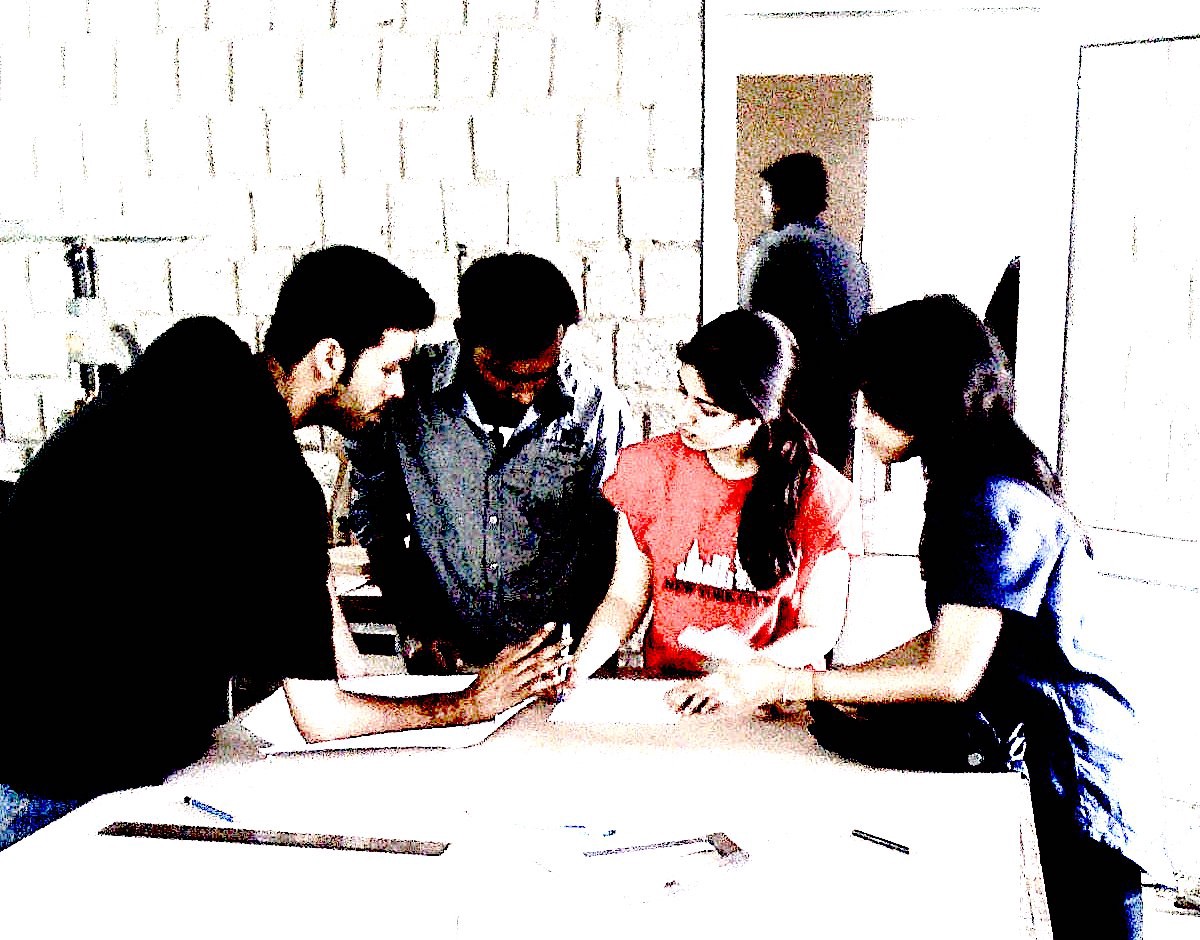
However, at its basic level, learning to become a designer still involves the simple dialogue that happens when two people sit at a table with drawings, sketches, models, prototypes and they simply discuss the problem at hand.

Image for post
The jury as a vehicle for dialogue.

The typical mode of feedback in design — the jury, or review, or pinup, and not an examination – is the primary means of assessing whether a design proposal works or not. Examinations, where a student provides a set answer to a set question and a typically faceless examiner in another room and place assesses whether that answer is correct or not, has little place in design education. In a design jury, a student presents his or her work, and a group of experts give their opinion on it, and usually provides suggestions on how to make it better. The group of experts don’t always agree with each other, and the students themselves don’t always agree with the feedback that is given. That’s all part of the dialogue of design critique, and it reflects how design works in practice as well. A designer is given a brief, works on a proposal, and shares it with the stakeholders (clients or users). They discuss, compromise, and sometimes argue and disagree, and they figure out how to go forward.

The result of this is that the student (and the professional designer) improves his or her design through dialogue, expands his or her knowledge, and goes through an iterative process that strengthens not only the quality of the design but the quality of the designer as well. The designer becomes more confident, more agile, and can better adapt to changing contexts. I might argue that indeed, this is the only way that a designer can become better. Good design requires validation for it to solve the problems it intends to solve, and dialogue can be the vehicle for that validation. Dialogue validates design. Dialogue drives design.

This not only facilitates a better designer, but a better person. A person who engages in dialogue shows that he or she does not have rigid ideas set in stone and is empathetic to the opinions and contexts of others. A person who engages in dialogue is often willing to take feedback, and to compromise and make adjustments to find real solutions. Thus, dialogue needs to be at the heart of any design endeavour, both in practice and in academia. (Fun fact: I believe this to such an extent that I named my own practice ‘DIALOG’.)

Image for post
Nothing beats sitting at the table and sharing ideas.

Many of my current colleagues and friends hesitate to believe this, but I’m still the same introverted kid that prefers to sit in the background with a book in hand and simply observe what’s happening. The difference is that I’ve learned to use the power of dialogue to try to improve myself and my situation. To try to improve my design. If I’m disconnected to a situation and have no interest in resolving it, then I revert to that inward-focused state. But when there’s a problem that needs to be solved, and I have a vested interest in its resolution (either as an academic or a professional designer), then there is no doubt that I will use what I learned that day in the EOP training session — I will voice my opinion, discuss it with others, and try to find a way to make it work. Sometimes I do it digitally [Thank you, Late-90s’ Internet Discussion Forums for that skill!] and sometimes I simply sit at a table with someone else and initiate a dialogue. Because dialogue drives design, and design solves problems. And there are still a lot of problems out there to solve.

(This article was originally published on Medium on 23 May 2018.)

designing better people

“That door is too small.”

In the spring of 1999, about a year after graduating from architecture school, I was invited by my former professor to be a jury member for the final year design project. Even though many of the reviews and juries during college were open, and students were always welcome to give feedback to their peers, this was my first time appearing on a jury as bona fide Design Professional. I was easily the youngest member of the jury, both in age and experience, and I really didn’t have much to say. All the other jurors were articulate and intelligent, and whenever they gave feedback to the students, I could only nod my head in agreement. I felt inadequate to the task, and didn’t feel I had much to offer. The extent of my meaningful contribution was the quote above —
“ That door is too small” — made in reference to one student’s project. Even when I said it, and elaborated on it, I knew immediately I was just trying to say something to make it seem that I belonged there. I could tell that everyone else could see right through this charade and knew quite well what an amateur I was. It was humbling.

Image for post
Not my first time around the block. (Photo credit: Moulshri Joshi.)

In the nearly twenty years since that day, I’ve appeared on many, many architecture and design juries. I’ve since become a professor and administrator in my own right, and not only do I appear on juries, I give students and faculty advice on how to conduct them, and how to give the best feedback possible without humiliating or demotivating the student. Despite the years of experience however, I still feel inadequate to the task and quite often, still unsure whether people are taking me seriously. But it doesn’t stop me from trying. I keep trying to become a better teacher, a better designer, a better boss, and a better person.

One thing that has crystallized in my thinking as a design educator (even if the means to do so has not) is that design education must be about about the person. I’m not just talking about the student person, but about all those persons that exist within the student’s circle of influence — the teacher, the administrator, the family member, as well as the student’s potential employer, colleague, client, and user. When one works on making the student a better person, one naturally impacts the people within that circle and one has the potential to make them better as well (not to mention being able to make one’s self better too).

I’ve studied and taught through many design curricula in which the goal was to achieve a certain prescribed graduate profile — a candidate for entry into the noble profession of design. Despite the fact that no two design professionals will ever agree on what exactly that profile should be, many educators and institutions feel that they have an idea and thus go about trying to create a curriculum that builds a student up into that fixed profile, piece by piece, until the student has become the paragon of what that profile entails. An Architect. A Graphic Designer. A Product Designer. But those capital letters don’t really exist. Some governments and professional bodies, for example, have a precise legal definition of what an Architect is, but I’ve never seen two architects who do the same thing, or in the same way. Even more so for designers, who mostly don’t have such regulatory constraints.

So… what should we be training our students to become? Again, the answer is broader… focus on making the student a better person. The hot molten core of a good designer will always be a good person. Compassionate, thoughtful, curious, agile, independent, driven, well-read, aware, eager, motivated, rational, irrational, organized… you can keep adding adjectives if you want; you get the point.

The thrust of a good design education should be to help the student become a better person, a better member in the society to which he or she belongs — an obverver of its contexts, a contributor to its change, a mirror of its past, present, and future, and a commentator of its culture. The rest is (relatively) easy… skills, knowledge, information, proficiencies… these things can be accumulated alongside the main objective, but should not be the main objective.

In future writings, I hope to expand on this and discuss with other educators, designers, and students on how this actually can be accomplished. I’ll try to relate the idea of dialogue as the driver of design, as well as open curriculum, the attempt to be student-centric, promoting innovation, non-academic pursuits, the global perspective, industry expectations, and other things. I’m not sure I myself fully know how this can be done…but I know that I and a lot of my colleagues and fellow educators are trying to figure it out. Hopefully we can share those thoughts and experiences and move in the right direction.

And move the conversation beyond how big the door should be.

(This article was originally published on Medium on 22 April 2018.)