architects, please pay your interns

My third year architecture students are supposed to start their internships at the end of this semester, and the pandemic has got them a little worried about their prospects. Last year around April and May, their seniors were stuck in a difficult situation – the lockdown here in India was in full force, and they all had to either find internships that they could do remotely or find internships in their hometowns which, for the large majority of them is here in Agra – a Tier II city in India that… erm… how do I put this… isn’t very high on the aspirational lists of places to do an architecture internship. Since the Covid pandemic had taken a major economic toll on many architecture firms who suddenly couldn’t do any work, and considering we were even wondering whether they would get internships at all, they were fortunate enough to all find positions somewhere. Now, the current batch of students is justifiably wondering whether they’ll be in the same situation in the next few months.

In such uncertain times, it’s hard to predict even a few months into the future, but I think things will be better by then, and they’ll be able to find work in other cities. The industry was hard hit by the pandemic and I don’t think it’s recovered fully yet, but things are better than they were nine months ago.

I spoke to them last week at length about preparing their portfolios, and near the end of our discussion we started talking about getting paid for internships. Yes… we opened that can of worms.

Now, before I say anything about this… this has been an oft-discussed, hot-button topic for a long time in the architecture profession (and in other design professions). There doesn’t seem to be much to add to the conversation, so I’m not entirely sure why I’m even writing this. Maybe just to put my own opinion on the record. Maybe because, despite all the debate and dialogue, we’re still nowhere near approaching any significant movement in the problem of unpaid internships in architecture.

While contemplating this topic as a blog post, I thought about starting with quotes from a few articles or opinion pieces on this topic, but… there are too many. It’s kind of like being a waiter at an all-you-can-eat buffet. You don’t need me to google that for you. Suffice to say, it’s an ugly aspect of our profession that somehow doesn’t want to go away.

In any case, my position on unpaid internships is that I’m thoroughly against it, both as a practitioner and an academic. I’ve hired interns of my own (and paid them), and I’ve sent my students out into the wild to become interns, and neither of my personas thinks it’s fair to not pay young people who perform work in your office that you’re getting paid for. If you’re not getting paid enough to pay your interns, then you have no business hiring them. Or you can take it out of your own income. I teach professional ethics in the classroom, and this is one of the clearest breaches of ethical practice that is somehow still commonplace in our profession.

That’s a rather ruthless way of putting it, I know. I have friends who run architecture practices that don’t pay interns. How can I continue to accept their behaviour in good conscience? How do I reconcile their otherwise good work with this arguably bad practice? The truth is that my position on unpaid internships is idealistically and unwaveringly clear, but I do retain some empathy for why it exists. I know that there are underlying problems in the entire profession itself that make unpaid internships a ‘necessary’ evil, and these problems don’t seem to be going away.

The central issue, of course, is that architects themselves aren’t paid enough. Given the length of their education and training, the breadth of their responsibilities, and the gravity of their legal liability in construction projects, architects are paid nowhere near what they deserve. Running an architecture practice is like riding a constant knife-edge between profitability and ruin, and the only reason we continue to flog ourselves through it is because of how stubborn we were taught to be in architecture school. That initial first year reading of The Fountainhead, as misguided as it ultimately turns out to be, makes it too hard to disassociate our internal Howard Roarks from our external selves. We’re going to make architecture, by God, even if we die trying!

But I’ll address the problem of finances in a minute. There are several other reasons people give in defence of unpaid internships, and the most common is that interns are apparently a net liability in a given architecture practice. The claim is that it costs more time, resources, and money to teach interns about the profession than the benefit derived from them. Interns (usually in their fourth year of education, here in India) are generally considered not much more than newborns in the life cycle of design maturity. They know some CAD, Sketchup, and Photoshop, and how to file away things, and perhaps know the basics of construction and materials. Interns are rarely asked to design anything, nor are they asked to manage construction. The reasoning is that the complex nuances of how to deal with labour on a job site require at least a few years of seasoning. Many architects tell me that they really don’t have the time to teach their interns anything, and the work that they do can be done by technicians and draftspersons who are already on staff and require much less oversight. In fact, some interns have told me stories about architects who, instead of paying them, demand to be paid a fee for taking on an intern. I’ve only heard about such incidents anecdotally; I can’t imagine any of my friends or colleagues being that pretentious and arrogant.

My rebuttal to this defence is that, for millennia, architecture has been a profession founded on the principle of apprenticeship. It’s only been a century or so that architects actually go to college for an architecture degree; most architecture education was on-the-job training. This is still generally true – most experienced architects will agree that the majority of what is to be learnt in architecture comes after graduation. The five-year course is just teeing up the ball for the real training-in-practice; it’s a foundation that primes you to be in a position to learn further. Given this long tradition of apprenticeship, I find it unconvincing when architects expect fresh graduates to be fully groomed for the profession. Do they think that they’re absolved completely from being part of the education of their employees? Interns are simply apprentices. They are there to learn to become architects. There’s a well-acknowledged limit to what we as educators can do to prepare them for work. College may be a safe space for students to explore and stretch themselves in their investigation of design but it can’t also provide the entirety of their practical and rational knowledge. Every architect in practice has been an intern in some way, and learned something from a working mentor in some way. This is the tradition we carry on as one of the oldest professions in the world, and we should carry it with pride. An architect who doesn’t consider it their generational responsibility to pass on what they know to intern apprentices is not worthy of holding the license they took pains to receive. They aren’t a net liability if an architect factors in their own internship, followed by hiring interns themselves… as a generational way of paying it forward.

Some practicing architects like to point out to us academics that since we get paid to teach students, then why can’t practitioners also be paid? Are they not teachers, too? This is a tu quoque fallacy of a high order. The equation isn’t anywhere near the same. Educators are paid to teach, but we don’t earn a profit from the students’ work. We’re paid regardless of the students’ performance (well, sort of), and the creative work produced by them isn’t a commodity that earns us a design fee. Practitioners, on the other hand, earn income on the basis of the work produced by the workers in their employ. If an architect receives a fee, part of that fee is assumed to go toward the architect’s overhead expenses, in this case, paying their employees. If, for example, you dine at a restaurant, and you pay a tip to a server, you expect that tip to go to the server, or at least be shared with them. You’d be furious if you tipped a server for good service and then discovered that the restaurant owner pocketed the tip for himself. Try to imagine what a client would think if you had interns working on the drawings for their project and the client learned that you weren’t sharing any of their fee with the people who were actually working on it.

Getting back to this issue of finances… Yes, I understand the low margin of profitability in running a design practice. But should that excuse the questionable ethics of unpaid internships? If you can’t pay people to do the work that earns you profit, then you need to learn how to be a better businessperson and entrepreneur. Few other industries make it a practice to make a buck on the backs of slave labour. Even companies like Amazon and Apple get heat for underpaying their workers, but no one is accusing them of not even paying them. Yet somehow this is common practice in design and architecture. Somehow, despite all our discussions about doing good for people, and designing with social conscience, and making habitats for humanity, we forget these values when it comes to simple entrepreneurial economics.

Part of the reason this practice gets perpetuated is also because interns are so willing to accept it. In countries like India, internships are required for their degree and they will be forced to take an unpaid internship if no other options are available (especially during a global pandemic). I certainly don’t blame them; I’ve done it myself. Not necessarily because there were no options, but because there are architects I really wanted to work for and I didn’t need the money. My classmates and I once worked for one of our favourite professors on a competition and he warned us that he couldn’t pay us (although the parameters for competitions are different because the architect isn’t get paid either; more on that in a minute). Ultimately at the end, he did pay us a token amount (perhaps out of guilt? a job well done?), but we willingly took the work knowing that we would get nothing in return financially. In fact, it would’ve cost us money because we had to pay for daily travel and meals. But we were just eager to work in a real-world office environment for someone we admired.

If it wasn’t for the fact that our professor did end up paying us, I might have looked back at that episode with some regret. In the capitalist world we’re forced to survive in, our worth as a working professional is measured in monetary compensation; there’s no getting past that. In most circumstances, getting paid nothing for our work implies we’re worth nothing, and that shouldn’t be true of interns. So I tell my students now that, while I understand their willingness to work for nothing because they either have no choice, or they’re getting a good experience in return, I urge them to still ask for compensation. At least put it out there for discussion; don’t just accept it out of hand. The more interns who willingly accept it, the more practitioners who will perpetuate it.

I’m not saying there isn’t dignity in working for free when the situation demands it. Throughout the entirety of my career, I’ve done some design work for free – pro bono and charitable work. Or professional courtesy for friends or family. Even as a teacher, I’ve given lectures and workshops for no compensation and I’ve invited people to do the same in my own classes. The difference, however, is that when we take on such work from others, both sides are usually on equal footing. When I invite a friend or colleague to give a guest lecture, they do it as a professional courtesy and they know I would happily do the same in return. We both choose to do it, and we accept the choice. It’s different with interns. They’re not on the same professional footing as their employers. The power dynamic is completely different, and they often take unpaid work because they have little or no choice otherwise. This is what makes it not a professional courtesy. It’s simply unfair.

One advice I give my students is to bring it up in the interview by asking “What would be my expected compensation?” as opposed to asking “Will I be compensated?”. This language at least signals to the employer that getting paid is expected and assumed. Even if they balk at it after that, the subtle message is sent. If the intern chooses to work for free at this point, at least that’s a negotiation from a reasonable baseline.

Of course, a major exception I have in my disfavour of students accepting unpaid internships is when the employers themselves are not getting paid for the work. This can cover pro bono projects, competitions, and working for charitable NGOs. If there’s no income being made on the project, then the student shouldn’t have a problem taking on unpaid work, assuming they can afford to do it. (Although to be honest, in one project in which I was doing the work pro bono, my interns on the project still got paid, simply because my reasons for doing it pro bono were not their reasons, and it would be unfair to treat it that way.)

If a salary (even a low one) for profitable work is still not in the cards, then I advise students to at least ask for a token payment that covers their expenses of daily commuting and workplace meals. I ask the same of any employers I know that are hiring my students. An intern shouldn’t have to pay out of pocket to come work for you every day. Of course, it’s hard to cover accommodation in this way. As I mentioned, many of my students aspire to work in larger cities, away from home, and this requires paying for accommodation which, in cities like Delhi and Mumbai where many good firms are situated, the housing rates are exorbitantly high. Of course, the deeper problem with this is a class issue; students who can afford to pay for accommodation and unpaid internships are the ones who will be more likely to grab such opportunities, skewing the balance inordinately against students of lower income brackets. Other biases like gender and caste also exist. In such cases, I ask students (of all income groups) to do a simple cost-benefit analysis and determine if they’re really getting what they’re paying for in this internship. And I ask them to think of their own self-worth in the larger picture.

What else can be done to solve this problem? I think in India at least, the Council of Architecture (our overall regulatory body) should acknowledge it as an ethical conundrum and take on the burden of resolving it. The Council has established minimum fees for architectural compensation, and they require all licensed architects to practice ethical behaviour. The same should be expected for internships since the Council anyway mandates them in college curricula. To me, this is a no-brainer, and I’m frankly surprised why this isn’t already on the table. Perhaps with new leadership in the COA, it will be.

There are other things being done around the world. Some countries are prohibiting architects from working on high-profile public projects if they make use of unpaid labour. Some governments have started the process of potentially banning unpaid internships outright, across all industries. Many university placement offices who help students find internships now require all recruiters to pay their interns a nominal compensation; no unpaid internships are allowed, and it’s great for a college to be in a position to enforce that. All of these are steps in the right direction. And certainly more needs to be done amongst the various professional guilds in each country, like India’s COA and the AIA in the United States. In almost all countries, the practice of architecture – unlike most other design disciplines – is tightly regulated. Why can’t this be included as well?

Those in glass houses shouldn’t throw stones, right? So what can we academics do to help, besides having a real, honest discussion with our students about the realities of the profession they chose? Personally, I think architecture (and design) curricula teach you almost nothing about how to be a businessperson, despite the fact that a disproportionate number of architects start their own businesses earlier and more often compared to other disciplines. Students are rarely taught how to manage their personal finances and save money, how to invest, how to pitch an idea to investors, how to seek and apply for loans and funding. Few graduates are armed with the knowledge of how to set their fees, how to indemnify themselves in their contracts, how to protect their intellectual property. Most of them are taught only to do architecture, and not how to use their broad design talents to diversify into other fields that can earn them steady incomes. I’m talking about things like: managing projects; building their own work (turnkey/design-build); making images and visualisations, or designing furniture, furnishings, lighting, accessories, or fabrications. One of the architects I used to work for had a 3D printer in the office (back when they weren’t ubiquitous) that was mostly sitting around unused. I had read an article about people charging $300 a piece to make 3D-printed figurines of their friends and family members based on submitted photographs. I told my boss that he should hire someone just to do that and have that 3D printer humming 24 hours a day, churning out cheesy knick-knacks so that it could subsidise our salaries, which we often had to forgo when our clients ‘forgot’ to pay us.

Many architects and interior designers are finding other ways to earn a living besides simply offering architectural services; they have retail shops that sell furnishings and lifestyle accessories. Such a thing used to be frowned upon by my architecture professors, as if it cheapened our lofty and noble profession. I now realise that architects and designers who do this are very, very smart. Why is there such a romantic association in architecture circles of the ‘starving noble architect’? Why aren’t we taught the skills needed to earn a livelihood and follow our passions? It’s high time we teach our students to learn how to balance ideological integrity with earning an honest living. Prepare them to understand their self-worth and be confident about their expectations. There’s a lot that we as academics can do for them, if we open up our curricula and find ways to include this.

Ultimately though, architects – and architecture students – need to raise their voices in their respective guilds, associations, and other public forums to speak about this problem, and start dismantling its silent toleration. More opinions need to be heard and more rational discourse needs to happen across the board. More solutions need to be shared. We have to stop assuming someone else will fix the problem and encourage a grass roots movement to fix this. Raise awareness and speak sincerely about the problem, and take a strong stance.

So in the end, I guess that’s why I’m writing this.
architect or teacher?

The Problem with Professional Labels

In the last year I’ve become a sort of an academic freelancer, teaching classes and workshops at various colleges on a contract basis. In order to reach out to different institutions for work opportunities, I’ve had to develop a way to “sell myself” and amongst the many difficulties for someone like me to do that, I’ve particularly grappled with the question of whether I’m an architect or a teacher. Sure, people love to say that they don’t believe in labels, and I’m no exception. But ultimately people do want to know what exactly you are, and they don’t want a long-winded explanation of it. A professional networking site like Linked In sort of requires you to indicate your “title”, and offers a wide range of readymade options. Since my career – both the academic and professional parts of it – has been somewhat complex, I chose to simplify things and just call myself an “Architect and Educator” and left it at that.

But aside from required labels, I do often wonder about my own professional identity. Am I an architect or an educator? The easy answer is “both”, of course. But I’m thinking more deeply about it. Is it really 50/50? Which do I identify with more? I need to think about this.

If I consider it chronologically, then I was an architect first (by training and then profession), and became a teacher later. I graduated from undergraduate architecture in 1998 and after working as an intern for several years and taking my registration exams, I was finally licensed as an architect in 2007. I started proper teaching a few months later, working as a part-time adjunct faculty at my alma mater about 2-3 days a week. So even though I worked in the field of architecture for several years before teaching, I could only legally call myself an architect a few months before I started teaching, and even then I was only teaching part-time. So, am I an architect because that’s what I was trained for, and that’s what I was first?

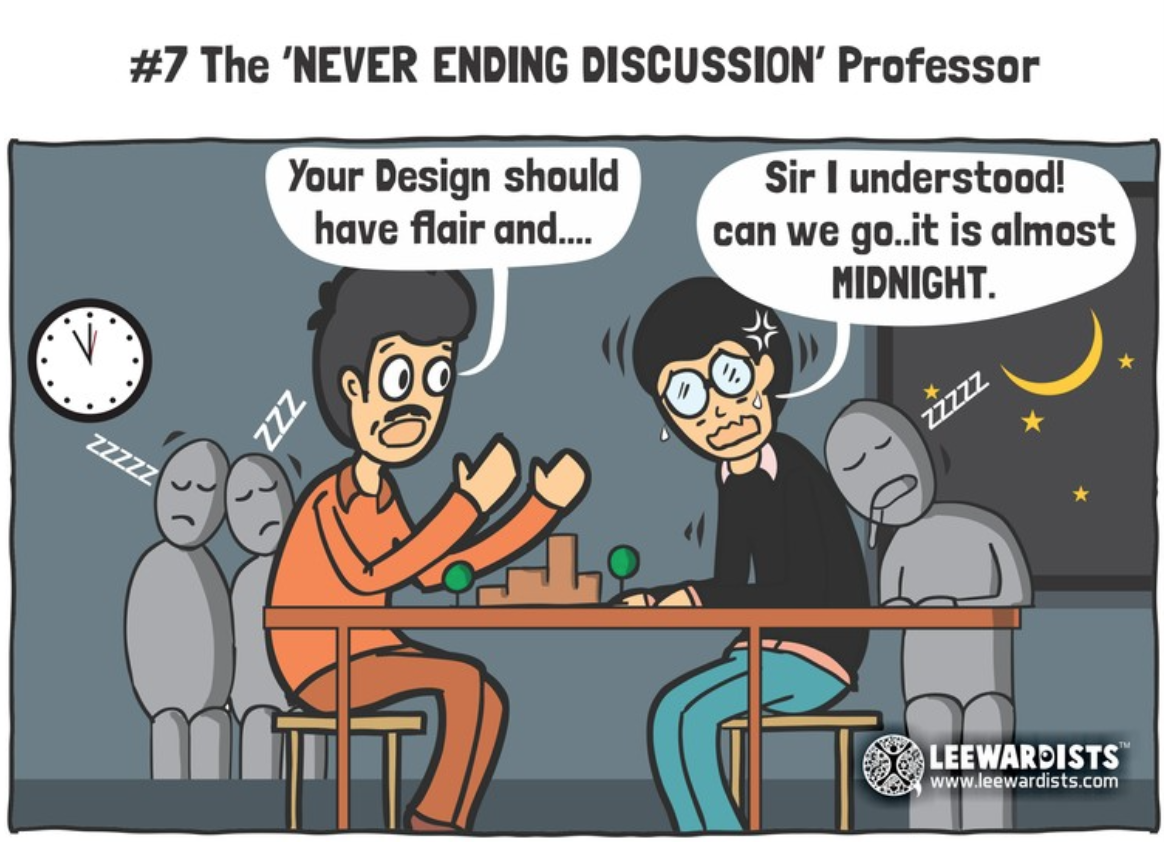
The type of professor that I like to think of myself as (Courtesy of The Leewardists, https://leewardists.com/)

In 2009 when I moved to India, I started teaching full-time (mostly by necessity) and enjoyed it so much that I didn’t really look back at full-time practice again. A few stints here and there, working on projects as a consultant, but for the last 12 years, I’ve been a full-time academic. So, if you consider what I am currently, then am I primarily a teacher?

What about the fact that I teach… you know… architecture? The two labels are not as distinct as they might appear because while I may have been an architect first and took up teaching later in life, I didn’t stop being an architect. So that’s a further argument for putting the architect label above the teaching label – one sort of encompasses the other. Or it furthers the argument to just say that I’m both?

But it gets more complicated than that. Because I don’t just teach architecture; I also teach design. And architecture is just one of the many design disciplines. So am I then a designer above all? And to make it even more confusing, for a a few years I wasn’t even really a teacher but an academic administrator. When I became a Department Head and then a Dean, I did very little teaching and even less architecting, and became more of an academic strategist. But it sounds kind of pretentious to call myself an “academic”.

So when I meet new people and they ask me what I do for a living, I default to the statement “I teach architecture and design” because that neatly covers everything, but it’s still a statement and not a title. And surely, if you’ve read this far, you must surely be saying “Hey. You are overthinking this. What does it matter?” to which I have to respond that it does matter. It has to do with my self identity, and even if I only come away realising that I’m equally a teacher and an architect, that still needs to be resolved. It’s not about labels but about how I’m perceived – by myself and by others, and unless you choose to live an ascetic life, such things are still important.

I also wonder how teachers in other disciplines classify themselves. I guess every teacher has, to some extent, an expertise in something. A history professor is a historian at the root of it. An economics professor is an economist. A physics professor is a physicist. So I guess and architecture professor is, ultimately, an architect. The architect part is more definitive of what my expertise is, and I guess that’s closer to how I’m perceived professionally. The fact that I teach doesn’t make me not-an-architect, it just redefines how I practice architecture… not by designing buildings, but by teaching others to design buildings. Architecture is what I am (professionally), and teaching is what I do with it, so I guess the architect label is probably more important (and not just alphabetically).

I wonder about the rest of of you who teach. How do you identify or label yourself? By your teaching or by your discipline? By your vocation or by your profession? Please comment below (even if you’re not a teacher… or an architect…. or whatever.)

The type of professor that my students probably see me as. (Courtesy of The Leewardists, https://leewardists.com/)

six levels of reflective learning

Last semester I taught several classes to final year architecture students and, as I often do, I required them to maintain a reflective journal for each class. One of the classes was Dissertation where students write a 10,000 word academic research paper on a topic in contemporary architecture. The journal for Dissertation was meant to be a research journal, in which they would compile summaries of the data they were gathering and any inferences they were making from it. I also asked them to fill in any thoughts or musings they might have on the class, what they were learning, and what it meant for them as future architects.

I did a similar thing with my Professional Practice class, except it wasn’t a research journal; it was meant to be a reflection on their learnings from the class – day by day, week by week. I asked them to keep the journal informal, and write entries as they would in a diary, but reflecting only on the learning of the class and expressing their real thoughts and opinions.

I reviewed their journals periodically, reading through all the entries, and after a few weeks I realised that the students were unable to reflect deeply on their learning. Every entry was some version of “Today in class we did this. It was very interesting.” It was reportage, not reflection – a shallow summary of the class, without any indication of how the learning affected them on a deeper level. They rarely critiqued the classes; at most, they would admit to not understanding it fully, or maybe finding it boring. But there was little or no reflection on what the learning meant in the context of their professional education, whether there were consequences of the new information, or whether it changed their existing viewpoint about an issue.

It occurred to me that the students, now in their mid twenties, had never really been taught to reflect on anything in their lives. If I asked them about a movie they watched, they responded with “It was fun”. If I asked them why they liked a certain song, they answered, “It’s really good”. It’s not that they don’t have opinions about things (I assure you, they do). They simply didn’t know how to articulate that opinion. Many of my students speak English as a second language, so I thought it might be a language issue, but even when I asked them for their opinions in their native language, they still find it challenging to express themselves with any degree of articulation.

This was when I realised that reflecting was the problem, and I immediately decided to conduct a tutorial on reflective learning, and to help them understand that meaningful reflection happens at a much deeper level than they were currently attempting. I naturally asked myself if I was qualified to teach this, but I reflected on it (meta-reflection!) and reminded myself that I do a lot of navel-gazing and pondering deeply about things. I’m no philosopher for sure, but as a natural lifelong introvert whose favourite thing to do is to sit quietly in a corner and read, I feel I can at least help the students learn how to reflect better than they were.

So before preparing my lecture, I naturally reflected on the nature of reflection (again, meta!). I wanted to express the value of reflection in a way that could be easily understood, but I wanted to avoid reducing it to just “thinking deeply”. So I came up with a framework for reflection, represented as a series of progressive layers of internalised thinking. It is, by necessity, reductionist, but I hope that doesn’t take away from how meaningful I intend it to be. In any case, for better or worse, here are my patented 6 Levels of Reflection™.

Let me explain the levels in more detail…

Level 1 – Documentation (FACTUAL)

This is the easiest and most shallow level of reflection. It barely even counts as reflection but is nonetheless an important preliminary step to deeper reflection. Level 1 is simple reportage, describing what has occurred, narration. It is highly objective and unbiased, and although it can be detailed, the information doesn’t really have much meaning. Here are some examples of 1st Level reflective learning:

  • “Today we were taught _______.”
  • “First we did _______, then we did _______.”
  • “The teacher told us _______.”
  • “We did an exercise that involved _______.”
  • “We were asked to do _______. Then we discussed it.”

This is what students do easily, and usually by default. When you ask them to reflect on their learning, they simply tell you what they learned, without articulating what the learning meant to them. The only thing I would ask students to improve about this level is to document the activity or learning as a cohesive narrative rather than a flat description of events. Otherwise, there’s not much else to say about this initial level; it’s fairly straightforward. So let’s swim a bit deeper.

Level 2 – Appreciation (EMOTIONAL)

At this level, students express their immediate emotional response to the learning – whether they liked it or not. It doesn’t go much beyond this, however; rarely will a student explain why they liked it or disliked it. I imagine that part of the reason for this is their hesitation to express disappointment to a nominal authority figure, which is still how many students (in India at least) see their teachers. If they do feel open enough to share their honest feelings, they will often be cagey about it, expressing their dissatisfaction in simple, uninformative terms, often writing things like:

  • “The activity was pretty fun.”
  • “We never did something like this before; it was exciting.”
  • “The feedback we received was demotivating.”
  • “Yesterday’s class was interesting, but today was boring.”

Even at this relatively low level of reflection, much can be improved within it. Students can be more emotive, more articulate, and more descriptive of what exactly they liked or disliked about the activity, and why it provoked an emotional response. But even if they’re able to do this, Levels 1 and 2 are usually about as far as most students will go. This is the Rubicon that they seem unwilling or unable to cross.

Level 3 – Relevance (APPLICABLE)

A minority of students I’ve had are able to venture down to Level 3, which is about evaluating the importance or value of the learning relative to their existing context. It’s about questioning whether it was helpful, harmful, or neutral for their ongoing learning. Reflection on relevance is not necessarily biased, but focused on what is applicable to them. Some examples of this are:

  • “This will help me organise my thoughts.”
  • “The examples clarified my doubts and now I know what to do.”
  • “This will add to my body of knowledge.”
  • “I don’t see how this will help me get unstuck with my project.”

Finding relevance is particularly critical for younger generations; Millennials and Gen Z are often characterised (perhaps unfairly) by their inability to focus on things that they’re not directly interested in, or things that aren’t going to help them in the here and now. My ongoing theory on why this is so (which I’ll perhaps discuss in a later blog post) is based on video game culture. Younger people will rarely involve themselves in a video game until they know what the game’s objective is. Are you supposed to kill all the Nazis? Accumulate treasure? Rescue a princess? Complete a mission? Until the objective is known, the player won’t “buy in” to the game, and won’t play it. Similarly, with learning, Millennials and Gen Z – generally speaking – must have a buy-in before engaging in their learning, and a deep reflection on the relevance of their learning is absolutely necessary for them to move on and apply that learning further.

Level 4 – Provocation (INTELLECTUAL)

This level is characterised as “intellectual” because it requires the student to question whether the learning provoked some intellectual thinking. Whether it reminded the student of some prior thought, or triggered a chain of new thoughts or realisations on the subject. The student might reflect on this in the following ways:

  • “The video made me realise that my project is not actually about _____ but about _____.”
  • “The lecture reminded me of a poem I read last semester.”
  • “Afterwards, it made me think about my previous mistakes.”
  • “This _____ is actually the same as _____.

This is a more momentary and instantaneous type of reflection; it represents the moment of provocation; the spark or light bulb that goes off when the student is able to make a connection to an existing idea, or find a pattern – through synthesis – from seemingly unrelated bits of data. Although the moment of provocative reflection may be fleeting, it leads to the next deeper level of response.

Level 5 – Response (CRITICAL)

Following the provocation is usually the response to the learning. I don’t mean the emotional response of appreciation (Level 2), but the critical response ignited by the provocation in Level 4, which embodies a deeper evaluative reaction to the points raised in the learning activity. It can be either a “gut reaction” or a “measured response”, and the student can either agree or disagree with the information. This level involves finding nuances, flaws, or strengths in the learning and formulating a responsive argument. For example:

  • “I disagreed with the teacher’s statement because ______.”
  • “This is a valid point, but it doesn’t cover all the reasons behind the problem.”
  • “This won’t work because ______.”
  • “Instead I think we should do ______.”

Some of my students have asked “What’s the difference between Levels 4 and 5?” I see Level 4 as the moment of a realisation and Level 5 as the rationalisation behind it. First, acknowledging that this is something new or different or wrong or right, and then reflecting on why it might be so. You can probably reach Level 4 and not go further, but it’s hard to reach Level 5 without first reaching Level 4. And Level 6 is usually the natural result of both.

Level 6 – Consequence (ACTIONABLE)

The final (?) and deepest level of reflection in my framework is when the student ultimately asks “Now what?” The student has to figure out what needs to happen and what can/should they do with this information. To reflect on this is to ponder the next steps, and it encourages a call to action, perhaps requiring a change in thinking or behaviour. In my experience, very few students dive as deeply as Level 6 – at least consciously. They may document their learning, gauge their appreciation of it, find relevance, and then ignite a provocation and subsequent rationale or response, but they rarely take it forward into the next learning domain, which requires students to say things like:

  • “How do I move forward?”
  • “I need more information.”
  • “I need to change my focus and find a new direction or approach.”
  • “I will try to fix the problem.”
  • “I need to practice this more.”

Reflection for its own sake – especially in design education – is usually not enough. It must lead to some resolution of learning, an action that results in progressive growth. It’s not enough to navel-gaze and ponder the mysteries; one has to think of the consequences and decide what to do with it. I consider Level 6 to be the most meaningful and important level because it results in forward motion, impetus, and potential innovation. As a teacher, I don’t want students to reflect on what I teach them and just mimic it; I want them to critically respond and then find their own direction and their own design identity.

Image for post
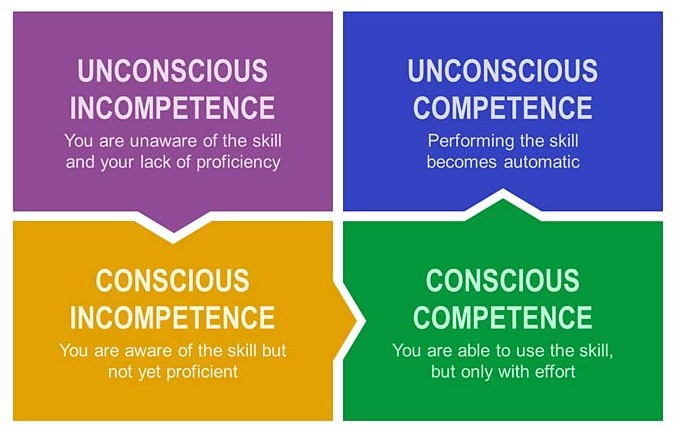
Competence model of skill development. Source: https://medium.com/@zainabz/the-four-stages-of-competence-ee5c6046b205

People who are experienced in reflective learning don’t necessarily go through these layers in sequence, but I do suggest that my students try to do so in the beginning. When learning how to drive a car, a new learner will go through each step sequentially and consciously, until familiarity is gained and sequential thinking is no longer required, and the driver is unconsciously competent at driving. The same applies roughly to reflective learning. It’s not automatically intuitive (especially after years of indoctrination by schooling), so in the beginning it’s better to do it step by step, layer by layer, with the conscious intention of reflecting in each of the six ways separately.

No doubt some of you reading this will be aware that mine is hardly the first model or framework of reflection that anyone has come up with. Indeed, after ideating these six levels, I googled to see if perhaps I was unconsciously coming up with something that I’d already seen before. The closest I found was Gibbs’ Reflective Cycle, which was remarkably (and embarrassingly) similar to my own six levels, with minor differences. On the one hand, I wondered whether I’d known about Gibbs before and had just suppressed it, but I didn’t think so. So I just assumed that Gibbs and I had independently come up with similar frameworks because, uh, great minds and all that. That made me feel slightly better.

All I can say is to reflect (!) on this however you like, and if it helps you be a more critical thinker, then that’s great. In any case, it’s an evolving framework (I’m already thinking of a 7th level) and I would certainly love to hear your thoughts and, ummm… reflections.

the broken pencil

HOW I LEARNED TO BE A MORE COMPASSIONATE TEACHER

Photo by: @shynlzbthnrcss

A year or so ago while teaching, I made a big mistake. But also a learned a big lesson in teaching. Yes, even after 14 years of teaching and being an academic administrator, I’m still learning how to be a better teacher.

It was during a session where I was teaching design students some fundamental drawing basics. My mistake was this: I broke a student’s pencil to make a point dramatically. I knew it was a mistake the second after I did it. In fact, I thought it might be wrong even before I did it, but I took a chance and did it anyway and I instantly realised my mistake, the moment I saw the student’s expression. Here I am – former design school Dean, well-respected teacher, trainer of teachers – suddenly faced with the embarrassment of doing the wrong thing in the classroom, with potentially devastating consequences.

But wait… let me go back a bit. You know… for context.

As a relatively experienced teacher who has had good results with students over the years, I’ve sometimes been asked to conduct teacher training at design schools. An important point I try to get across is the need to be a more compassionate teacher. This can sometimes be a hard sell because design teaching (especially the kind you find in architecture schools) has enjoyed a lot of notoriety for being hard on students’ mental well-being. Which is ironic. On the one hand, we teach design students to be empathetic designers – to deeply understand the user, the client, the public… whoever we’re designing for. Design thinking – which is basically empathetic decision making – has become something of a fad, and designers are quick to point out how we have always been empathetic thinkers because we keep the user at the heart of everything we do.

But do design teachers have empathy for design students? In my personal experience… well, let’s just say things could be better. Certainly those days are gone when teachers would tear apart sheets and destroy models, leaving students in shock and in tears. Those habits had already started to vanish by the time I was in architecture school in the mid 1990s. Although my generation of GenX students – the generation infamously known as slackers – would probably have just shrugged such things aside, I think we were starting to foreshadow the coming of the Millennials, who, as we all came to learn, would not stand for such nonsense in the classroom.

But we did get regularly told by some teachers and some jury members that we were lazy, stupid, decrepit, wasting our time, or that we should think twice about continuing in architecture. We regularly had teachers draw marks with permanent marker on our pristine presentation drawings, often to make the not so subtle point that our work was not precious. We were often subjected to sarcasm as a teaching tool, which – unlike current generations – we totally understood as being subtle ways to humiliate us without, you know, actually humiliating us.

When I became a teacher myself, I tried to avoid going down that route (although I do admit that sarcasm has been one of my favourite critiquing tools, now rendered useless by GenZ students who were never raised on steady diet of 1970s British comedy shows like I had been). I never once intentionally sought to humiliate a student or make them feel bad. Unintentionally, though, it’s happened. There are times when I was perhaps a bit overzealous in my disappointment, and to tell the truth, I was never really raised in a household where praise was in big supply. In my house, good work was simply expected, and required no significant lauding beyond the occasional gruff “Ok, good.” Bad work (or worse, bad behaviour) was roundly criticised and punished, and that trend continued through 1990s architecture school. The ability to critique what was wrong in a project or how to improve a project rubbed off on me quite well, but not the ability to impart significant positive reinforcement and make someone feel really happy and motivated about their accomplishments.

But as I mentioned, any shortcomings on my part in teaching were unintentional, and arose more from ignorance and inexperience than anything. I could also blame the mixed signals I used to get from other, more experienced, teachers. Some were always friendly with students, while others said that this was not a good idea. Some said that it’s okay to be “soft”, while others insisted on professional discipline. Often such messages had to do with the divide between academia and industry, and the supposed failure on the part of teachers to enforce rigour and discipline that would result in the inability of graduates to manage with the Real World – the mythical and mystical place where everything was much harder and harsher than the cozy confines of college.

But as I taught over the years, I also learned. For one thing, I learned to dispense with the theatrics I once would employ: slamming the door and leaving the classroom to express my disappointment; or emotionally blackmailing students to make them feel guilty about not doing enough work, while I – busy architect and teacher – was working so hard to teach them. (Ok, I admit I still sometimes do the second one.) And I’ve learned to find a balance between being a student’s friend and also ensuring a sense of rigour and discipline. At least, I’m trying to. Which leads back to the incident where I broke the pencil.

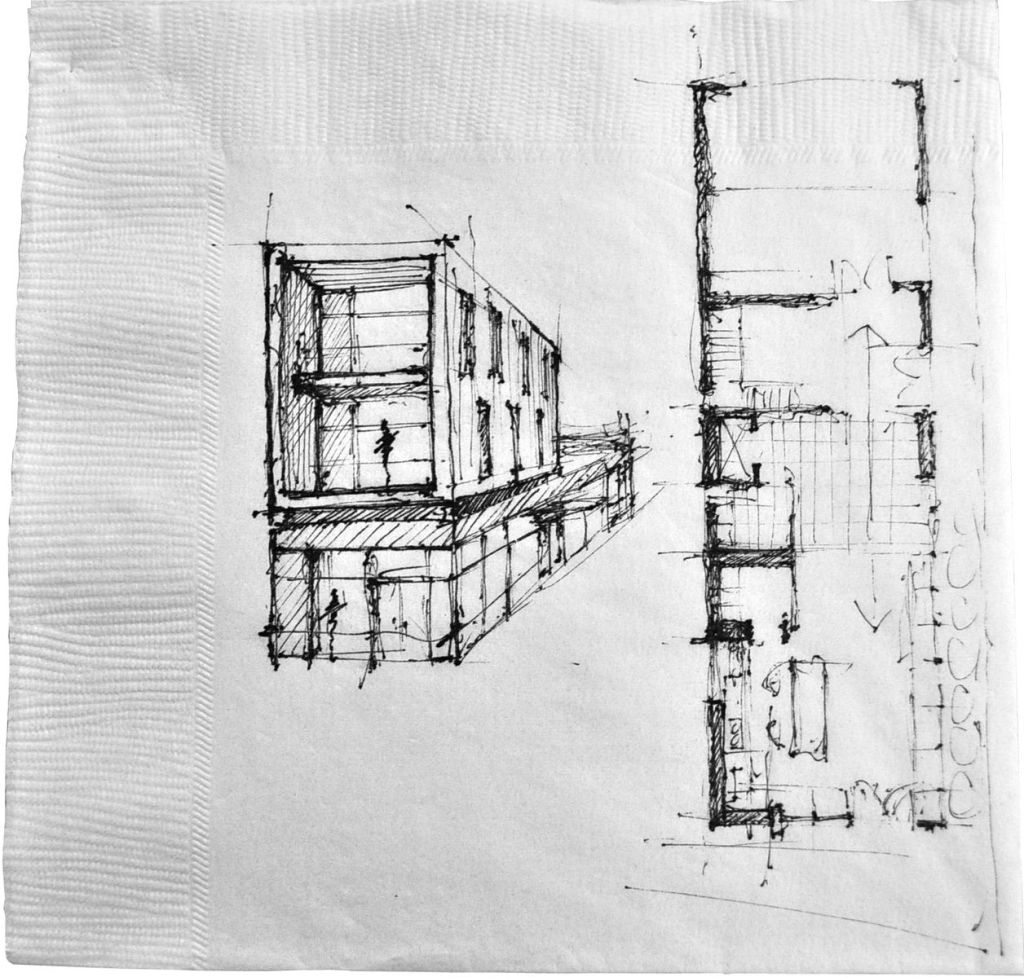
Let me explain the incident in more detail. I was teaching second year design students about manually drawing different orthographic views – top view, side view, etc. I was teaching them how to do this quickly and roughly, but also precisely. Not a super-precise drafted design drawing made with drafting instruments, but drawing a basic plan or elevation accurately by hand – balancing looseness with precision. This is a skill that most designers will need as a professional – the infamous “napkin sketch”, requiring both the roughness of a work in progress and the precision of a drawing that adhered to a correct scale and proportion.

An example of the famous “napkin sketch” in architecture. (Source: wikimedia commons/unknown)

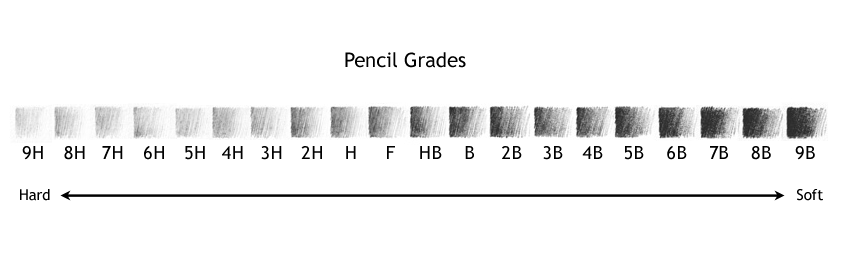
I’d seen some students using hard pencils (or even worse, mechanical pencils) and I was starting to get upset because I would have thought they’d learned how to use soft pencils for rough, loose drawing in their Foundation year. I’d earlier told them not to even bring any pencils harder than HB into the class; we were not going to do any of that kind of precision drawing. I told them to use only soft B-range pencils, meant for rough and loose manual sketching, not for drafting.

In the class I noticed one student – actually one of the more gentler and sweeter students in the class – using an H pencil. I wasn’t infuriated by this, but I did want to make a point right then and there. I don’t know what came over me, but I guess these were students I was teaching for the first time (I visit this university only once a month) and I dipped into my old toolkit of theatrics in order to make some kind of impression on them. I went to the student and – in what I felt was a more amusing than vindictive way – I took her pencil and broke it right in half and pretended to throw it out the open window. Point made. Or so I thought.

Pencil grades, modified from the original image by Untitledmind72 (source)

The look she then gave me was a mixture of shock, disappointment, and resignation. She took it much worse than I expected. She didn’t say so, but I could see it on her face. I knew instantly that I shouldn’t have done it. I even said something to the effect of “You’re not upset that I broke your pencil, are you? Are you really upset?” I may have even half-heartedly apologised a few minutes later. The student was quick to say how she wasn’t upset, but I could see that she was. For the rest of the class period, this bothered me. I’d miscalculated.

I thought about this for some time, and at the end of the day, I went over to the campus stationery and bought a new pack of soft drawing pencils for her, compelled mostly by guilt, but also because I wanted to make another point, both to myself and to the student. I purchased the pencils and started walking back to where I was staying on campus, and I saw the student outside the design building with a small group of friends. I went up to her and quietly handed her the pack of new pencils and told her that I was sorry, that I was just trying to make a point, and that I realised she was upset.

This was very awkward for her, I thought. In India, there’s still a fairly strong hierarchical divide between teacher and student (we’re still called “Sir” and “Ma’am”) no matter how friendly you try to be. I can’t say for sure, but it could very well have been the first time a teacher had ever genuinely apologised to her, let alone buy her a new pack of pencils. She was effusively trying to tell me how it was ok, and she didn’t feel bad, and how I didn’t have to do this, but I insisted. And despite the awkwardness, I could tell she was touched by the gesture.

No, she’s not in this photograph.

And this is where I finally get to my point in all this. This act, this gesture, this episode of disappointment followed by camaraderie – this balance between being a bad guy and being a good guy – this is what I’ve learned is at the heart of teaching. This is the existential nature of what we as teachers do. We make mistakes and we sometimes make students feel bad, and this is forgivable most of the time, but we must – without exception, without delay – follow that up with compassion and goodwill. It’s what makes us human, and we need students to understand that we’re human, otherwise that divide between student and teacher will never be bridged.

That act of breaking her pencil and then immediately buying her a new set, this act helped to convey both the seriousness of what I was teaching and the empathy of understanding that mistakes can happen, that it’s ok, it’s not a bad thing. It also conveyed that I was a real person, not just a figurehead with a bank of knowledge to impart. I haven’t discussed this incident with the student since then, but I genuinely think that we reached an understanding that day, and we smoothed a pathway toward future learning, where she knows that, as a designer, I’m not only very serious about what I do but that I also don’t take it too seriously. And that has led to more effective learning. The student really put in a lot of effort in that workshop that semester, and was one of the most diligent and enthusiastic students in the class. It’s possible that she was this way well before the Broken Pencil Incident, but I like to think that whatever barriers may have stopped her from going the extra mile in that workshop were dismantled by our mutual encounter.

I later taught another workshop at the same university, with the same student in the class. This time we were doing an anthropometrics exercise – mapping the way the human body interacts with furniture. During the mapping process, I wanted the students to use a digital tool which most had never used, as a means to do the tedious mapping more quickly. The ‘pencil student’ at first hesitated to use the digital tool, and insisted on doing the mapping by hand, but I insisted that she try it and get out of her comfort zone. Reluctantly she did it, and soon realised how much easier it was to do it digitally, and mapped her anthropometric diagrams successfully. I like to think that her willingness to change her medium was partly based on the trust we had earlier established. That she tried something new because she knew that if I suggested it, then it was worth doing.

I may never know this for sure (or maybe I will when she reads this), but I do think that rigour and discipline can go hand in hand with compassionate, friendly teaching. I’m often tough with my students, and I often expect a lot from them – a lot of work or a lot of critical thinking. But before I ask them to do so much work for me, I try to build a foundation of trust and compassion, I let them know that I’m a friend, and that I’m here for them in a real and human way. As teachers, we often forget this, and we expect students to work hard simply because they should. Because they’ve engaged in some holy contract by enrolling in a design school for which they should feel pride and nobility. But this is not always enough of a buy-in. This value has to be proven, and the steps to prove it require teachers to engender trust with our students. The trust can’t come after the fact, like it did in our generation of academics. We trusted our teachers after they put us through the ringer, but that doesn’t work anymore. A teacher needs to earn that trust before, and then you can expect the magic to happen.

the new abnormal?

MID-PANDEMIC REFLECTIONS ON ONLINE TEACHING

My friend Sudip, a fellow architect and teacher, recently asked me to share my thoughts and experiences about teaching online over the last few pandemically bizarre months of our collective lives. I told him that I’ve been planning to write a blog post about it which is true enough, but the fact is that I’ve been hesitating for two main reasons.

First, I’ve felt that it’s a little premature to reflect on the ‘new normal’ when nobody really knows what that means. Even as I write this, both of my ‘home’ countries are facing spiking infections and deaths from Covid-19 with no sign of relenting. Today, on 10 August, 2020, India and the United States together account for 37% of global cases and 29% of global deaths from the coronavirus. Both of these countries account for 22% of the world population. (source: worldometers.info) Educational institutions everywhere are weighing the risks of opening up their schools and campuses against continuing some form of online learning. Unfortunately, many such decisions are being taken for reasons beyond the medical or financial; there are lines being drawn on political and ideological fronts as well. So, I thought, does it make sense to reflect on the current situation when no one truly knows how long it’s going to last, and how it’s going to evolve?

Second, I wondered whether my voice was even needed right now. The Covid-19 pandemic is probably the most talked about and written about event in human history. The challenges being faced by teachers across the globe are common and universal, more so than they have ever been. What’s the point of adding to the cacophony of opinions?

But I like Sudip and I respect his opinions. He asked me for my thoughts and it spurred me to finally put down some words. Ok, a lot of words. (The fact that I have a lot of papers to grade which I’ve been procrastinating about has nothing to do with it, no sir, not at all.)

“What do you think about online teaching?”

The quick answer to this frequently asked question is almost universally “It depends”. There are a few who absolutely hate it, and a few (only somewhat surprisingly) who love it. The rest of us are somewhere in the vast, grey middle. We’re doing it because we have to. There are advantages and disadvantages. Sometimes it’s good, sometimes it’s bad. All of these are common answers, and mine are no exception.

As a teacher of architecture, there are certainly things that I miss about physical in-person teaching. Design and architecture are such an intimate form of education; there is a long-treasured romantic attachment to the physical design studio – the place where magic happens in the casual interactions between teacher and student. This is no exaggeration or flowery sarcasm; it’s genuinely the single biggest thing that distinguishes our teaching from that of other disciplines, and as of now, there’s no readily available technology that perfectly replaces it. Sitting next to a student on a large table, marking up their sheets with a 2B pencil, gesticulating your critique in a frenetic fervour – I haven’t seen anything that replaces the natural ease of those actions so far, although it’s fair to say we’re getting close. The tablet, the stylus, and near instantaneous internet connectivity are starting to clumsily approximate the studio tools, but not the studio environment. The chance interactions, the random student or teacher stopping by the table to observe and offer their own comment. The unforeseen long digressions about movies or artists. If these things are happening online, it’s in spite of the medium, not supported by it.

Teaching by example. Physical proximity is key.

And since my career has involved not just teaching, but administration, I’m not only thinking about the conducting of online classes, but the strategy and tactics of it. How are teachers delivering the intended curricular content? How are students receiving it? What logistical factors come into play? Is it promoting or suppressing flexibility in learning? What can we learn from it? Is it exposing flaws and weaknesses in how we teach, that we may have been ignoring all this time? These questions have been nagging me over the last few months, as I try to cope with my own classes and students.

My online teaching scenario

Before I share my reflections on online teaching, let me explain my current teaching situation. I teach architecture at a local nonprofit university in Agra, Uttar Pradesh, India. I started teaching here somewhat formally in February 2020 and I was asked to teach both Design and Research classes to 4th year undergraduate students. I teach at a traditional campus with the usual pros and cons – we have our own architecture building which we love, but we’re always short on space and facilities. Students are a mix of local commuters and out-of-town hostellers. Their socio-economic backgrounds are also diverse, ranging from children of affluent families to first-generation college-goers from families of humble means. Because the architecture course requires it, all students have their own high-end laptops with specialised software, and because it’s 2020 India, they all have smartphones. Very few have tablets or other special devices.

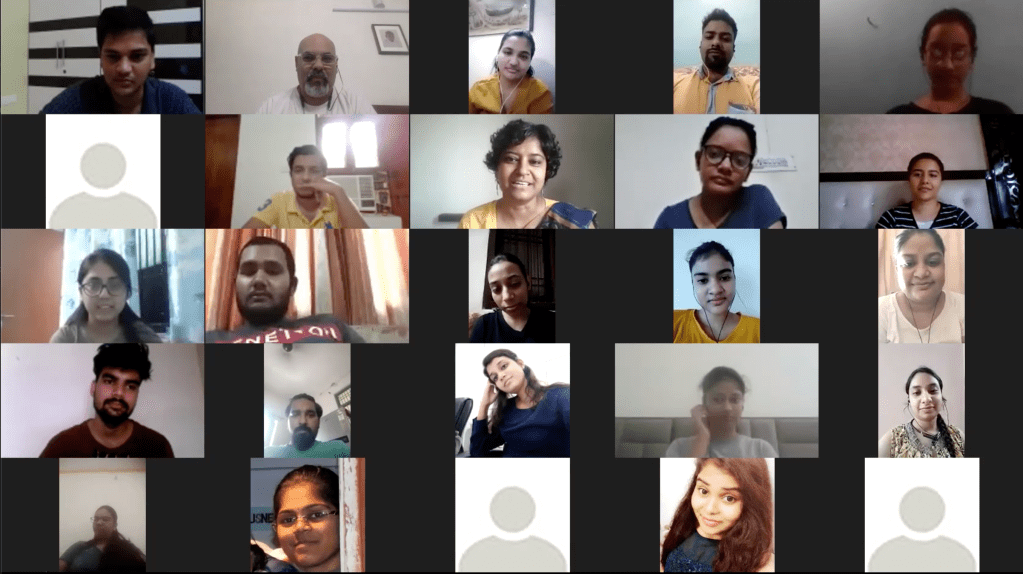
Less than a month after I started teaching, and a week or so before the official nationwide lockdown came into effect in late March, our university saw what was coming and sent all students home for their own safety. Classes were quickly and chaotically shifted to fully-online, leaving many of us scrambling to figure out what platforms to use. The university had a native online EMS (education management system) for things like grades and admissions, but otherwise we weren’t doing any teaching through Blackboard, Moodle, or other online teaching platform. So we quickly set up free Google Classroom pages and Zoom accounts and shifted our schedules and materials online. Classes were held whenever it was convenient or necessary, sometimes in the evenings. We tried different video conferencing apps and coordinated between those and email, WhatsApp, and even the lowly telephone, We managed to get through to the end of the semester, holding our juries and exams online, and when we were given the indication that classes would remain fully online through all of 2020, we started to do things in a more planned and formal way. In this new semester, our classes are following the proper timetable, all subjects have a Google Classroom page, and faculty have settled into either Zoom or Google Meet for their live sessions, as per their personal preferences. Things are more organised than last semester and both students and faculty have settled into a routine and pattern of online education, although we still have our challenges.

But let’s rewind a bit.

Not my first time around the online block

My previous institution – where I started as a regular permanent faculty and eventually became a Dean before leaving in 2019 – is a private and non-regulated design college. It doesn’t come under the ambit of government regulators, but is nevertheless one of the premier design schools in the country.

It’s owned by a foreign education conglomerate that, as early as 2014, had started to push the idea of online learning. The truth is that this was done mostly because they foresaw what the future of education would be, but also partly because it held a lot of opportunity to teach a much broader range of students without the usual investments in capital infrastructure. For the next few years, the leadership and academic teams had long, and sometimes fierce, debates about how (and if) we could teach design online. I won’t narrate that complex story here, but it’s enough to say that we began a program to phase in hybrid online learning over time. We introduced Blackboard and started training both faculty and students not just in the technical details but also the ideological aspects of teaching and learning in the digital environment. There was some resistance, as expected, but eventually every teacher became a sort of expert at online teaching so that when the coronavirus lockdown hit in March 2020 (a few months after I left), the institute was able to pivot to online more quickly than most.

Having been one of those that were trained and (I admit, reluctantly) pushed into shifting some of my teaching online (and getting my staff to do so as well), I was probably prepared better than some of my new colleagues in Agra, who had not really done it before. (In a further rewind) it probably helped that I’ve had experience in distance education as far back as 1994, when I worked a part-time job in the Distance Learning department of my undergraduate university to help pay my tuition fees. Among other tasks, I used to help professors convert their lecture notes into Powerpoint slides. I also did my own distance learning course in 2006. While living in New Jersey, USA, I got a Diploma in Theology from the same institute in Agra where I’m teaching now. They’d just started delivering distance education a short while earlier, but in a somewhat more text- and lecture-based format than what we do in design education. They offer vocational and other courses to over 80 study centres all over India using centralised physical course materials that are delivered by courier, and with local coordinators that facilitate students to participate in recorded and live video lectures. You could consider them more like small satellite campuses rather than the home-based flexible online learning that the whole world is experiencing now.

All of this is to say that I’ve had experience with distance and online education before, but not so comprehensively as I’m doing now. I guess I could’ve just said that to begin with and saved you a lot of reading, but I do feel some specific background is required to contextualise what I’m going to say next.

Back to the future (?)

“It depends.”

Yes, that’s still my answer to Sudip’s request. I wish I could be more passionate or polarised about it, but I’m not. This isn’t Marvel vs. DC here, or Star Trek vs. Star Wars! [Just kidding, I love all of those things equally.] I’m trying to take as pragmatic a view as possible about this because it’s no longer postulating about what the future holds. The future is here. The uncertainty that I always rant about is here, much sooner than I expected. We have to be pragmatic about it because it’s now our hot, blazing reality and we need to get it under control as much as possible.

Despite my earlier experiences with distance learning and HBO learning (no, not The Sopranos… “Hybrid Blended Online”), I’ve still learned a lot over the last few months. I admit that in earlier debates and discussions as an administrator I held the strategic viewpoint. It’s been about five years since I actually taught a full load of classes, and now I’m once again balancing a teaching load, preparing for classes, grading, and counselling. Now all of it is one hundred percent online, with no physical interaction with my students and co-teachers at all. And that’s not likely to change anytime soon; it may very well be this way for the remainder of the academic year, until May 2021. Maybe even longer. Teaching online in some capacity is something we need to get used to, quickly and intelligently. There are definitely disadvantages, but there are some things to take forward as well.

What online can’t do

Why Millenials Need Less Studio Time in Architecture School ...
The studio environment at architecture school (source: architizer.com)

I already mentioned the lack of the studio environment that we normally have in design and architecture education. Admittedly, it’s now rare to find that 24-hour open studio that was commonplace a couple of decades ago. You only see it in more well-established and well-funded design schools. Real estate costs have gone into the stratosphere and colleges all over the world are re-thinking the idea of providing dedicated, often empty, studio classrooms for a cohort of students to use as they wish. Studios are now often assigned by rotation, and more urban colleges are creating flexible, open spaces to be used commonly, rather than assigning them to specific students or cohorts. There are also calls to reduce the dominance of the design studio in architecture education. Even so, such spaces – whether dedicated or common – still allow for the intimate chance interactions that design schools are known to provoke. When you go to campus, you know other students will be there, and faculty as well. Design is driven by dialogue, and impromptu discussion and critique takes projects further and makes them better.

Can this be done online? Well, yes… after a fashion. A student can send a teacher a text message asking for advice, or they can post their progress work in a WhatsApp group for peer critique. But this doesn’t always happen. One difficulty I’ve encountered is the students’ reticence to use the full corpus of social media to discuss their work with their peers, especially in textual modes. My students have numerous WhatsApp groups but they rarely use them except for posting announcements about the class (when the group includes teachers) or gossip (when the group doesn’t include teachers). I don’t see any productive conversation, dialogue, critique – no posting of work in progress, no posting of interesting links or helpful tutorials. Maybe this is happening outside of my view, but probably not as much as I’d like to see, and this can be attributed to a number of factors, including the student’s lack of confidence to articulate their thoughts in written words (as opposed to verbally). Although they’re supposedly digital natives, they haven’t really figured out how to engage in productive online written discourse, something that I literally grew up on during the early years of internet message boards and chat rooms.

And even in the virtual video classroom, the immediacy, spontaneity, and – most importantly – the smooth, evolving articulation of verbal conversation is lost in the choppy digital back-and-forth. Facial expressions and gestures that teachers and students rely upon are not as well conveyed on screens full of lo-res rectangles.

I’ve predominantly settled on Zoom as my video conferencing platform of choice, and I’ve invested in the annual Pro plan to get features which have helped me with my online teaching. I’ve tried other apps but Zoom is the most stable and has the most Host features. I frequently use the Breakout Rooms feature to split up my larger classes into smaller groups for discussion. But Zoom is still designed for business, not for education, so it lacks many things that teachers need. The digital whiteboard and annotation tools are not intuitive without a stylus and tablet. I can’t keep track of 30-40 students and see if they’re paying attention, getting bored, or even if they’re in their room if their video is off. And it’s frustrating to constantly ask them to turn their video on, so often I just forget about it and move on.

In design education (and increasingly in other disciplines) the use of physical resources are critical. A great deal of time in design studies is spent in the physical act of making, even in the digital age. Every design school in the world has labs and workshops where students can tinker, fabricate, and assemble. Using physical tools and working with the hands is still (and will foreseeably) be a crucial part of design and architecture education. Suddenly having no access to these resources has been a major handicap because they are integral to learning design. Even losing access to the library has been a problem, despite all efforts to build collections of e-books and e-journals.

School of Design Courses -Pearl Academy
Design labs and workshops (source: pearlacademy.com)

There’s also a very pernicious problem with online video classes – because our college is a nonprofit with low fees, many of our students enjoy a quality education that they otherwise may not be able to afford. Asking such students to now upgrade their internet data plans so that they be on bandwidth intensive video calls all day means an expense they may not have foreseen. Some of them don’t live in areas with good network connections. Some of them have only one laptop in the family, and if it crashes, their online learning grinds to a halt.

This isn’t even touching on the psychological price that many of them pay for an online-only education that they never bargained for. What many professionals are facing with WFH are also being faced by students – lack of space, lack of privacy, lack of noise isolation. Fatigue from sitting all day, staring at screens all day, wearing earphones all day. Even I’m exhausted from a day of online teaching, more so than physical teaching. It requires a focus of concentration, volume of speaking, and energy of managing multiple screen windows at once that you don’t have in the physical environment, or at least, not in such a prolonged way.

And there are hidden costs. Students who used to find solace and respite in college because their home lives were troubled, chaotic, or even abusive – they no longer have that luxury, and were given no time to prepare for the sudden change. The number of students that face such issues is woefully underestimated and largely unknown. No attempt at focusing on the cost savings of not commuting, or not having to ‘dress up’ for college, and other such silver linings can erase the difficulty that comes from such circumstances.

There are also many factors I haven’t had to experience because I teach in higher education. I sympathise with the struggles that school teachers are going through around the world, and I won’t even enumerate the problems that online teaching has for them, and for parents of school children as well. The dilemma of keeping children occupied and interested is universal. We love to think that children of the 21st century are ‘digital natives’ but we can’t overestimate this. A child may love to play games or watch cartoons on an iPad all day, but do they want to learn in a classroom that way? Maybe years from now when this is commonplace, their attention spans will be accustomed to it, but if we’re in a transition phase right now, it’s not looking good at all. And what about social interaction? School-age children need to be in collaborative and collective environments to develop personalities and social skills, and that is now lost completely.

Image may contain: 5 people, people standing, text that says 'Schools starts today. As teachers you are safe. We've taken every precaution'
Teachers as redshirts in the Covid era (source: unknown meme)

Some of these challenges can perhaps be overcome or managed over time, and with better planning and resources. My former colleagues who are using Blackboard invite me for online sessions, and in some ways the interface of Blackboard Collaborate is better than Zoom, because it’s designed for education. For example, my online class on Zoom is linked to my Zoom account, using my Personal ID (so that I don’t have to send my students links for every class). It’s attached to the teacher, which can sometimes be a problem if someone else has to take my class, or if the students want to meet without me. In Blackboard the session is attached to a given class, not to any specific teacher. All the resources for that class are likewise attached to that virtual classroom, which anyone with the proper credentials can log into and access. The class materials, the assignments, the grades, and the venue for video classes itself… all exist in the virtual class space. It’s a much better holistic solution that we don’t have yet. Zoom is where we hold our classes, and Google Classroom is where the resources are kept.

But different apps and platforms won’t change the other things I mentioned – the loss of the studios and workshops, the lack of intimate critique, the psychological challenges. I see no solutions for those things yet.

What online can do

It’s becoming clear to me that online classes have their place in education; we just have to be smart about where that is, and how can it best be leveraged. There are things I’m learning and practices I’m starting that will very likely continue once (and if) we go back to a physical campus. For one thing, the timetable – always a complex puzzle for every educational department – was much easier to manage this semester without having to tussle with room availability. If some portion of classes can be shifted online, even in part, then the burden on resources can be relieved.

Amongst the community of design educators that I know, there seems to be a consensus that theoretical and lecture classes are easier to manage online, although I don’t think it’s a completely resolved issue. On the one hand, attending an online class is much easier, so my online attendance has been nothing short of remarkable, averaging above 90% in the 5 weeks of the semester so far. And although it sometimes may not seem like it, my students do seem to be paying attention in class.

I like to think of myself as a good teacher, and my students seem interested in what I generally have to say. They behave well in my classes, for the most part. I think that online teaching has perhaps polarised the good teachers from the not-so-good ones. If you’re an engaging teacher, you will perhaps be more engaging online because your ability to keep students’ attention can still be effective even when their hidden laptop screens may be teeming with unknown distractions. But not-so-good teachers will suffer; if your lectures are boring, they will be even more boring with the disconnect from physical interaction.

Design education tends to have less lectures anyway, and even theory classes are more like seminars than anything, containing more discussion and dialogue. These classes may not be perfect online, but if anything can be shifted online to save resources, theoretical classes can be. The losses are not so noticeable, and the adjustments are achievable with a bit of training and planning. If a portion of subjects can be shifted to asynchronous online learning somewhat painlessly, then it’s also easier for students to engage with the class on their own terms, at their own pace of learning. This aligns with current trends that indicate today’s students are more amenable to flexible learning models. They can also do a portion of their work in their own comfortable and convenient environment (home, cafe, beach… anywhere, as long as they get the work done), as long as they come to campus for the practical learning.

The world of education was anyway moving towards what’s called a ‘flipped classroom’ model, which means that rather than lecturing and then assigning readings based on the lecture, you ask students to prepare ahead of time with readings and other resources, and then attend classes only for questions and clarifications. This avoid repetition of information and waste of resources. Online learning works well for this, with a combination of synchronous and asynchronous learning. Students use the off-hours to learn and absorb on their own time and pace (asynchronous), and time with the teacher is spent only on the critical or complex aspects (synchronous).

Online classes then become a sort of ‘virtual office hours’, which is something I’ve actually incorporated into my classes already. Most practical subjects have lots of hours in the schedule, which, in a physical studio environment, means the students work for most of the time, and occasionally come to me individually for questions or critique. If I convert the same number of hours online, I needn’t interact with all students for the entire class time. They work and I’m there to answer questions and resolve problems as needed. I often use a portion of the time for students to critique each others’ work, while I observe and interject.

Assessment and feedback is also easier online. Assignments like essays, quizzes, and other strictly written or visual material can be assigned online, submitted online, and graded online, reducing paperwork and tracking of documents. I can assign a task and know immediately when students have submitted them early or late. Questions can be posted online which can be answered at my own convenience. Feedback is made easier through the use of rubrics, which is nicely facilitated by apps like Google Classroom. I can create rubrics easily, reuse them, modify them. And students instantly get the results. We used rubrics before but because of how easy it is to use them online, I almost exclusively give feedback in rubric-form, saving me a lot of repetitive work. They don’t give all the feedback I necessarily want to give, but whatever isn’t covered in rubrics, I can type separately, or discuss with students when I meet them in class. But this quantity is much less.

Apps and platforms like Google Classroom and Blackboard – although they have their interface shortcomings – also make record-keeping much easier. Everything is stored in the cloud, no worry about data loss or laptops crashing, and I can access everything from any device.

As I mentioned, online teaching can tend to separate the good teachers from the bad, so teachers need to be trained to use online platforms to their best advantage. A sudden shift to online teaching as it happened this year doesn’t allow for this, but if this truly is to be the future, then we’d best start training ourselves now.

But one of the single best things about online teaching is the near universal availability to recruit talented professionals and academics from around the world to supplement my teaching. Before the ubiquity of live online sessions, it was often a struggle to get people to conduct guest lectures, talks, and workshops with my students because it involved the high cost of physical travel and accommodation. Since I’m doing all my classes online now, it’s really no big deal to ask a friend or acquaintance in the industry to conduct a session with my students on Zoom. We used to think it was inferior to physically conducting workshops in person, and it is. But if I can get some level of guest interaction at a fraction of the cost and hassle, then I’ll do it. And I have, with good results.

The hazy future

Sudip, if you’re reading this (and have gotten this far!) I hope you’re satisfied with my 5000-word response to your query. More likely it’s more than you bargained for, but that’s the kind of teacher I am, for better or worse.

As I said, I do hope to continue some online practices when we get back to campus. The parts of online teaching that work for me – virtual office hours, virtual guest lectures, flipped classrooms, online ‘anytime’ discussions, feedback and assessment, record keeping – these I will probably keep doing, and hopefully refine them along the way with more practice and better technology.

I also believe that the forced evolution of the pandemic will accelerate the technology to make virtual teaching less and less distinguishable from physical teaching. AR/VR, holograms, haptic and gesture-based tools, and integrated devices can all help to ease the transition.

I’m still eager to see how this all plays out. As I said, everything is too uncertain to make definitive statements just yet. Despite what they say, no one has any idea what’s going to happen next. Certainly the next year or so is going to be a difficult and challenging time for academics, in all aspects of administration and teaching. My personal view is that this is a sort of reckoning. Covid-19 has done one thing very effectively – it has exposed the flaws, gaps, and weaknesses in our social systems that were heretofore ignored or under-appreciated. In the short run, things are going to be tough, and unfortunately it’s possible that some academic careers as well as whole institutions may not be able to survive. But in the long run (how long?) things will eventually evolve and get better; of this I have no doubt. It truly has become adapt-or-die, and I for one am going to do my best to adapt. I can’t do anything else, and I still absolutely love teaching.

As it is for many, I see this another learning experience – perhaps a forced one, and very aggressive at that – but all the same it’s getting us all to take stock of who we are, what we do, and how we do it. The good thing, in a way, is that it’s happening to all of us at once, so there’s a great solidarity to be found in this crisis. All these months I’ve been doing my best just to absorb and listen to what everyone is saying about the future of education (another reason why I hesitated to write this article), and knowing that we’re all in this together is a huge boon.

I sincerely hope we know how to take advantage of it.