dear design students: here are ten tips for your upcoming jury

You’re welcome. Sincerely, Your Design Faculty
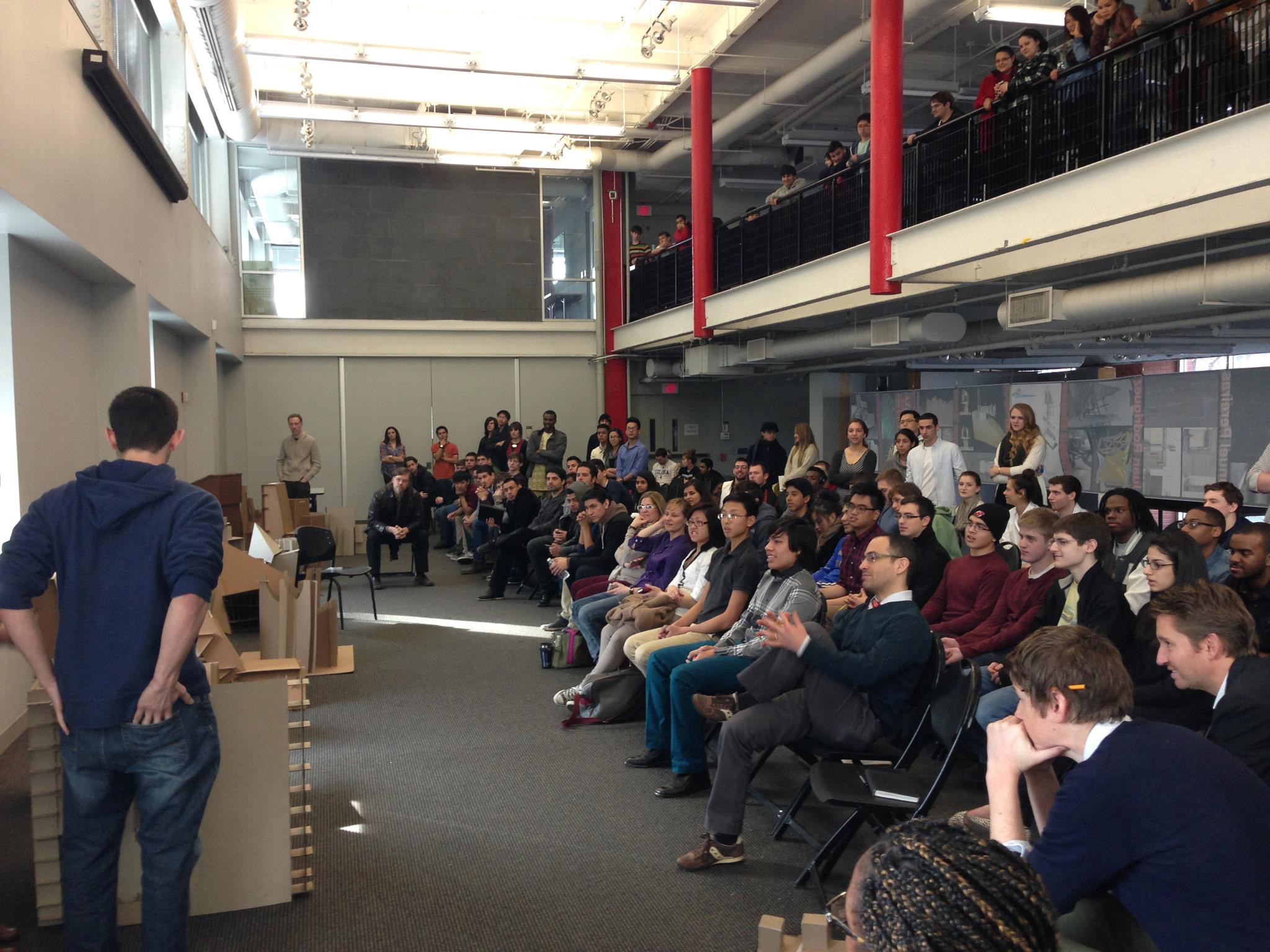
Image for post

For design students, juries are often a source of anxiety and stress, but ideally they shouldn’t be. Juries are primarily about design critique and they work best when they’re open, honest, impersonal, and transparent. However, this openness can also mean that jury feedback can be subjective, contradictory, and confusing. Add this to the anxiety of presenting your work to ‘experts’ and ‘professionals’ after many months of hard work and naturally students find juries a cause for distress. And I admit that we as design teachers often give mixed messages about how seriously you should approach juries:

Message A: “Juries are important; take them seriously. Don’t embarrass us in front of industry professionals!”

Message B: “Juries are not that important; don’t worry, relax. Don’t take it personally.”

These messages aren’t necessarily contradictory, they simply need to be balanced. So take the jury seriously if you want to get feedback, but don’t take it so seriously that you get nervous and can’t represent your work in a good light. But do remember: It’s only a jury, after all…. it’s not a trial, or a judgement, or a punishment. It’s simply a critique on your work by professionals and academics who are not intimately familiar with your project, or with you. I think many students have the wrong impression about juries and put a lot of pressure on themselves which itself causes the distress that one is fearing and in turn causes the jury to go ‘bad’.

Yes, you should take juries seriously. Yes, you should speak maturely, dress appropriately, and be well groomed and bathed. You should make a good impression not just for yourself but your institution. To help with this, I’d like to share ten general tips for a healthy, productive, and stress-free jury.

1. BE PREPARED

Double check your sheets, slides, videos, renders, animations, prototypes, models. Make sure you have everything. This doesn’t mean that you’ll present everything, but be prepared to show any work that jurors may want to see. Keep in handy, and ready to find in an instant, either physically or digitally. Give yourself enough time to check. Enlist your family to help you. Be ready when it’s your turn, and don’t make the jury wait for you. Arrive on time and set up on time. If you’re presenting digitally, check all A/V connections and make sure all your tech gadgets work properly. If you’re posting physical sheets on a wall panel, bring plenty of pins! Rehearse your presentation beforehand. Keep notes if you need them, and present your work in the form of a story or narrative. Many of you go through your project like this: “First you enter from here, then you go here, then there’s a desk, then there’s a table…”. Instead, talk about your design process. Start with your design problem, your case studies, and your analysis. Describe what you learned from them, and what you chose to bring into your design brief and concept. Then explain how that concept manifested in your design development and detailing. Use the right design vocabulary which was taught to you. Avoid the words “basically” and “just” and “like” and “kind of” and “sort of” and “ummm”.

2. BE RESTED

Don’t make the mistake of staying up all night before your jury. Get a good night’s sleep. Eat a healthy breakfast. Be clean and fresh and alert. Dress appropriately; be cognisant of your appearance — whether it’s about clothes, makeup, headgear, or accessories. Be aware about appearing too formal or too casual or too revealing. You have the freedom to wear what you like, but if the focus is on your look rather than your work, then it will distract the jurors.

3. BE THICK-SKINNED

Yes, the jurors may say some things that sound humiliating or condescending. Design faculty usually try to find jurors who are not aggressive or mean-spirited, and to be honest even the ones who may say nasty things about your work (or lack thereof) or who may laugh at certain elements of your design are not doing it to be intentionally mean. They have certain standards for where you as a student should be, skill-wise or knowledge-wise, and they’re expressing their frustration at your inability to meet your potential. And jurors are human, too; they’re not perfect. Sometimes they are harsh, but more often than not they’re making a valid point. In the professional arena you will get burned much worse, believe me. So it’s good to develop a thick skin; if a juror is being harsher than you think you deserve, then keep cool and move on. Which leads to the next point…

4. BE COOL

Stay calm always and don’t lose your cool. Don’t be defensive. Don’t argue with the juror. Try not to get angry or sad or sarcastic. Not everything they say is going to be valid; that’s why we usually have more than one juror. But this is not the time to defend yourself; you’re there to receive feedback. You can ignore it or use it, that’s your decision. But it doesn’t help to be combative because then the juror will most likely get combative right back at you and you don’t want that. Students often ask me whether they should defend their work when the juror doesn’t “get it”. It depends; often I find that it doesn’t really help because there’s limited time to really change people’s minds. You stand to lose more than you gain by trying to defend yourself. Unless you think you’re really being treated unfairly, or the juror is completely off-base, then I would avoid getting entangled in an argument. But take a call.

5. BE AN OWNER

Take ownership of your work and your design decisions. Too often I have seen a response to a juror feedback as “Ma’am/Sir/Professor said to do that.” Sorry… as a design student, once you choose to accept your tutor’s critique and incorporate it into your design, it is now yours. Don’t blame your tutor for design decisions that may not have worked out. Sometimes it could be because you misinterpreted your tutor’s critique. Sometimes the critique may have been given with too little background. Sometimes the tutor may simply be wrong, but that’s part of the subjectivity of design education. You’re being trained to absorb critique, reflect on it, and decide how to incorporate it, if at all. Once it’s part of your design, it’s yours.

6. BE HONEST

Don’t try to bullshit your way through a jury. If you don’t know the answer to a question, say “I don’t know.” A juror can tell when you’re making stuff up. It’s better to be honest and say that you don’t know, or didn’t get a chance to resolve it, or ran out of time, or simply that you were unable to solve the problem. Capitalise on such a moment as an opportunity for learning, and ask the juror if they can assist you with the answer. Which leads to…

7. BE INQUISITIVE

Very few designs are fully resolved at the time of the jury. This is expected. There is always room for change, improvement, or further development. Use the jury as an opportunity to gain insight into how you could have done better, or to find out how to get past an obstacle that you just couldn’t manage by yourself. The jury is there to help you, not judge you (despite the name). And if there’s something you just couldn’t figure out, it’s ok to ask the jury to suggest a solution or direction. Learning does not end with a jury. At the end of a project, there should be a reflection on what you could do to make a better design resolution (or even a better presentation). Which leads to…

8. BE CONSCIENTIOUS

What does this mean? It means you should be an active presenter, not a passive one. Don’t just stand there and present your project. Take notes on the critique, record the comments, document the feedback, so that you can reflect on it and apply the learning. When you’re nervous anyway, you may not be n a position to remember all the feedback. So recording helps, and your friends and classmates can help you with this. Also, when you’re not presenting, be considerate of other presenters. Give them the respect and attention you would want if it was your turn. Don’t whisper, chat, giggle, laugh, or carry on while others are doing their best to concentrate on the presentation. If you need to talk, go outside. And silence your phone!

9. BE PRESENT

Don’t just be there for your own jury. Be there for the entire proceedings. You will learn far more from listening to the presentations and critiques of 10, 20, or more of your classmates than you will ever learn in the scant 15 minutes of your own feedback. Many students waste the jury day by wandering around or chatting/texting/surfing, or trying to desperately finish their projects, or simply not even being on campus. Why? You are missing out a super intense learning experience. Not to mention, why wouldn’t you want to support your friends for their presentations? It means so much to someone who is nervous to have a group of friends in the audience lending moral support, a group of reassuring and familiar faces to cheer them on. It’s about compassion and camaraderie.

10. BE BRAVE

This is the most important. Many jurors comment that student often have difficulty applying the learning from one year to the next. I think this is because of the Ostrich Syndrome. Like ostriches, when you sense danger, you bury your head in the sand and believe that if you can’t see the problem, it will go away. Which is why so many of you skip your classes and mentor sessions, and even worse, your own juries. In the design world, missing your jury is an unforgivable sin. You have robbed yourself of the chance to get what you claim you crave most — feedback. And why? Because you’re embarrassed about not having enough work to show, or the work is perhaps poor quality? So what? How do you think you’re going to get better next time? You learn from your mistakes and rebound! This means that, yes, you do have to listen to the jury tell you that you didn’t do a great job, and that’s never fun. But then you should admit your lack of progress, then turn it around and explain what the problem was and why you got stuck, and ask for advice on how to get unstuck. The most noble thing in academics and professional life is to fail and then get back on your feet and succeed. When you fail, you must acknowledge it and try to find out why, and then move on. This is life, not just design. It will define your whole existence for years to come. But if you retreat and avoid in the face of failure, you’ll almost certainly fail again. When college is long over and finished, you’ll still regret that retreat.


One last request. Please don’t ignore this advice. Design students have so much potential and so much talent; just managing to get through design school is itself a big achievement which many people can’t do. Don’t let your inner fears restrict you and get in the way of your success. Creativity requires action, boldness, honesty, and dignity. The worst punishment that design students get is from themselves, not from jurors or tutors. We’re not here to beat you down or boost our egos. We’re here to discuss new ideas and learn new things (yes… in teaching, we are learning just as much as you, if not more). We’re here to help you and we do the tough and tiring job of teaching and sitting in juries because we’re hungry to talk about design with you. If you’re not as hungry as we are, then you’ll see us become sad and frustrated, because no one wants to spend an exhausting day talking if the other person is not listening. So please continue to work hard, be imaginative and brave and confident, and we look forward to sharing ideas with you very soon.

Best of luck to all of you, in your juries and beyond!

teaching for uncertainty

Adapting to new academic realities during a global pandemic and how it changes not just HOW we teach but WHAT we teach

Over the last few years, in many conversations with students, parents, designers, and educators, I’ve been using the word uncertainty quite a lot. Colleagues of mine have used the acronym VUCA over and over, which stands for “volatility, uncertainty, complexity, and ambiguity”. For many of us, this has been a guiding parameter for framing the way we teach. Seen in a larger perspective, it frames how we prepare young people for a future professional life.

The biggest problem I’ve experienced with many existing academic curricula is that they work from a fixed set of knowledge and skills that the professional world presumably expects from a young graduate. That knowledge base and skill set are often addressing concerns of the now, and sometimes even worse, of the past.

I’ve always maintained that this is a mistake. What’s the point of preparing students for the future by using skills and knowledge designed for the past? Or the present? And even if one is forward-thinking, it’s still a mistake to assume that the future is something that can be predicted with any degree of certainty. Even five years from now. Even two years from now.

Heck, even a few months from now. Look at our current situation in March 2020, in which we face a crisis of global proportions that no one predicted a few short months ago (well, predicted by a few, but not in this time, in this way, or in this form). The ongoing Coronavirus pandemic has shoved aside all other crises in in conversations around the world. Everyone has been talking about a good number of different crises lately — climate change, extreme politics, misinformation, inequality, gender rights, safety of women, air pollution, and so on. All of these things have been overwhelmed and even subsumed by a crisis that no one expected, that has impacted everyone on the planet, every single country, every demographic group, every industry, every sector. It has disrupted healthcare, education, the workplace, and all kinds of social interaction. And if what they say is right, it’s going to have an even deeper impact economically, and very likely not for the better.

In the education sector alone, the disruption caused by this pandemic is forcing us to change the way we’re teaching. I remember several years ago when my institution gave us a mandate to shift 30% of our teaching to hybrid-blended online mode. Back then we had lots of conversations about how we would do this, and why we should do this. There were intense arguments and debates, and some of us were resistant to the idea, not necessarily in theory, but in application. “Sure, you can teach accounting online, but not design! You can’t remove physical contact! What about the design studio?!”

Much of the skepticism was from thinking that this was just something that our business-side colleagues were proposing to reduce costs and increase profits. Even I was skeptical about some of it, who already had significant experience in Distance Learning:

  • In the mid-1990s, I had a part-time job working in the Distance Education office, making Powerpoint slides for tech-unsavvy professors.
  • In 2006, I completed a one-year PG Diploma in Theology entirely in distance mode (offered by an Indian university, while I studying in New Jersey).
  • In 2012–13, when I was pursuing my Masters and simultaneously teaching, I was using Moodle both as a teacher AND as a student.
  • In 2010 my wife was working in the Distance Learning office for her university, helping facilitate learning for 75+ learning centers all over India, and she teaches at three of those centers even today.

So, even someone like me, a clear Distance Learning advocate, was wary of trying to make design education overly ‘remote’.

Yet here I am, sitting at home, grading assignments and giving feedback to students on Google Classroom. Why? Because of uncertainty. Because at some point in my life, I realised that it would benefit me to be more flexible in my thinking and more adaptive in my approach to teaching. Because I had no idea what’s coming next. I had no idea whether teaching GenZ would be similar to teaching Millennials. I had no idea whether the skills for which I was preparing my students were going to be relevant by the time they graduated. Whether there would even be a job market for them.

Since I couldn’t predict the future, I changed my approach from teaching or “covering” a defined set of knowledge and skills, and focused instead on trying to make my students more adaptive, more confident to face uncertainty, and more eager to try new things. As a Dean, my teachers would often come to me and say “But what about X? We didn’t get a chance to cover X this semester!”. I would tell them “So what? Don’t focus on X, or Y, or Z.” I told them to teach them enough so that they can learn it later, on their own. Make them interested enough so that they extrapolated their own learning. I told them, “You can’t teach them everything; they can’t learn everything; and even if they did, it may not be relevant by the time they get to it.”

This is the best thing we can do for our younger generation. Move away from the fixed knowledge base, and teach them instead to appreciate learning and exploring on their own. Prepare them for the unknown, the uncertain, the uncomfortable, and the unforeseeable. Focus on teaching them how to navigate the world, to be independent, to express their opinions, to be unpopular, to rebel, to demand satisfaction. To deal with unforeseen consequences. To plan ahead but also allow for the unplanned. To maintain order but allow for chaos. To be rational but allow for the irrational. To follow and learn but also to lead and teach.

Uncertainty isn’t the future anymore. It’s now.

(This story was originally published on Medium on 20 March 2020.)

the digital campus

PREPARING TODAY’S STUDENT DESIGNER FOR THE TECHNOLOGY OF TOMORROW – AN EDUCATOR’S DILEMMA

When I was studying architecture in the mid-1990s, the design profession (and design education, by extension) was in the middle of a massive paradigm shift. CAD (Computer Aided Design) was becoming the norm in architecture firms everywhere, and colleges were struggling to figure out how to strike the right balance between ensuring that students learned vital manual drawing skills — passed down through centuries of architectural teaching — and preparing them for the digital skills needed by the professional marketplace upon graduation. Before joining architecture school, I had worked as a CAD draftsman in an architecture firm for a year, and in those days many offices had specific employees (sometimes students) who were responsible for preparing all computer-drafted drawings based on hand-drawn sketches and notes given to them by older architects who weren’t proficient in the software. Firms would manage the skill disparity by striking their own balance between older and younger designers, who had varying levels of competency in the software used at the time. The typical office space had just as many drafting tables in the studio as bulky computer workstations.

Fast forward two decades, and the profession is still trying to negotiate the balance between digital tools and manual skills. The actual physical tools may have changed, but if you ask any designer practicing today whether they value digital skills or manual skills, they will undoubtedly say that both are required, in different degrees. Where does that put people like me — design educators who are also trying to straddle the right line between these teaching these seemingly opposing skills? Given the limited time we have to prepare students for an increasingly competitive industry, where should we focus our energies in teaching? Students in Indian design schools today express a strong desire to learn digital skills, whereas the employment market is looking not only for people who are conversant with software, hardware, digital fabrication tools, prototyping, and so on, but who can also sketch and model by hand. That’s not to mention the ongoing important need for critical thinkers and problem solvers.

One of the common discussions I have with design students is managing their expectation of learning software. Savvy students know quite well that the industry will require them to be fluent in various software suites upon graduation, and they often demand that we teach them how to use the important software in the classroom. But this presents a two-pronged problem: (a) Are design schools simply software training institutes? And (b), what happens when the software (and other technologies) become obsolete by the time they graduate? Which is increasingly common these days, with the rapid, almost monthly, upgrades and innovations in technology.

The answer to the first problem is that, no, design teachers should not be software trainers. There is already a huge (and low-cost) market for that. Students paying high fees for quality design education would be better served learning software from technical training centres (or even learning it themselves online), while design colleges should focus on the aforementioned need to develop conceptual skills and critical thinking. Colleges should instead be concerned with teaching software approach rather than instruction. In other words, design teachers should avoid spending valuable class time teaching how to navigate menus of specific (perhaps soon-to-be outdated) software suites, and instead focus on general approaches to digital visualisation and prototyping. This should be independent of the brand or version of a particular software or technology.

The answer to the second problem is that, along with genericising the teaching of technological tools, design curricula should be flexible enough to allow for rapidly changing technologies. Embedding a specific software brand or suite by name in the curriculum is a mistake. In fact, assuming that the design process is dependent on that specific type of digital tool, which may not even be relevant in a few years, is misguided. An example is 3D printing, which is all the rage these days — not just in design, but in other walks of life; 3D printers were one of the first high-tech tools we purchased for our campus. But this technology undergoes new innovations almost every few months, and the applications for 3D printing increase rapidly across many disciplines and domains. So embedding a design class in the curriculum writeup that’s strictly about 3D printing, using only the technology we have at hand, is short-sighted.

Design curricula must not only be adaptive in its language, but a good design school should constantly be revisiting and revising the curricula to update against new innovations and trends in the profession. And they must manage resources, too, which is in many ways more difficult because the cost of quality equipment and infrastructure is very high. Realising that the expensive tech that was purchased last year is going to be outdated next year causes anxiety for many college administrators who are setting up and upgrading workshops and labs. The approach is to follow a more data- and research-driven process to understanding and forecasting trends in tech innovation rather than taking a knee-jerk reaction to buying the latest fashionable tools.

In the design school where I teach, we revised our curriculum and purposely removed any mention of software suites, brands, or specific technologies. The learning outcomes refer instead to generic and innovative ways to use the software and tech tools, with exploration taking priority over proficiency. Our assessment system rewards students who show initiative and ingenuity in finding the most suitable software for their particular needs and using it in innovative ways, often exceeding their own teachers’ expertise and expectations. We’ve also taken a more progressive approach to technology, and attempted — as best as possible — to train students for future technologies as well as existing. We have also worked with digital partners to provide software subscriptions to students at low cost to avoid the ethical (and pervasive) conundrum of digital piracy.

Managing these expectations — the students’ demand to be technologically dexterous and up-to-date against the constant flux of changing technology — against the desire to keep the focus of design education on critical thinking, theory, process, and problem-solving is the task of the 21st century design educator, and it’s not an easy one. But a way forward is to understand — and help students understand — that technology in any form is a tool, and is not the solution itself. No amount of cutting edge technology on its own is going to solve design problems… that has been, and always will be the domain of the intellect and talent of the designer’s mind and spirit. Just as a pencil is only useful in the hands of someone who knows how to use it skilfully, through long practice, with failures followed by success, so is any high end technological tool. It has to be used — and taught — wisely.

[A version of this article was previously published in the March 2018 issue of Silicon India magazine.]

towards divergence in the age of automation

A CASE TO RECONSIDER THE GRADUATE PROFILE OF YOUNG DESIGNERS IN 21ST CENTURY INDIA

A large number of articles and research published globally in the last few years have spoken about the looming threat of automation having a major impact on employability in the near future. Automation — or industrialisation as it was known back in the early twentieth century — is, in fact, no new threat. Countless historians, both contemporary and latter-day, have talked about how the Industrial Revolution changed the way people work, and how the imparting of skills and knowledge in higher education took a radical shift towards better understanding of mechanised processes and of mass distribution of both products and ideas. Automation in this century has a definitively digital flavour and is akin to the previous century’s shift only in the quickly pervasive way in which entire societies and cultures were dismantled and created anew. We are in the midst of a major transition towards complexity and uncertainty in human interaction.

Research by the McKinsey Global Institute suggests that “Indian workers have a technical automation potential — the overall share of activities that can be automated by adapting currently demonstrated technologies — of 52 percent”. This is tempered by the same Report’s suggestion that, due to India’s infrastructure gap and other social issues, the change will be sectoral and evolutionary — not revolutionary. This implies that Indian industry has some time to adjust, and that job roles in the near future may not be replaced so much as changed. Working alongside automation will necessitate different learning at all levels of Indian education, particularly in professional studies at institutes of higher learning. This change is already being noticed at design institutes in India. A quick tour of any design school will reveal that workshops using traditional artisanal tools are not disappearing but are existing alongside more modern labs with cutting edge digital media and equipment. A lathe machine very likely sits in a room adjacent to a motion capture studio.

The Link to Academia

The impact this has on design education is at once significant yet unclear. The design industry in India is still widely divergent and no one is quite sure which direction the country will ultimately take with regards to specific employability factors. There are design firms partnering with local skilled artisans to promote dying regional crafts, and there are firms harnessing the power of computational design for rapid prototyping and production. Often this spectrum of work happens in the very same office, within the purview of a single design associate. Thus, design institutes must prepare graduates for this full spectrum of skills — they must appreciate the old with the new, often in less time than before, since employers have less and less time or resources to devote to the type of apprenticeship model that companies followed in the past. Employers want graduates with these attributes already baked in.

Where does that put academia? There has always been a perceived skill gap between academics and industry, no matter how many colleges partner with industry for live projects or to impart professional workplace skills. Does the gap widen with the necessity of adapting to automation? What exactly are the skills needed for this adaptation? What if the skills quickly become obsolete?

The report on Future of Jobs in India recommends embracing active learning, learner-centricity, and life-long learning. However, these attributes have been fundamental to design education from the start, so the implication is that design graduates are better prepared for the future than other disciplines. Further, the same E&Y reports suggests that Indian workers are well-primed for the ‘leapfrog’ effect in technological advancement, in which traditional evolutionary trajectories that the West followed may often be skipped entirely by the Indian marketplace. The telecommunications industry has been a good example of this, in which a large majority of Indians embraced cheap mobile phone technology well before landline networks were in place nationwide. Most of rural India skipped landline networks entirely and a majority of Indians across the socioeconomic spectrum now use mobile phones directly. This required divergent thinking.

Convergence and Divergence

Traditional learning systems in India have been largely convergent in nature, focusing on single, linear solutions for problem-solving. There is a correct answer somewhere and memory and logic will serve to find it. Design education, using divergent thinking, replaces this approach with an open-ended system of problem-solving, where the answer may lie in multiple and perhaps infinite solutions. Artificial intelligence now has the potential to do both our convergent and divergent thinking for us. Traditional computational algorithms use memory and logic to solve convergent problems far more quickly than the human brain, so fixed and formulaic solutions can be easily solved. Jobs reliant on this ability are already vanishing — counting, sorting, calculating, producing, searching, etc. are now firmly in the purview of simple computing systems (bin sorters, for example) as well as artificial intelligence (internet search algorithms).

As illustrated in an article published in The Atlantic, “[w]hen most people think of AI’s relative strengths over humans, they think of its convergent intelligence. With superior memory capacity and processing power, computers outperform people at rules-based games, complex calculations, and data storage… What computers lack, some might say, is any form of imagination, or rule-breaking curiosity — that is, divergence.” But advanced AI may even achieve this. As processing power improves and better understanding of machine learning and quantum networks leads to closer simulation of the human brain, then even divergent solutions can be managed by AI.

The Human Factor

Where humans still have a role is in experience, which is where divergent educational models come into play. With AI and automation increasingly being able to provide basic problem-solving skills, design students must grapple with the choice between specialisation and diversification, even if it’s just to remain ahead of the technology and innovation curves. Currently, there is a wide demand for design graduates to achieve broad, fundamental skills topped by specialised competencies in a particular subject area or market segment. Hence, we have architects who know how to draw, design, and render, and also have expertise in residential, commercial, or institutional buildings. A typical employer may, for example, be a specialist design firm for the hospitality industry and would demand architecture graduates to have some experience — even while in college — of understanding the needs of the user group related to hotels and restaurants. In India today, this characterises the bulk of the design industry — employers looking for graduates with fundamental skills in broad areas, with some level of competency in a specialisation (e.g., lighting, furniture, advertising, web design, etc.).

But this is starting to change. More and more design firms are starting to embrace the idea of ‘service design’, a divergent discipline in which the final design solution may not be known at all. So now, a design firm no longer gets commissions only from hospitality clients, but from clients who want a diversified solution to a broad-based problem. So, the solution is not just a beautiful hotel design, but unified designs for staff uniforms, menus, signage, amenities, fixtures, products, entertainment portals, websites, and communication systems, all preferably designed by the same firm, under the same roof.

In the past such work was distributed to a variety of consultants all working independently and not always aligned in purpose or even quality. Today, a client may request a designer to provide a brief for which the design solution is not known — it could be a space, a product, an app… What the solution actually will be could be one, some, any, or all of the above, and the designer must be ready to provide expertise in multiple disciplines.

The impact of this is profound and necessitates a complete change in how design education is currently conceived. A multidisciplinary approach cannot just be a feature of design curricula but must be its primary attribute. Students must be encouraged to be divergent thinkers by exposing them to design approaches outside of their chosen disciplines. Since the duration of design courses isn’t increasing to accommodate this wider learning, specialisation often has to take a back seat, but perhaps this isn’t such a bad thing. Specialisations that follow traditional silo divisions — lighting, furniture, web design, app design — are fading because design problems are growing more complex, and solutions are growing more divergent. Furniture is not just an object in space but can shape the space itself and can also have embedded technologies. Thus, a kitchen counter is not just a place to prepare a meal, but a place to have a conversation, with embedded screens and smart controls to provide information and data as well. The lines become blurred, so that a designer who sees a kitchen counter only as a piece of furniture to chop vegetables becomes quickly outdated and outpaced by the designer who sees many more opportunities for innovation.

Automation, for the time being, cannot fulfil such a function. Certainly, AI increasingly has the ability to observe patterns in human behaviour and suggest predictive outcomes, but the ability to use human interactive experience and associations still rests within the ambit of human designers. Prior to its launch in India, IKEA — a global company well-known for its innovative use of industrial automation — spent significant time in trying to understand the Indian consumer market by having individual employees visit 1000 Indian homes. This was not done by robots but by actual human beings who observed the way Indian families live and analysed the data.

The New Graduate Profile

There is clearly a need to consider both convergent and divergent thinking in design education. The traditionally desired graduate profile of a young designer — essentially a database of basic skills and knowledge — is no doubt important, but employers will soon rely on digital information systems for those attributes, and the young designer must embrace divergence in order to stay relevant — and employable — in the future. In turn, the design institute must develop curricula and pedagogy that fosters this approach and move away from stagnant models that require the student to develop specializations that may not even exist by the time they graduate. Forward thinking institutions need to amend their curricula now to accommodate this trend, and develop academic models that allow for not one, but multiple (and someday perhaps, infinite) graduate profiles that are flexible and adaptive enough to solve the multitude of problems that we can’t foresee. This in itself requires a divergent approach so that we can design the right design education for the twenty-first century.

[A version of this article was originally published in July 2019 in the blog for Pearl Academy, where I was until recently the Dean of the School of Design.]

the academics/industry gap in india

A while ago, I was invited to speak at a conference session in Delhi conducted by CII (Confederation of Indian Industry) whose theme was Bridging the Gap Between Academics and Industry. Along with me on the panel were some important people in education from prestigious institutions, although I was the sole panelist from a design college. Their stimulating words gave me a lot to think about and my own talk reflected on their valuable insights. It was clear from the comments during and after the panel that many people from academics and industry believe that there is a wide gap between what students in higher education are taught and what the industry expects of them when they graduate, and that there’s an urgent need to narrow that gap significantly, considering India is cascading into a turbulent period of economic and social uncertainty. Admittedly, I truly don’t believe that anyone is 100% sure how exactly to prepare our students for the future when the future itself is so ambiguous.

The panel at the CII conference on”Bridging the Gap Between Academics and Industry.

What did became clear to me were two things: First, that our traditional educational systems are designed for the present situation (and arguably even the past), and that we need to significantly overhaul the entire structure and prepare students for uncertainty by making them more adaptable to new paradigms. Second, I felt that the Academics/Industry Gap is actually more a perception than reality.

To address the first issue, we need to reevaluate existing educational models from top to bottom — in the private, non-profit, and governmental sectors, and in both schooling and higher education. Society seems to demand that traditional paradigms — degrees, fixed curricula, and numerous rules and regulations — lead to academic quality, but that is clearly not the case. Requiring all new higher-ed teachers to have PhD’s, for example, is not necessarily going to improve teaching in the classroom nor produce better graduates. Such teachers may have more domain knowledge, but does that necessarily mean they are better at teaching? I don’t believe so. Look to sports and you can find numerous examples of average players becoming excellent coaches, and vice versa. Society should start to accept that many of our recognized educational models are often outmoded and are designed for a fixed set of outcomes based on known scenarios, whereas the current need is to embrace non-traditional approaches plus different ways to produce and measure quality.

And I don’t automatically think we need to look only to the West for this, by the way. India’s own rich and ancient history has numerous examples of adaptive teaching methods, so as a start we can certainly look within in our own culture for the answers.

As for the second issue, I believe that Industry (although there is hardly such a monolithic thing anymore called ‘capital-I’ Industry) has to reassess their expectations of a graduate and abandon the idea that a fresh graduate must already have a full checklist of skills and knowledge, ready to become a professional the moment they take off their graduation cap and gown. Particularly in the design disciplines education has, for centuries, been followed by years of apprenticeship where the learning continues, and where professionals have taken on the onus of continuing the education of young aspirants. In addition, there is no longer a fixed graduate profile; every employer has different expectations and requirements, so a single fixed curriculum is not going to fulfill all workplace demands. So, if the working environment is rightly considered a natural extension of learning, the ‘gap’ between academics and industry is seen as more perception than reality.

Even so, there are ways to reduce this perceived gap, and I’d like to highlight four strategies that we have been practicing in my own institution:

Industry Accountability

As I’ve said, professional firms and companies of all shapes and sizes need to consider themselves as equal partners in education rather than just ‘recipients’ of skilled and trained professionals. Employers needs to be willing to spend the time and effort to continue the training that begins in college and provide a seamless transition to workplace learning by acting as true mentors to young graduates.

Adaptive Curricula

Academic institutions should move towards designing curricula that produces graduates of diverse profiles rather than assume that all graduates in a discipline fit a fixed outline. Allowing flexibility and student choice in the curriculum via electives and open learning, and not worrying about how much there is to ‘cover’ in a given semester is important. No teacher is able to actually ‘cover’ whatever is needed anyway, so we should give students the freedom to chart their own learning pathways. Institutions should also allow more students and teachers the flexibility to adapt to wider varieties of industry collaborations which don’t necessarily coincide with academic timelines and structures.

Embedding Industry Early and Often

Institutions should rethink the traditional internship model and think of ways to include industry from Day One of a student’s college experience. The involvement of working professionals can start small and get progressively higher so that a student’s skills also grow professionally. Moving from basic industry masterclasses to intensive workshops to live industry projects and consultancies is one way to make this natural progression happen. This mitigates the culture shock of moving directly from classroom to workplace and the ensuing distress that often gets in the way of learning performance.

Value-based Education

Finally, both teachers and employers need to strive towards creating not just better professionals, but better citizens and better human beings. Curriculum and pedagogy on one side and industry practice on the other must both be infused with sensitivity towards ethics, compassion, cooperation, integrity, and honesty. Technical skills will always be important but human skills are absolutely essential towards preparing students for uncertain futures.

Going Forward

The academics/industry gap, whether perceived or real, can be bridged with just a little bit of effort and a whole lot of mindset change. The notion that education’s purpose is solely to serve up a steady supply of workers to fill standardized positions in industry is long gone, but current practices and systems in India don’t seem to reflect this. Acknowledging that our students and graduates are diverse young talents with differing abilities and different learning preferences is an important first step towards creating a more seamless integration between two worlds which actually serve the same purpose.

(This article was previously published on Medium on 22 Aug 2019)