delayed gratification: the long term benefits of learning

Choosing to make a profession out of academia has innumerable challenges – the bureaucracy, the workload, the unfortunate behind-the-scenes politicking, and of course the disproportionate compensation relative to one’s perceived expertise. And then there’s the frustration of being unable to connect with students in a class or to motivate them. Indeed, many of my colleagues have left academia because of these challenges and I don’t fault them in the least. It does take a toll.

One coping mechanism that helps me deal with these challenges is to detach myself from the expectation of immediate gains and to seek satisfaction in the long-term results of my teaching, results which often bear fruit long after the student has left the classroom, well outside of my purview. No doubt, it’s a wonderful thing to see a student’s discovery unfold before your own eyes, within the duration of a class or a semester. It’s a great satisfaction to see that glint of an awakened mind, an imaginative thought, a deep reflection, or an innovative idea. But the absence of visible awareness in a student doesn’t necessarily mean that the teaching didn’t make it through, or that the student didn’t learn. The aftereffects of learning can sometimes be quite delayed.

I’m fortunate that, for most of my own education (especially my design education, which I undertook when I was older and mature enough to notice such things), I was able to appreciate what I was being taught right at the time of learning it. But much of my appreciation also came later, as a working professional. Some of it happened when I became a teacher myself. This delayed appreciation isn’t a bad thing; it’s natural and expected. So as a teacher, I assume the same happens with my own students and I’ve stopped looking for immediate results. Most students don’t become talented designers overnight, or even within the few years of design school. Many young designers really start to thrive when they’ve had the time and space to build on what they’ve learned in school and supplement it with the knowledge and resources that come from the profession or further studies. As long as I’ve inculcated in them the ability to continue learning far beyond graduation, that’s fine with me.

There’s no better example of this delayed outcome than the daily reminders of the accomplishments and achievements of former students in their current lives and careers. In my case, this is no exaggeration. Literally on a daily basis, I get some notification from somewhere (one of the few reasons I still appreciate social media) that a former student has done something good for themselves, for their clients, or for humanity at large. Sometimes this manifests as an award, sometimes as a successful project, sometimes as a new role or a job promotion. Whatever form it takes, it’s a reminder to me that I had some tiny part in that achievement, either directly as a teacher or mentor, or in my role as an administrator.

Six years ago, with great hesitation, I relinquished my role as a full-time teacher and agreed to become an administrator and academic leader. I say “with hesitation” because any teacher would know the sense of loss that comes with not being in a classroom day to day. But one of the things that propelled me was knowing that my impact, while indirect, was now broader and embraced many more students in many more disciplines. Teachers don’t often get a lot of appreciation (at least, not as much as they deserve), but the appreciation for administrators is even rarer. When students succeed, they may credit their teacher first and foremost, and rightly so. But rarely are academic administrators thanked for, say, framing a new curriculum, or requisitioning a new lab, or facilitating the hiring of good teachers. Occasionally, an administrator might be able to connect with some students directly, and that does make things better, but it’s more often that the efforts go unrecognised students. And that’s ok. I’ve made my peace with that.

The satisfaction instead comes from the quiet knowledge that you had some small part to play in a student’s success, either before or after graduation, that small part is multiplied by all the student successes that happen year to year. By my own rough estimates, I’ve directly taught about 600 students in my overall career. As an administrator, I’ve overseen the education and graduation of perhaps another 600. All told, that’s a lot of successes to have played a small part in, even if some of those graduates barely knew me, I did impact their education in some way, whether they were aware of it or not. And I’m nowhere near finished teaching; I still have many years left in my tank, and many more students to come.

What keeps me going through the sometimes frustrating parts is the awareness that although most of the students leave my teaching not fully knowing the value of what they learned, some of them will likely figure it out over time. The delayed gratification that comes from deeply embedded learning makes it fruitful for me, and in many ways the fact that the outcome is delayed somehow actually makes it even better because you realise that the learning wasn’t momentary; it stuck with them and guided them when they really needed it, even if they weren’t fully cognizant of it. I advise my colleagues sometimes when they’re really upset about a difficult batch of students, or angry at the “system”, that this is really what teaching is supposed to do, and it works better when the learning materialises over time. One just has to be open to seeing it.

a tale of two aristocracies

When was the last time you thought of Thomas Jefferson and Elvis Presley in the same context?

Thomas Jefferson portrait by Rembrandt Peale, 1800 (public domain)
Elvis Presley portrait by Ollie Atkins, 1970

Last week I brought up these two personalities in a class discussion about aristocracy, and that was likely a first for me. This semester, I’m teaching a class on the Evolution of Spaces in History in which last week’s topic was Aristocratic Spaces – an overview of historical forts and palaces of India. Every week, I ask students to give a lecture on the week’s topic, which is followed by a discussion and then a debate prompted by a provocative statement.

This week’s provocation said that the government, as the nominal owner of these forts and palaces, should sell them to modern-day celebrities, who would take up the architectural legacy of these places and live there in splendour like the modern-day aristocrats they are – corporate leaders, movie stars, musicians, athletes. These are the people that have replaced the rajahs and emperors as the aristocrats of modern society, so doesn’t it make sense that they should occupy the spaces historically reserved for them?

The provocation was a hypothetical statement meant to stimulate a discussion about the changing nature of aristocracy in the social order. It generated a lively debate, but it got me thinking about an American road trip I took in my college days, a road trip that illustrated the near-perfect alignment between the aristocrats of the past and the present. And this is where Jefferson and Presley came into the picture.

The Road Trip

During spring break in 1996, my friend Larry and I decided to take a road trip from New Jersey down to New Orleans. Neither of us had ever been there, and my cousin was studying architecture at Tulane University, so we thought it would be a good opportunity to see the city as well as visit another architecture school. The drive takes a couple of days so along the way we visited two places we’d always wanted to see – two sites that figured prominently in our architectural and cultural heritage. 

The first was Monticello, the Virginia home of Thomas Jefferson – statesman, architect, third President, author of the Declaration of Independence, and founding father of the American nation. 

The second was Graceland, the Memphis home of Elvis Presley – singer, actor, prolific hip-shaker, author of Heartbreak Hotel, and founding father of American rock-n-roll. 

Monticello (left) and Graceland (right) (wikimedia commons)

It was well after our road trip had ended when I reflected on the bizarre similarity in visiting these two holy shrines to American culture, one after the other. Sure, there are differences between them. One is highbrow; the other is decidedly lowbrow. One is centuries old; the other, decades. One was owned by a politician and bureaucrat; the other by a popular entertainer (a distinction that has recently blurred, I know). One is situated on a quiet, pastoral, country estate; the other in a metro city on a main traffic artery. But as I now think about the physical visits to both of these places – the similar sequences, narratives, highlights, and commentaries on the lives of the men who lived there – I can’t help but dwell on how celebrity and aristocracy are perceived by the masses. How we perceive the lives of people who have shaped our collective culture. Who we admire and look up to over time and what that says about our own evolution as a society.

The Home of an Aristocrat

There is so much that was comparable in the experience of visiting these two monuments (or at least twenty-five years ago when I visited them). When you reach Monticello, you park at a visitors’ center, purchase a ticket, and board a minibus that takes you up the estate itself. Same with Graceland, where you board the bus for a short drive across the street up the similar long, circular driveway leading to the house itself. Both are situated at the crown of a hill, overlooking a wooded and grassy estate.

The houses are both stately mansions with a similar classical façade – symmetrical, with a central entry portico with standard neoclassical elements of columns and pediments. Both are meant to evoke the psychological image of “home” while sending the clear signal that someone of importance lives here. 

When you enter each home, your tour group of about 10 tourists is taken through the various rooms of the houses, while the tour guide offers a descriptive commentary on the life of the prominent man who lived there. I don’t think there could be two men more different than Thomas Jefferson and Elvis Presley, and indeed the décor of both places bears this out. You won’t find mirrored ceilings or crushed velvet cushions in Monticello, and you won’t find ancient oak floorboards in Graceland. Both homes look exactly how you would expect the homes of their residents to be. Jefferson’s home is dignified yet rustic while Presley’s is kitschy and opulent. Both are designed with innovations that reflect the lifestyle of the owner – Jefferson built his modest bed into the poché and installed a dumbwaiter from the wine cellar hidden in the dining room fireplace. Elvis outfitted his basement with a wall of television screens and stereo equipment. 

35 Amazing Small Space Alcove Beds | Alcove bed, Home, Thomas jefferson home
Jefferson’s alcove bed, built into the wall. (history.org)
Graceland TV room and bar in basement | Lee Bennett | Flickr
The basement entertainment area in Graceland (Lee Bennett on Flickr)

Only one of the tour guides mentioned the owner’s predilection for fried peanut butter and banana sandwiches. I’ll let you guess which one it was.

Both tours culminate in a visit to an onsite museum of the owner’s personal memorabilia and both end with a short walk to their respective grave sites, where visitors are expected to pay their final respects to two men who profoundly shaped the culture of their country, but in two markedly different ways and in two very different eras of American history.

Graves of Jefferson (left) and Presley (right) on the grounds of their respective estates (wikimedia commons)

Aristocracy Evolves

What does this say about aristocracy in America, or anywhere for that matter? What does this say about who our society values, past and present? Both Jefferson and Presley are deeply revered and memorialized. Both served their countries as patriots through critical wars – Jefferson as a politician, and Presley as a soldier. Both were populists, admired and well-liked by the common man. Are both aristocrats?

Jefferson fits the description in the traditional way. He was literally a member of the landed gentry and was as close to a feudal lord as one would find in democratic, colonial America. But such people are few and far-between in modern society. Powerful men these days are not known to be gentleman farmers. Numerous late night talk show hosts have made light of the fact that a photo of a pop star is more recognizable to the modern general public than a historically important politician or wartime hero. People model their lives and lifestyles on the personalities and behaviours of entertainers, not on the philosophies of founding fathers. And most would admit that real political control lies more in the hands of corporate oligarchs than in the people who are actually elected into office.

Yet the admiration we have for them is the same. The influence they’ve had on our lives is the same. The affluent elite of today garner the same level of attention and admiration as the landed aristocrats of yesterday (as well as the same reproach and infamy when things go wrong). The lords and landowners, princes and emperors are no different in that respect than the powerful influencers of the modern world; they hold the same sway over the way we live and they wield the same level of power to impact our lives.

The reasons for this are too many to discuss here, but I think a lot of it has to do with the emergence of democracy as the new paradigm for global governance. People’s heroes and influencers are nowadays more likely to have emerged from humble beginnings rather than from inherited nobility. Information technology has likewise made it easier to disseminate cultural mores; every day a new hero or celebrity is born and every day an old one fades away, and we get to know of it instantly.

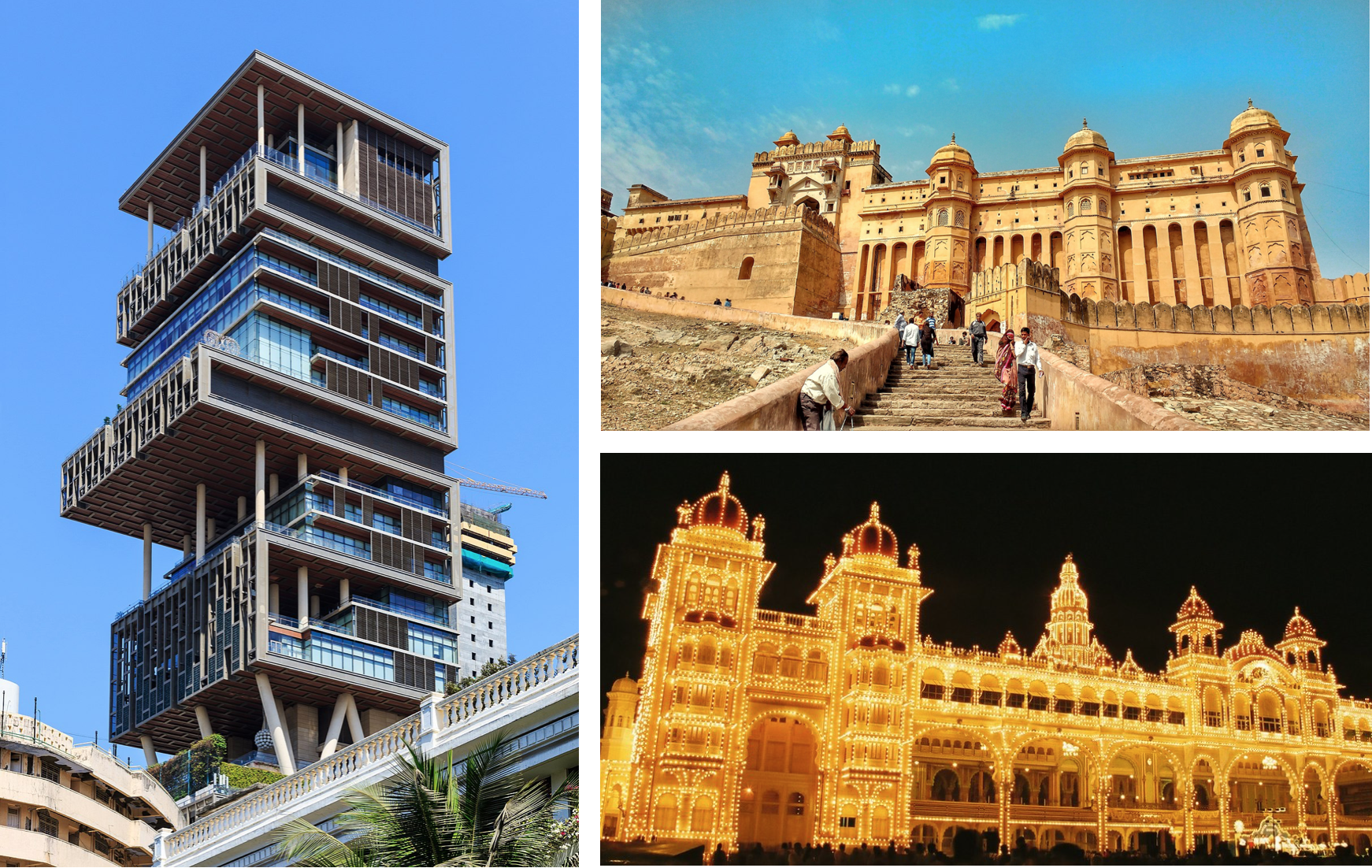
Antilia (left, wikimedia commons); Amer Fort, Jaipur (upper right, wikimedia commons); Mysore Palace, Karnataka (lower right, Ananth BS on Flickr)

During the students’ presentation on Indian forts and palaces – spaces of historical aristocracy – I hoped that they would end the talk with a picture of Antilia, the bombastic home of India’s wealthiest industrialist, Mukesh Ambani. To me, Antilia is no different from Amer Fort or Mysore Palace, and represents the culmination of that architectural evolution of aristocratic spaces. Each represents the glory of a powerful family, each in its own ostentatious yet magnificent way. Each represents the fantastical ambition and aspiration of the common man whose life is impacted by the aristocracies that rule over him.

farewell, alok baraya

Sometimes in my cynicism I wonder if perhaps some human beings are just too good for this often unruly world. As if they don’t really belong here with the rest of us troublemakers, and they were only put here to give our otherwise sullen lives a bit of brightness and joy.

My friend and colleague Alok Baraya passed away yesterday from Covid complications, and he was one of those genuinely good humans who brightened our lives and brought us joy. This alarming Covid surge in India has suddenly hit too close to the heart and has taken away one of the most genuinely decent humans I’ve had the good fortune to know. I had recently spoken to him a few weeks ago about a potential teaching opportunity at Ashoka. We had a nice long conversation after more than a year of not working together and of no longer seeing each other every day. We made plans to meet in Delhi after this current incarnation of Covid went back into its cave to hibernate. Now this same ugly scourge has taken away that chance. We won’t meet in Delhi. We won’t meet in Jaipur. We won’t go on our long-planned retreat in Rajasthan that we had been talking about for years.

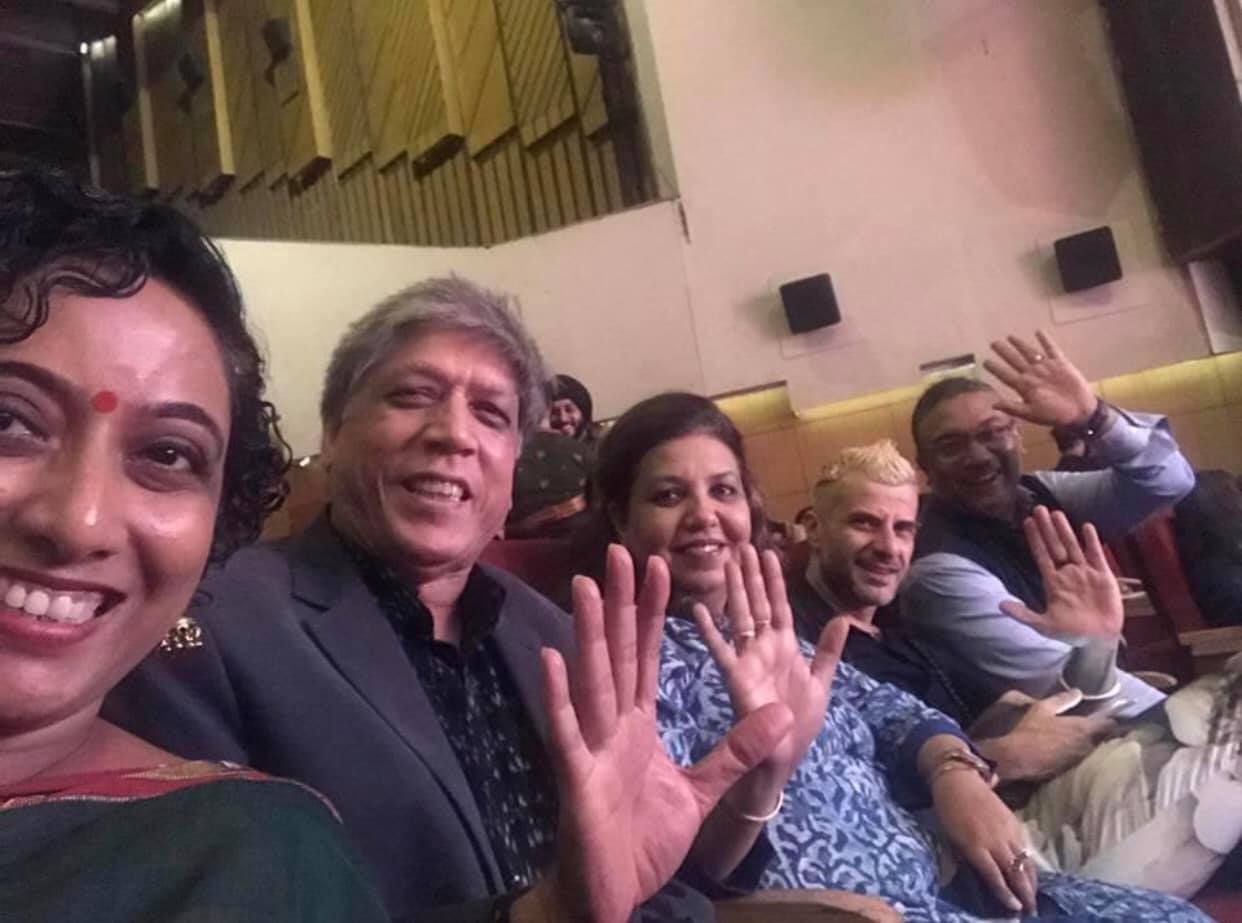
When Alok joined Pearl Academy some four years ago, he became part of our leadership team as the head of Institutional Affairs. It took me some time to figure out exactly what his role was in this newly minted position, but it took me no time to take an instant liking to him. Here was this tall, handsome, gregarious fellow who got along with everyone and quickly became one of the ever-present smiling faces in a multitude of group selfies taken after meetings, lunches, events, workshops, and other such lively affairs. When he eventually transitioned into the role of the Delhi Campus Director, I pitied him because I knew it was a thankless and stressful job. No doubt he would be a great public face to the campus and a good co-manager of our faculty, but I couldn’t bear the prospect of his gentle heart and glowing smile being dimmed by having to extinguish a constant stream of small fires that a Campus Director must always deal with. But he thrived (of course) and his smile never dimmed (of course).

Alok, myself, and other dear friends in Independence Day colours, pre-meeting (photo courtesy of Priya Mary Mathew)

I will remember countless discussions with him about life and work. His office was just a few doors down from mine and it was a solace sometimes to just sit with him and unload our mutual frustrations about working and teaching and ensuring that students would always get the best education that we could give them. I was an academic and a designer, and he was an administrator and management guy. These things don’t often mix well. But he lived in a family of creative people and he knew what people like me were all about and shared those sensibilities. He wasn’t a corporate guy. He wasn’t a money guy. He genuinely believed in academics as a noble calling and was genuinely involved in education for all the right reasons. He and I had many ideas about raising the level of discourse amongst our students and staff, to introduce debates to promote critical thinking, and to show how the idealism of design could co-exist with the pragmatism of business.

He wasn’t afraid to speak the truth either. Once, in a particularly frank team-building workshop, he asked me why I always tended to find fault with everything and why I had to always take the stance of the contrarian in administrative discussions. It was a harsh truth spoken with civility by someone whose opinion I valued, and it really made me reflect about myself and made me want to change. I’ve never been apologetic about being a contrarian because the world needs that, but his honest and well-meaning critique made me think about how my message was maybe getting lost in my idiosyncrasies.

Photo courtesy of Priya Mary Mathew

More often though, we were in sync and if there was something we felt needed to change in our organization, we tended to agree with each other and worked together to fix it. He was much better at it than me, because he was smarter, more pragmatic, more eloquent, more diplomatic, more concise, and far more charming to boot. I was glad to have him on my side on more than a few occasions. He made my job easier and was a pleasure to work with. It was only natural that we would also become friends as well as colleagues, and I will treasure that.

My heart reaches out to his family – his wife and children whom I’ve had the pleasure to meet. I may have lost a friend – a true gentleman, and a kindred spirit – but they have lost a son, a brother, a husband, and a father. I also considered him a big brother in many ways, but I offer my prayers and condolences to his bereaved family and I hope that Time is compassionate to them and allows them to heal soon. To Alok I say only that I will miss you, and that you were a good friend to me and many others. Godspeed.

the beauty of the long form

In my work, I’m (in)famous for writing long emails. Most of my colleagues joke about it, and I imagine whenever they see an email from me in their inbox, they first groan and then they settle in for what they know is going to be a long, boring read. I defend my long emails by explaining that everything you need to know is in that email, hopefully answering as many questions and addressing as many issues as I could think of, precluding any need for dozens of further emails requesting clarifications. And this is demonstrably true; when I would send out long emails to my staff about tasks that needed to be done, there were very few responses. (Of course, that could also mean that very few people actually read them, but let’s not go there.)

But the true, naked heart of this matter is that I love The Long Form. I prefer the lengthy, detailed, complex, nuanced thing that takes a long time to unpack and understand over the quick, simple, generic, easily digested thing. For most things that I consume, I like them longer… movies, television, books, stories… Probably the only exception is that I eat rather quickly, but even though I literally consume my food quickly, I still like long, leisurely meals, especially when there’s good conversation to accompany it. People often complain about movies being too long, but I rarely mind. Frequently, I’ve suggested books to my friends and family, who read the first few pages of a thousand and then give up. “It’s too long,” they say. My students… I can’t begin to explain my frustration with students who don’t want to read anything longer than a Buzzfeed article, or won’t watch anything longer than a 5-minute YouTube video (unless it’s a Marvel movie). Finding meaningful, short content that I know they will willingly consume (and enjoy) is an impossible chore.

And even though we now live in a world of rapidly decreasing attention spans, I know that I’m not alone. I know that most good entertainment, for example, is appreciated when it’s long. Look at most of the Best Picture winners at the Oscars over the decades, and you’ll see that lengthy films tend to win awards. This article from 2011 analysed eighty years of Best Picture Oscar winners and found that 70% of winners were over 2 hours long. (Although length alone is no guarantee of quality – case in point: 2001’s Pearl Harbor, a solid clunker at over 3 hours.) When done right, longer films take the time to build up the story, provide motivations for characters, allow those characters to develop. They often have more complex and subtle storylines that take some thinking to figure out.

Most fans of the HBO Game of Thrones TV series who hated the way the show ended (and there are a lot of you) complained that the show’s final seasons were too rushed – characters travelled long distances in very little screen time, and their motivations changed too rapidly to justify their actions. People notice these things. On the other hand, television shows that take a while to unspool and develop their storylines over multiple episodes (or even seasons) have received accolades like “greatest show in TV history” (The Wire, Breaking Bad, The Sopranos). Why? Because their stories and characters are so complex, they can’t be introduced and then wrapped up in a single episode. George RR Martin (author of the very long books that inspired Game of Thrones) himself said that his books could never be adapted into movies because of how complex they were. Had he written them in a time that wasn’t considered The Golden Age of Television, the HBO series may never have happened.

I won’t even try to say too much about books. The longer the better. Most of the great books I’ve read have been long, complex, and detailed. A lot of them are books in series; my favourite genre – science fiction & fantasy – is no stranger to this. When you’re creating entirely new worlds and histories from scratch, it takes time for the reader to fully immerse themselves. Such books are notoriously long. And often when I finish them, I wish they were longer (especially when they’re really good). I wish I could stay immersed in those imaginary worlds for longer, and continue the story, and keep following the characters lives. (However, some books/series can indeed be too long and drawn out. Wheel of Time, I’m looking at you.)

One of my favourite mediums for the long form is journalism, and quite often the winners of the Pulitzer Prize are writers of long, explanatory, investigative stories that took many months or years to pry open. These long form stories make great reads, despite existing in a time when news articles have started to preface the text with the number of minutes it will take to read them, so that casual readers can skip them if they seem too long. The 21st century would have become a graveyard for traditional journalism had it not been for these wonderful long form articles, afloat in a sea of listicles and clickbait nonsense. The 2019 Pulitzer winning story in the LA Times that cracked the case of the USC gynecologist who abused hundred of young female students. The same year’s NY Times story that revealed a decade’s worth of tax abuses by the Trump family. The NY Times/New Yorker story in 2018 that exposed Harvey Weinstein and essentially started the global #metoo movement. These stories, built up laboriously by teams of reporters, replete with details – these are only some of the more recent examples of the long form in journalism.

That’s not to say there aren’t great books, movies, and TV shows that are short. The Little Prince, one of my favourite books of all time, is only 16,534 words long. I’ve written research papers longer than that. (I’m kidding; only one of them was longer.) It packs so much into so little, every word carefully chosen for maximum impact – simplicity and poetry conveying depth of emotion. I also tend to like British TV shows because their seasons (“series” in the UK) are so short, usually only 6 episodes. Tight, compact stories that say a lot unlike the mammoth bloated 24-episode seasons of US shows (most of which are filler, let’s be honest). And I already mentioned Pearl Harbor, so enough said about that.

As I mentioned, length alone can’t bestow quality on the written word, or the filmed narrative. But it certainly allows room for quality to thrive. Stories – because that’s what all these things are – require space and time to build appreciation for, like the complex flavours of gourmet cuisine. Don’t get me wrong – there’s nothing I like more than a quick slice of pizza from a corner pizza shop in Manhattan. There’s so much creative space for short, simple, poetic, and concise. But the world also needs more things that take time to savour and appreciate. The world should embrace the beauty and complexity of the long form.

r/Damnthatsinteresting - Jack Kerouac typed the entire manuscript of On The Road on a single 120-foot roll of teletype paper, single-spaced, with no paragraphs.
Original scroll manuscript of Jack Kerouac’s On the Road (source: reddit.com)

architects, please pay your interns

My third year architecture students are supposed to start their internships at the end of this semester, and the pandemic has got them a little worried about their prospects. Last year around April and May, their seniors were stuck in a difficult situation – the lockdown here in India was in full force, and they all had to either find internships that they could do remotely or find internships in their hometowns which, for the large majority of them is here in Agra – a Tier II city in India that… erm… how do I put this… isn’t very high on the aspirational lists of places to do an architecture internship. Since the Covid pandemic had taken a major economic toll on many architecture firms who suddenly couldn’t do any work, and considering we were even wondering whether they would get internships at all, they were fortunate enough to all find positions somewhere. Now, the current batch of students is justifiably wondering whether they’ll be in the same situation in the next few months.

In such uncertain times, it’s hard to predict even a few months into the future, but I think things will be better by then, and they’ll be able to find work in other cities. The industry was hard hit by the pandemic and I don’t think it’s recovered fully yet, but things are better than they were nine months ago.

I spoke to them last week at length about preparing their portfolios, and near the end of our discussion we started talking about getting paid for internships. Yes… we opened that can of worms.

Now, before I say anything about this… this has been an oft-discussed, hot-button topic for a long time in the architecture profession (and in other design professions). There doesn’t seem to be much to add to the conversation, so I’m not entirely sure why I’m even writing this. Maybe just to put my own opinion on the record. Maybe because, despite all the debate and dialogue, we’re still nowhere near approaching any significant movement in the problem of unpaid internships in architecture.

While contemplating this topic as a blog post, I thought about starting with quotes from a few articles or opinion pieces on this topic, but… there are too many. It’s kind of like being a waiter at an all-you-can-eat buffet. You don’t need me to google that for you. Suffice to say, it’s an ugly aspect of our profession that somehow doesn’t want to go away.

In any case, my position on unpaid internships is that I’m thoroughly against it, both as a practitioner and an academic. I’ve hired interns of my own (and paid them), and I’ve sent my students out into the wild to become interns, and neither of my personas thinks it’s fair to not pay young people who perform work in your office that you’re getting paid for. If you’re not getting paid enough to pay your interns, then you have no business hiring them. Or you can take it out of your own income. I teach professional ethics in the classroom, and this is one of the clearest breaches of ethical practice that is somehow still commonplace in our profession.

That’s a rather ruthless way of putting it, I know. I have friends who run architecture practices that don’t pay interns. How can I continue to accept their behaviour in good conscience? How do I reconcile their otherwise good work with this arguably bad practice? The truth is that my position on unpaid internships is idealistically and unwaveringly clear, but I do retain some empathy for why it exists. I know that there are underlying problems in the entire profession itself that make unpaid internships a ‘necessary’ evil, and these problems don’t seem to be going away.

The central issue, of course, is that architects themselves aren’t paid enough. Given the length of their education and training, the breadth of their responsibilities, and the gravity of their legal liability in construction projects, architects are paid nowhere near what they deserve. Running an architecture practice is like riding a constant knife-edge between profitability and ruin, and the only reason we continue to flog ourselves through it is because of how stubborn we were taught to be in architecture school. That initial first year reading of The Fountainhead, as misguided as it ultimately turns out to be, makes it too hard to disassociate our internal Howard Roarks from our external selves. We’re going to make architecture, by God, even if we die trying!

But I’ll address the problem of finances in a minute. There are several other reasons people give in defence of unpaid internships, and the most common is that interns are apparently a net liability in a given architecture practice. The claim is that it costs more time, resources, and money to teach interns about the profession than the benefit derived from them. Interns (usually in their fourth year of education, here in India) are generally considered not much more than newborns in the life cycle of design maturity. They know some CAD, Sketchup, and Photoshop, and how to file away things, and perhaps know the basics of construction and materials. Interns are rarely asked to design anything, nor are they asked to manage construction. The reasoning is that the complex nuances of how to deal with labour on a job site require at least a few years of seasoning. Many architects tell me that they really don’t have the time to teach their interns anything, and the work that they do can be done by technicians and draftspersons who are already on staff and require much less oversight. In fact, some interns have told me stories about architects who, instead of paying them, demand to be paid a fee for taking on an intern. I’ve only heard about such incidents anecdotally; I can’t imagine any of my friends or colleagues being that pretentious and arrogant.

My rebuttal to this defence is that, for millennia, architecture has been a profession founded on the principle of apprenticeship. It’s only been a century or so that architects actually go to college for an architecture degree; most architecture education was on-the-job training. This is still generally true – most experienced architects will agree that the majority of what is to be learnt in architecture comes after graduation. The five-year course is just teeing up the ball for the real training-in-practice; it’s a foundation that primes you to be in a position to learn further. Given this long tradition of apprenticeship, I find it unconvincing when architects expect fresh graduates to be fully groomed for the profession. Do they think that they’re absolved completely from being part of the education of their employees? Interns are simply apprentices. They are there to learn to become architects. There’s a well-acknowledged limit to what we as educators can do to prepare them for work. College may be a safe space for students to explore and stretch themselves in their investigation of design but it can’t also provide the entirety of their practical and rational knowledge. Every architect in practice has been an intern in some way, and learned something from a working mentor in some way. This is the tradition we carry on as one of the oldest professions in the world, and we should carry it with pride. An architect who doesn’t consider it their generational responsibility to pass on what they know to intern apprentices is not worthy of holding the license they took pains to receive. They aren’t a net liability if an architect factors in their own internship, followed by hiring interns themselves… as a generational way of paying it forward.

Some practicing architects like to point out to us academics that since we get paid to teach students, then why can’t practitioners also be paid? Are they not teachers, too? This is a tu quoque fallacy of a high order. The equation isn’t anywhere near the same. Educators are paid to teach, but we don’t earn a profit from the students’ work. We’re paid regardless of the students’ performance (well, sort of), and the creative work produced by them isn’t a commodity that earns us a design fee. Practitioners, on the other hand, earn income on the basis of the work produced by the workers in their employ. If an architect receives a fee, part of that fee is assumed to go toward the architect’s overhead expenses, in this case, paying their employees. If, for example, you dine at a restaurant, and you pay a tip to a server, you expect that tip to go to the server, or at least be shared with them. You’d be furious if you tipped a server for good service and then discovered that the restaurant owner pocketed the tip for himself. Try to imagine what a client would think if you had interns working on the drawings for their project and the client learned that you weren’t sharing any of their fee with the people who were actually working on it.

Getting back to this issue of finances… Yes, I understand the low margin of profitability in running a design practice. But should that excuse the questionable ethics of unpaid internships? If you can’t pay people to do the work that earns you profit, then you need to learn how to be a better businessperson and entrepreneur. Few other industries make it a practice to make a buck on the backs of slave labour. Even companies like Amazon and Apple get heat for underpaying their workers, but no one is accusing them of not even paying them. Yet somehow this is common practice in design and architecture. Somehow, despite all our discussions about doing good for people, and designing with social conscience, and making habitats for humanity, we forget these values when it comes to simple entrepreneurial economics.

Part of the reason this practice gets perpetuated is also because interns are so willing to accept it. In countries like India, internships are required for their degree and they will be forced to take an unpaid internship if no other options are available (especially during a global pandemic). I certainly don’t blame them; I’ve done it myself. Not necessarily because there were no options, but because there are architects I really wanted to work for and I didn’t need the money. My classmates and I once worked for one of our favourite professors on a competition and he warned us that he couldn’t pay us (although the parameters for competitions are different because the architect isn’t get paid either; more on that in a minute). Ultimately at the end, he did pay us a token amount (perhaps out of guilt? a job well done?), but we willingly took the work knowing that we would get nothing in return financially. In fact, it would’ve cost us money because we had to pay for daily travel and meals. But we were just eager to work in a real-world office environment for someone we admired.

If it wasn’t for the fact that our professor did end up paying us, I might have looked back at that episode with some regret. In the capitalist world we’re forced to survive in, our worth as a working professional is measured in monetary compensation; there’s no getting past that. In most circumstances, getting paid nothing for our work implies we’re worth nothing, and that shouldn’t be true of interns. So I tell my students now that, while I understand their willingness to work for nothing because they either have no choice, or they’re getting a good experience in return, I urge them to still ask for compensation. At least put it out there for discussion; don’t just accept it out of hand. The more interns who willingly accept it, the more practitioners who will perpetuate it.

I’m not saying there isn’t dignity in working for free when the situation demands it. Throughout the entirety of my career, I’ve done some design work for free – pro bono and charitable work. Or professional courtesy for friends or family. Even as a teacher, I’ve given lectures and workshops for no compensation and I’ve invited people to do the same in my own classes. The difference, however, is that when we take on such work from others, both sides are usually on equal footing. When I invite a friend or colleague to give a guest lecture, they do it as a professional courtesy and they know I would happily do the same in return. We both choose to do it, and we accept the choice. It’s different with interns. They’re not on the same professional footing as their employers. The power dynamic is completely different, and they often take unpaid work because they have little or no choice otherwise. This is what makes it not a professional courtesy. It’s simply unfair.

One advice I give my students is to bring it up in the interview by asking “What would be my expected compensation?” as opposed to asking “Will I be compensated?”. This language at least signals to the employer that getting paid is expected and assumed. Even if they balk at it after that, the subtle message is sent. If the intern chooses to work for free at this point, at least that’s a negotiation from a reasonable baseline.

Of course, a major exception I have in my disfavour of students accepting unpaid internships is when the employers themselves are not getting paid for the work. This can cover pro bono projects, competitions, and working for charitable NGOs. If there’s no income being made on the project, then the student shouldn’t have a problem taking on unpaid work, assuming they can afford to do it. (Although to be honest, in one project in which I was doing the work pro bono, my interns on the project still got paid, simply because my reasons for doing it pro bono were not their reasons, and it would be unfair to treat it that way.)

If a salary (even a low one) for profitable work is still not in the cards, then I advise students to at least ask for a token payment that covers their expenses of daily commuting and workplace meals. I ask the same of any employers I know that are hiring my students. An intern shouldn’t have to pay out of pocket to come work for you every day. Of course, it’s hard to cover accommodation in this way. As I mentioned, many of my students aspire to work in larger cities, away from home, and this requires paying for accommodation which, in cities like Delhi and Mumbai where many good firms are situated, the housing rates are exorbitantly high. Of course, the deeper problem with this is a class issue; students who can afford to pay for accommodation and unpaid internships are the ones who will be more likely to grab such opportunities, skewing the balance inordinately against students of lower income brackets. Other biases like gender and caste also exist. In such cases, I ask students (of all income groups) to do a simple cost-benefit analysis and determine if they’re really getting what they’re paying for in this internship. And I ask them to think of their own self-worth in the larger picture.

What else can be done to solve this problem? I think in India at least, the Council of Architecture (our overall regulatory body) should acknowledge it as an ethical conundrum and take on the burden of resolving it. The Council has established minimum fees for architectural compensation, and they require all licensed architects to practice ethical behaviour. The same should be expected for internships since the Council anyway mandates them in college curricula. To me, this is a no-brainer, and I’m frankly surprised why this isn’t already on the table. Perhaps with new leadership in the COA, it will be.

There are other things being done around the world. Some countries are prohibiting architects from working on high-profile public projects if they make use of unpaid labour. Some governments have started the process of potentially banning unpaid internships outright, across all industries. Many university placement offices who help students find internships now require all recruiters to pay their interns a nominal compensation; no unpaid internships are allowed, and it’s great for a college to be in a position to enforce that. All of these are steps in the right direction. And certainly more needs to be done amongst the various professional guilds in each country, like India’s COA and the AIA in the United States. In almost all countries, the practice of architecture – unlike most other design disciplines – is tightly regulated. Why can’t this be included as well?

Those in glass houses shouldn’t throw stones, right? So what can we academics do to help, besides having a real, honest discussion with our students about the realities of the profession they chose? Personally, I think architecture (and design) curricula teach you almost nothing about how to be a businessperson, despite the fact that a disproportionate number of architects start their own businesses earlier and more often compared to other disciplines. Students are rarely taught how to manage their personal finances and save money, how to invest, how to pitch an idea to investors, how to seek and apply for loans and funding. Few graduates are armed with the knowledge of how to set their fees, how to indemnify themselves in their contracts, how to protect their intellectual property. Most of them are taught only to do architecture, and not how to use their broad design talents to diversify into other fields that can earn them steady incomes. I’m talking about things like: managing projects; building their own work (turnkey/design-build); making images and visualisations, or designing furniture, furnishings, lighting, accessories, or fabrications. One of the architects I used to work for had a 3D printer in the office (back when they weren’t ubiquitous) that was mostly sitting around unused. I had read an article about people charging $300 a piece to make 3D-printed figurines of their friends and family members based on submitted photographs. I told my boss that he should hire someone just to do that and have that 3D printer humming 24 hours a day, churning out cheesy knick-knacks so that it could subsidise our salaries, which we often had to forgo when our clients ‘forgot’ to pay us.

Many architects and interior designers are finding other ways to earn a living besides simply offering architectural services; they have retail shops that sell furnishings and lifestyle accessories. Such a thing used to be frowned upon by my architecture professors, as if it cheapened our lofty and noble profession. I now realise that architects and designers who do this are very, very smart. Why is there such a romantic association in architecture circles of the ‘starving noble architect’? Why aren’t we taught the skills needed to earn a livelihood and follow our passions? It’s high time we teach our students to learn how to balance ideological integrity with earning an honest living. Prepare them to understand their self-worth and be confident about their expectations. There’s a lot that we as academics can do for them, if we open up our curricula and find ways to include this.

Ultimately though, architects – and architecture students – need to raise their voices in their respective guilds, associations, and other public forums to speak about this problem, and start dismantling its silent toleration. More opinions need to be heard and more rational discourse needs to happen across the board. More solutions need to be shared. We have to stop assuming someone else will fix the problem and encourage a grass roots movement to fix this. Raise awareness and speak sincerely about the problem, and take a strong stance.

So in the end, I guess that’s why I’m writing this.